Showing posts with label recorded delivery. Show all posts

Thursday, 25 June 2026

Five New Machin Priority Service Stamps - 28 February 1995

In February 2009 Royal Mail issued the first self-adhesive definitive NVIs and high values stamps with new security features.  This was the birth of the Machin Security Stamps which indirectly lead to the bulk of posts on this blog over the next decade.

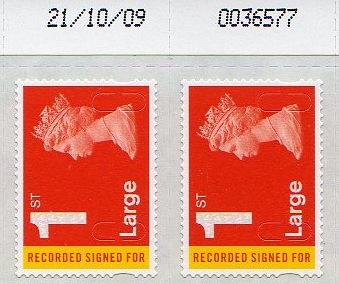
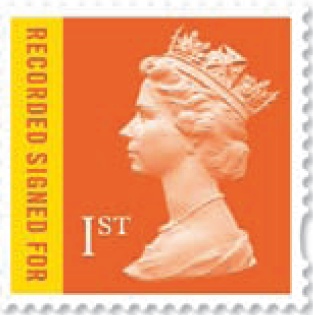
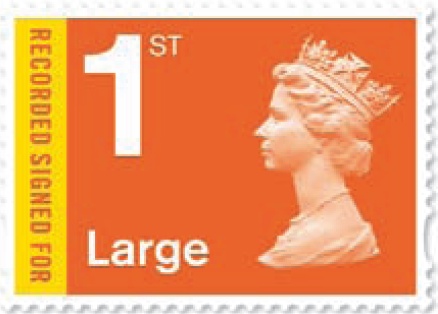
Then in November two surprise additions to the series were added, the Recorded Signed For 1st class and 1st class Large to “satisfy an operational demand at Post Office counters”.

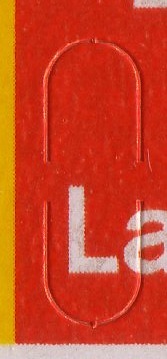
As we know these were self-adhesive, die cut, with security features, with slits through the stamp and with iridescent printing across the design.   The slits were said to be designed to inhibit the removal of these Stamps for fraudulent sale and re-use.

But although this was described as an innovation it wasn't actually new – the concept originated in 1994, as shown in an internal Royal Mail document found by one of our contributors MM.

This document shows that Royal Mail were considering special stamps for Priority Servics with what would seem to be the very same security features.

“The stamps will be self-adhesive and die-cut, 25 to a sheet, with additional security features because of he stamp's premium.”

Design: a centrally-placed embossed Machin head (29.5 mm), with the service indicator at the bottom of the stamp which would be of similar colour and branding to the specific services. Unfortunately there are no pictures (in any case it is a black and white potocopy) and we don't know what colours they were planning. I suspect predominently dark blue iwith different inscriptions, per this leaflet.

(More on the new labelling and system below.) 

The costs of the service, and therefore of the stamps, is shown as follows.

Recorded Delivery - 55p

Special Delivery - £2.70

Registered - £3.00

Registered Plus to £1500 - £3.30

Registered Plus to £2200 - £3.60

Note that these are supplementary stamps – in addiition to 1st class postage (or a choice of 2nd or 1st for Recorded Delivery) for the weight concerned.

The issue date was to be 28 February 1995 with stamp cards (PHQ cards), presentation packs, and “philatelic souvenir covers”, which is an odd way of saying First Day Covers. 

The alternative postmark was Windsor (with the primary one obviously being Philatelic Bureau Edinburgh).

No printer was identified at this stage.

Click on the image to see it enlarged

So what happened? Why did this apparently good idea, suggested with the new 1993 branding, fail to be implemented?

Was it problems with Post Office counters, with users, with separation of the different classes in the mail stream?

Maybe someone decided that using an extra stamp for the priority service would be a problem, although it could reduce the number of stamps required. (Stamp dealers of course would have plenty of other value postage to use!)

One thing I do know – if these had been introduced in 1994 as planned, I would not have been as involved in Machin Security Stamps as I came to be in 2009/10 etc. At that time I had not retired, and my interest in Machins was far reduced from its previous peak, and my focus switched to the stamps and postal history of the countries of the Former Soviet Union.

On the other hand, I would have been able to put more focus onto the aforementioned, and Great Britain modern postal history and usages, and I might not have as many boxes to go through now.


More on Priority Services.

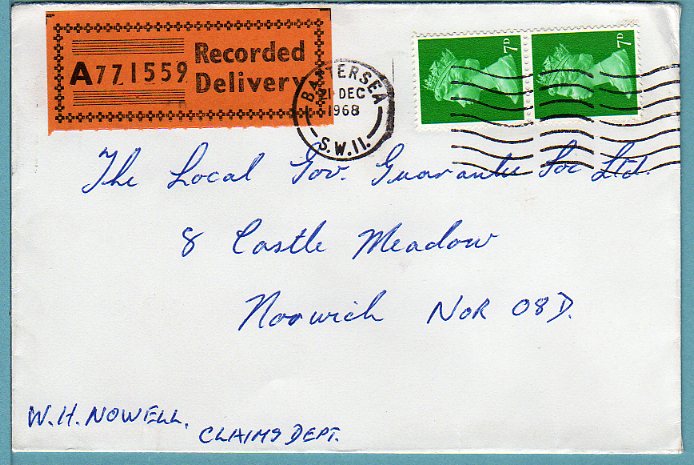
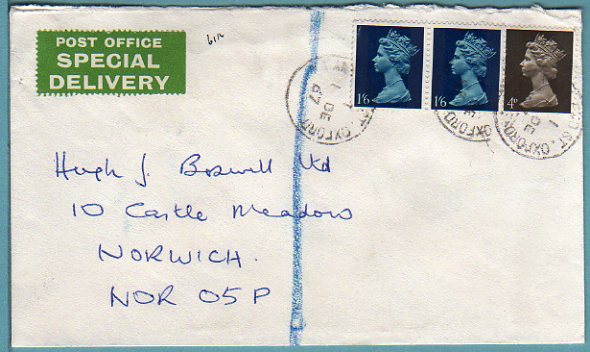
When introduced in 1961 Recorded Delivery used yellow labels which over the years varied to several different shades of orange. Registered Mail, of course, had used numbered blue 'R” labels for over a century, and Special Delivery was identified by a white on green label for many decades.

The June 1993 leaflet 'Now Even Better” illustrated the labels for the new services (shown above), which used dark blue in all cases, which I thought could lead to confusion compared with the previous system. Although the labels stuck on envelopes and packets had different text, further confusion was possible for users as the Registered and Special Delivery (SD) forms were both headed Guaranteed Delivery. In fact it really made no difference to processing as both Guaranteed Delivery services provided the same service, the only difference being that SD paid up to £24 compensation, and Registered paid up to £500.


Recorded retained an orange aspect, Registered had a light blue background to the number labels, and SD had an orange background to the number labels.  Soon afterwards pre-paid postal stationery envelopes were introduced.

From the top, Registered Plus, indicated by the pale blue + at the foot, Registered, and Special Delivery which is lighter blue.

 Here's an example from March 1994.


It's impossible to know, apart from by the postage paid, which service is being used (and not necessarily then!).  In this case postage is £3.08 which is 38p first class postage for a 40-100 g first class letter plus £2.70 Special Delivery fee. 

For the delivery postman it is clear that this is a priority item, but for tracking at any stage from the post office counter to delivery the barcode on the reverse has to be scanned.  Did posties carry any barcode readers then?  

By 1995 a further rebranding introduced the Silver Service for inland Special Delivery and from from 12th October 1998 they were all combined into a single rebranded service under the Special Delivery banner.  (GB Philatelic Society)

This is an interesting and relatively short-lived period in British Postal History affecting more expensive mail than just ordinary letters.  Material is not easy to find, but stamp dealers were always big users of premium services and their covers are more likely to be kept.

I've got more like the one above, but not many.  This will be the subject of a post on the Modern Postal History blog some time.


Monday, 15 November 2021

Special Delivery Guaranteed & Royal Mail Signed For Stamps - a definitive statement from Royal Mail

Back in July we reported that Post Offices would not be selling the Special Delivery and Royal Mail Signed For stamps after 31 October 2021 and that all four* of the special purpose non-value indicator stamps are being phased out. 

Despite asking Royal Mail then, and frequently since, just what the story was behind this we had the first official statement only today.  Previously we had been told on social media or at branches that POs would not sell them because Royal Mail had stopped printing them, or vice versa.  The statement reads:

"Royal Mail has withdrawn from sale Special Delivery Guaranteed and Royal Mail Signed For Stamps from The Post Office and Royal Mail Direct Channels. This decision has been taken as a result of continued decline in usage and demand, for the stamps, over a number of years. The services will of course continue to be available using labels printed at point of purchase. The sale of these stamps from Post Office and royalmail.com ceased on 31st October 2021 but will remain available via philatelic channels until 31st January 2022 at which point they will be fully withdrawn."


The predecessor of the RMSF stamp, the Recorded Signed For, was issued on 17 November 2009, being replaced on 27 March 2013 by stamps with the new branding.  

The Special Delivery stamps were issued on 26 October 2010.

Recorded Signed For 1st class and 1st Large stamps issued 2009.

Royal Mail Signed For stamps issued 2013


The only good thing about this is that collectors with a limited budget who would otherwise like to have every stamp with every year code, will save £19.44 by there not being reprints this year.

Update.  For those people who have difficulty navigating Royal Mail's very difficult shop, the make-up values and airmail values can be found here (this is sorted into lowest first).


UPDATE 30 November: On the MBPC website a member has commented: “Regarding RM’s September stocklist, I checked with RM but the stock number has already been deleted from the system. The operator had just received a message to that effect."

This suggests that these stamps may only be available to dealers, which is misleading (and bad practice). 

UPDATE 3 December: reporting this to my Royal Mail contacts I have been advised that 

"The products are not available Online, as this is a general channel not exclusively a philatelic channel. Our Philatelic channels are Regular Order, Mail Order (telephone/post via Doxford) and Trade. The data set up team have checked, and confirmed, that the part codes are still available for ordering via our philatelic channels."

Stock codes for ordering are 

1st class Signed For DLR - DS 155; 1st class Signed for Walsall - DS 155WL;
1st Large Signed For DLR - DS 185; 1st Large Signed For Walsall - DS 185WL

Further update: as I was publishing this I had an email from a reader who "tried to use one of these stamps on an item today and was told by the counter staff that these are no linger valid."

I have told him otherwise,  and will contact POL.


Sunday, 5 April 2020

Spot the difference!

A quick Sunday evening snippet, at the end of a glorious sunny day in Norfolk. With so much wet and windy weather in the first few months of the year, it was good to get into the garden - we wouldn't have gone to the coast today even if we could.

So, just to give you something to ponder over this evening - answer tomorrow sometime - can you spot the difference (other than the barcode number) between these two Recorded Delivery blanks? (I took the image from an eBay listing.)


Second question, have you seen the different one before?

Third question, have you seen or got one on cover?

I don't think I have, but I'll have to look closer at what I do have.

Update - Happy Monday morning!
Thanks for the answers overnight.  Here's the reverse - there's a big clue at the lower right, but again you might need to click on it to see it.


I don't think many of the recorded delivery, special delivery or registered labels had the Royal Mail Cruciform on, so few would have the two versions.  In Scotland, Queen Elizabeth is not the Second, so they don't have the E II R cypher on their postboxes, and they use the Scottish crown.  It's much easier to see on the side of this postvan.


Later today I'll be showing some more modern postal history on the other blog. 

At the right-handside of this one, where I list other blogs you will see when the Postal History one gets updated.


Wednesday, 18 July 2018

Received after last acceptance?

The purpose of the postal mark shown below would seem to be self-evident: the item was received at the Post Office branch after the last post for the day, and therefore any delivery guarantee would not apply as if it was received on the day of posting.


Received after
sites latest 
acceptance time


This would be especially appropriate for Special Delivery mail which is guaranteed (in most parts of the country) to be delivered by 9am or 1pm the next day.  Nowadays the receipt given at the Post Office counter indicates whether or not the item was posted 'After last acceptance time', as this example from Dereham shows.


Normally the large letter would be cancelled at the counter with the counter datestamp, but in this case all the stamps have been cancelled with an unusual mark, and there is no indication of the place of posting.  The sender lives in West Yorkshire, but occasionally posts from Lancashire or Derbyshire, so we are no close to knowing where this was applied.

Could it have been applied at a Royal Mail Enquiry Office?  Seems unlikely as they would surely be accepting mail until the despatch to the Mail Centre. 


So, the owner and I are throwing it open to blog readers to explain it.  I'll also be putting it on the Stampboards forum, and will in due course send it to the British Postmark Society (unless one of the section editors wants to pick it up from here - be my guest!, but let me know.)


Saturday, 8 December 2012

Royal Mail proposes 2nd class and small/medium parcel service

7 December 2012 - Edited Press release

Royal Mail announces proposals to change its parcels range

  • Royal Mail is consulting on changes to its parcels range. The proposals apply to consumers, small non-contract business and franking customers. Currently, there are up to 15 weight bands for parcels. Royal Mail’s proposal is to reduce that by more than half to seven weight bands from April 2013
  • The proposal means Royal Mail’s range of parcel products should be easier for consumers to understand and improve choice. They will have the ability for the first time to send parcels between 1kg and 20kg using Royal Mail’s 2nd Class service, with the added option to receive a signature on delivery
  • The proposal also includes introducing two broad parcel categories – small parcels and medium parcels.
The proposals should be easier for consumers to understand and improve choice. They will have the ability for the first time to send parcels between 1kg and 20kg using Royal Mail’s 2nd Class service, with the added option to receive a signature on delivery.

Currently, for items weighing up to 20kg, signature on delivery is only available through 1stClass. We believe the increase in the 2ndClass weight limit to 20kg is a very meaningful addition to customer choice. As a result of this improvement, our Standard Parcels product will be withdrawn.

In addition, Royal Mail’s proposal is to introduce two broad parcel categories – small parcels and medium parcels.  Parcels are priced by weight but the size of a parcel has an impact on the cost of collecting, transporting, sorting and delivering an item.

Changes to compensation levels for untracked and Recorded Signed For items

Royal Mail intends to change its compensation arrangements to bring them more in line with other postal companies. It is our intention to increase the maximum compensation payable for loss or damage of Recorded Signed For items from £46 to £50. These are items for which a signature is collected on delivery and a proof of posting receipt is provided.

Alongside this, it is our intention to reduce compensation for loss or damage of items sent using our untracked 1stand 2ndClass stamped mail and parcels from £46 to £20. Many countries do not offer any compensation for loss or damage of untracked items, including Germany, the Netherlands and the United States.

We will continue to pay compensation for delayed items and the limit will be unchanged. The changes will ensure that Royal Mail provides proportionate and reasonable compensation based on the service used and postage paid.


I doubt that there will be much impact on stamps and collecting, although there may well be an option for 2nd class small parcels on Post and Go machines.

In the letter service, the Packets are anything over 353 x 250 x 25mm, and 2nd class (for which Recorded Signed For is available) is limited to 1 kg.

The new proposals will introduce

Small parcels - items that weigh up to 2kg and are no larger than 450mm x 350mm x 80mm in size; and

Medium parcels - items that have dimensions larger than the small parcels size but no bigger than 610mm x 460mm x 460mm, and up to 20kg in weight.

Under the proposals, items larger than the medium parcel size (610mm x 460mm x 460mm) or over 20kg in weight will no longer be delivered through the Royal Mail letter service as Packets, but will be sent by ParcelForce.  Recorded Signed For will not therefore be available for the larger-sized items.

Although this is supposed to provide extra services and simplify the service, there seems to be a degree of overlap with the Packet rates - customers will have to compare the options carefully.


Tuesday, 27 March 2012

British Stamp collecting just got very expensive.....

... and the costs of mail order, including eBay auctions, will also hit small buyers.


Royal Mail have announced their 2012 price rises, to take effect from 30 April 2012.


Headline changes:


1st class letters rise from 46p to 60p
2nd class letters rise from 36p to 50p

1st class Large Letters up to 100g rise from 75p to 90p, while 2nd class rise from 58p to 69p;
the next step 101-250g rises from £1.09 to £1.20 1st and 92p to £1.10 2nd.

But a fundamental change comes in the restructuring of packet rates.  Currently as low as £1.58 and £1.33 for 1st & 2nd class under 100g (which would include very light electronic items in crush-proof boxes) the 100g, 250g & 500g steps have now been merged into a 750g minimum rate of £2.70 1st and £2.20 2nd.  The current 501-750g rate is thus reduced from £3.05 and £2.61, but all the other rates rise.

The recorded signed for premium rises from 77p to 95p.  Thus a 1st class RSF letter becomes £1.55 (from £1.23) and 2nd class £1.45 (from £1.13).

Special Delivery 1pm next day rises from £5.45 to £5.90 including postage.

Standard Parcels up to 2kg rise from £4.41 to £5.30.

Post Office Box users suffer a massive increase for the third year running, up this year from £170 to £185, now plus VAT at 20% making £222.

International rates: Airmail
The worldwide postcard, and European 20g letter rates rise from 68p to 87p. The Worldwide 10g letter (previously 76p) also becomes 87p.

The Worldwide Letter 20g rate rises from £1.10 to £1.28.

Small packets up to 100g rise from £1.49 to £2.70 Europe, and from £2.07 to £3.30 Worldwide.  This huge hike must be passed on to customers around the world who will see the costs of collecting rise.

Small Packets and Printer Papers over 100g change from 20g steps (to 300g, 100g steps thereafter) to steps for 101-150g, 151-200g and then 100g steps to 2kg.  As an example of the new prices 300g is up from £2.61 (E) and £4.26 (W) to £3.62 (E) and either £5.54 or £5.70 for World rates which are now resplit into two Zones.  Europe still includes all of the former USSR, right through to the Pacific, Zone 2 is Australasia, and Zone 1 is the rest of the world.

Surface Mail basic changes are 20g letters up from 66p to 77p,  100g small packets up from £1.12 to £2.20 (still cheaper than the airmail rates, but in future more expensive than current airmail rates.

International Signed For is up top from £4.95 to £5.15. Airsure rates are complicated by VAT so I'll look at them later.

A leaflet can be downloaded from Royal Mail's website.

Update: New Machin definitive stamps with values of 87p, £1.28 and £1.90 will be issued on 25 April 2012.   According to Doug Mayall the colours will be "87p Orange; £1.28 Emerald green; £1.90 Rhododendron (Amethyst)"  
I wonder if that 87p will be the same colour as the 9p that I am currently using with a 27p to make up the 2nd class rate?

We are awaiting any news of the previously announced and then cancelled 50p rust with one phosphor band, but have been told that instructions have been sent to branches to stop selling the current 50p grey (which has two phosphor bands of course).


Wednesday, 15 February 2012

"Private" Royal Mail Special Delivery Label

A reader has sent a copy of a Special Delivery PPI (Postage Paid Impression) label, used by Courier/Distribution company FRT Group of Crawley last October.

I presume the company is allocated a batch of numbers and prints the labels when sending out tickets for events or journeys (note the 'Booking Reference').


This is on a standard DL window envelope, so I suppose there would be no excuse for not obtaining a signature on delivery.  But without the sliver and blue of the standard labels, it would be easy to overlook this type of thing in the sorting office, given that so much mail has so many different non-postal labels, barcodes etc on.

Updated March: Another reader has sent a copy of a similar Recorded Signed For label:


It seemed appropriate to include it here.  As mentioned in the 'comments' it seems even more likely that this would be overlooked, than the separately handled Special Delivery packet.

Wednesday, 19 October 2011

Post and Go version 2 brings 40g - and premium services!

The delayed introduction of version 2 of Post and Go software has at last brought the Worldwide 40g Faststamp (current price £1.65).


The new value first appeared at London's Broadway SW1 branch on 13 October 2011.


At the same time changes to the Post and Go system also allows customers to post Recorded Signed For, Special Delivery, Airsure and International Signed For  Royal Mail products as well as Parcelforce Express items within the UK and to the EU.

Examples of the Recorded Signed For, 2nd class Letter <100g (£1.13), 1st class Large Letter 170g £1.86)


The machine dispenses a certificate of posting upon which the RSF label number must be affixed.  Unfortunately, but sensibly, the certificate has to be posted over the counter to receive the counter date stamp as proof of posting.  It remains to be seen whether there is a fast-track queue for this service, otherwise the benefits of speed by using the Post and Go will be lost.

Birds 4 are expected at Broadway soon.  Pictures when we have them.

Monday, 25 April 2011

Security Machins - Recorded Signed For 2010 pictures

As mentioned here, the Recorded Signed For 2010 versions are now circulating - we will have them in stock after the holiday weekends, ie early May.  Thanks, Richard, for the pictures:


Thursday, 21 April 2011

Security Machins - 1st Large Business Sheet 2011, Recorded 2010

Thanks to Richard P we can now confirm the existence of the 1st class Large Business Sheet for 2011, with MA11 in the usual place above the ge and MBIL at lower right:


Two more 2010 coded stamps have been reported with the Recorded Signed For Letter and Large Letter stamps being printed on 11/03/10 and 12/03/10 respectively.  Once again, pictures will be provided as soon as we have them, and we will also announced when we have them in stock. Pictures here.

Saturday, 21 August 2010

Horizon Label Service indicators - explanation

I've been asked to explain the various codes used on the Horizon labels, our own web page describing these having fallen far behind, sadly.  Updates added in blue following publication of a list on the Stampboards forum.

I've no idea of the full range of codes originally used when the system started in 2002.

There was 2ND and 1ST for 2nd class and 1st class inland mail, and P for inland Parcels.
SD was used for Special Delivery, but Recorded Delivery passes as 2nd & 1st as it has no priority treatment.    A for Airmail, and S for Surface were other commonly found usage, though as these went on international mail there are not many to be found here.

From 2003 the indicators went to lower case and as the normal designations didn't comply with Welsh language designation, so for bilingual labels we have different ones for Welsh offices: 2nd 2il 1st 1af. 

AX is used for the Airsure service, but no special indicator is used for International Signed For, even though both are used as substitutes for the obsolete Registered service.   

There are many service indicators that are rarely seen by the public, for reasons which will become obivous.  The indicators had to change when Pricing in Proportion (PIP) came into effect in 2006, to take account of Large Letters and Packets, though even some of these have changed over time, 1LL, 2LL and BLL being changed to 1LG, 2LG, BLG.  This current list may not be exhaustive, but includes the more common ones.  The 'B' indicators in the first three categories, are for British Forces mail, which is 1st class but is carried under PIP rules:

1st - only for Articles for the Blind as no labels are produced for items under 100gr and any other mail over 100gr is a Large Letter.

1L/2L/BL - 1st/2nd class Letter -  restricted to Recorded Signed For (small) letters

1LG/2LG/BLG - 1st/2nd class Large Letter (no longer applied to items under 100gr)
1PK/2PK/BPK - 1st/2nd class Packet

SD - Special Delivery 9am and 1pm services
SP - Standard Parcel
PE - International Economy Parcel
PS - Standard International Parcel
BF - BFPO Parcels 

A / SU - Airmail, Surface mail to all countries
AAX - Airsure service (limited to about 30 countries)

FP - Fully Paid Reposted Underpaid Airmail (items returned to sender for additional payment).
MOR - Mail Order Return (one that is unlikely to be sent to a private house!)
RPR - Packet Post Return (Limited to Value of Recorded Signed For)
FF - I've not seen one of these, but I assume that it may be for Forces Free, sent to British Forces 'in theatre' in Iraq and Afghanistan.  Confirmed as Forces Freepost.


Tuesday, 30 March 2010

Do you collect Postal History the Modern way?

Many people think that stamps issued these days are only for collectors.   There certainly isn't much variety on the mail these days, unless you count the variations in the 2nd class blue and 1st class gold.  Incidentally, how often do you see these stamps from ordinary counter sheets, ie without any hidden security code?  Most of the ones I get are from booklets, with business sheets a close second.  Ordinary sheet stamps could be quite scarce!

Over on my other blog, I'm showing stamps actually used.  I'm stuck in the late 1960s/early 1970s at present but will add to it from time to time, and I'll be interested to have your reactions.  Some of these stamps are not in many collections - on cover, doing the right job!


If you're interested in this aspect of collecting, please follow the Postal History blog as well as this one.

Thursday, 12 November 2009

Recorded NVIs not printed until mid-October

Supplies of the new Machin Recorded Signed For stamps have now arrived and the printing date blocks show why at Stampex Royal Mail officers could not confirm for sure, the colour of the stamps. At that stage - despite our cynicism! - they had not been printed (assuming the ones we have now were from the first printing batch. We have now seen printing dates of 16 and 19 October for the small stamp and 21 October for the Large stamp.


The Security Overprint is the same style as on ordinary sheet stamps, ie with no code, and the security slits are bisected by the smallest of 'nicks' which has been described as Type 2a.


Cylinder blocks and first day of issue special postmarks are shown on our webpage here.

Wednesday, 14 October 2009

Recorded NVIs coming on 17 November (v2)

Readers may wish to know that images of the Recorded Signed For stamps are shown on the original posting.

Wednesday, 7 October 2009

Recorded NVIs coming on 17 November

Royal Mail has announced the issue of two new Machin definitives on 17 November. The new NVIs combine the Recorded Delivery Fee and the 1st class / 1st class Large Letter 100gr fees.


We now have the images, and I admit to being a little disappointed. Whilst the stamps keep the 'house' colour scheme of the Recorded Signed For service, I expected that they would be 'flame' on a white background, similar to the airmail NVIs.

When we first heard about the possibility of combined 'postage and premium service' stamps we assumed it was because there was a need expressed by small/medium businesses who would normally use Business Sheets. However a Post Office Ltd spokesperson said that their introduction was because of 'an operational need at Post Office counters' and that they would be issued 'in normal counter sheets only'.

It is to be expected that the sheet format will be the same as other definitives, but whether self-adhesive or ordinary we don't know, nor therefore whether they will have security features!

We now know that these will be self-adhesive with security features. The basic stamp is 24mm square, making it 4mm wider than the ordinary definitive.

Royal Mail will provide definitive First Day Covers in the usual way. Product codes are as follows:


Recorded 1st class £1.14 DS114
Recorded 1st Large £1.36 DS136
FDC Tallents House
or Windsor £3.34 DF053


This is an interesting development. Currently all letters up to 100gr have to be stamped with adhesives, and Horizon Labels cannot be produced. But under 100gr items sent by Recorded Delivery can be sent with a Horizon Label.

However, as the address has to be entered into the system to provide the certificate of postage, and then the weight and so on, to produce the label, all this takes longer than just adding a stamp. Could it be that somebody has discovered the disadvantage - in a busy office - of the Horizon system?

Will the next step be a Special Delivery Machin? Probably not: what we are more likely to see - once all our posties get personal data assistants to scan bar-coded mail - is a Machin Horizon Label with a unique bar-code which will save the production and use of separate Special Delivery bar-code stationery. Or have you a better idea? Let me know, or comment in the space below. Watch this space for developments.