Showing posts with label surcharged mail. Show all posts

Thursday, 19 June 2025

To Surcharge or Not To Surcharge - the inside deal.


Collectors and dealers alike agonised over what Royal Mail intended for non-datamatrix stamps three years ago.

What soon became apparent was that there was a grey area.

Some stamps were definitely invalid and should be swapped, some would definitely remain valid.  And some would remain invalid but would also be accepted for the swap scheme.

Here and on various philatelic forums people were asking why Royal Mail didn't just produce a list of what would remain valid and what would not, and what would be swapped and what wouldn't.  The grey area didn't matter so much because stamps could be on both lists.

Thanks to a reader and regular contributor we now know much more.  The reader was given a tour of part of a Mail Centre and spotted a notice board with some very useful information, which I have reproduced below.


So what does this tells us? 

At the time of printing ordinary old Machin and country definitives are invalid and the £1.10 surcharge applied.

The Machin Signed For and Special Delivery stamps should not be surcharged.  Likewise the Machin airmail postcard, 20g and 40g stamps.

Definitive-sized Wildings and the 1d red (and black and 2d blue) stamps should not be surcharged.

Post and Go stamps should not be surcharged unless underpaid.

And as we know, Christmas stamps without barcodes remain valid.  

Dates and timing

The £1.10 surcharge applied in 2023, so we don't know whether the poster has been updated, replaced, or whether RM HQ have simply assumed that all postal operatives now know what is what - which, given the high turnover of staff, would seem to be a foolish assumption.

But it's something.  And something that I will try to explore with Royal Mail.


Friday, 27 September 2024

News snippets for September 2024

Greetings everybody, we're back from Ireland where the weather was much better than it has been, and remains, here in the UK.    A taste of this was the yellow alert issued for the eastern side of Northern Ireland after we sailed to Scotland on Wednesday, and what we had for a considerable time in Co Durham and the north east yesterday which continues today- after a sunny interlude across Lincolnshire yesterday afternoon - in Norfolk.

It's happened before that important announcements are made when we take a break, so this is a quick acknowledgement to the many people who have written in the last three weeks.

The following topics will be covered in blog posts soon:

- September slogan postmarks

- Postage rate increase meaning a new airmail rate stamp (and Royal Mail have confirmed that there will be no more airmail rate country definitives.

- outstanding orders: sorry I forgot to shut the shop so a few orders have been delayed.

- the person who wrote about Universal Mail will get a reply eventually!

- forgeries and how Royal Mail is dealing with them

- amazingly incorrect information being supplied by Post Office branches including Crown Offices. (You don't have to use old stamps before the price increase!)

- I'll also be writing about blog comments which have not been published.  Comments must be relevant to the post they are on.

UPDATE  So circumstances conspired to prevent my dealing with these in a timely manner.

1. Royal Mail is not presently surcharging any mail which apparently has postage paid with a forgery, so no 'yellow-label' mail at present.  This despite the scanner addition to the Royal Mail app, and Stanley Gibbons being engaged to adjudicate on disputes over surcharged non-forgeries.

2. There was a short spate of incorrect information being provided by POs, in comments here, by emails to me in August, and on social media platforms.  Sadly I have lost track of where so this topic will await new instances and reports.

3. This continues, unfortunately, and often from people who are either anonymous or who I don't know from their nickname.  Comments must be relevant to the post they are on.  I am not going to reply, even when the topic is worth it, on a comment which is irrelevant to the subject post.  

Also, if you have a question or a comment on something older or more obscure, it is worth using the search box a the top left, to find out if this has been the subject of an earlier blog post.   We have covered the new Tracked 24 and 48 service and the fact that you can NOT use stamps for it.  And that compensation on Signed For has dropped from £50 to £20.  But if you still have questions about that, then that is the place to ask them, or use email.


Sunday, 28 April 2024

Royal Mail bows to pressure from the media and MPs on Counterfeit Stamp Surcharges

Following widespread media and political criticism about the handling of counterfeit stamps, I have been told this by a reader, but I have been unable to confirm that things will be changing.

Royal Mail is changing how it handles counterfeit stamps it identifies.

From tomorrow (29th April) if the item does NOT have a return address it will be delivered with a yellow sticker informing them the stamp is fake and advise them to let the sender know, but it will not be surcharged. 

If there is a return address, it will be sent back and surcharged as now.

Look out for new yellow labels! 

UPDATE 29 April.

The Telegraph has reported that Royal Mail are under more political to change:

(Business and Post Office Minister Kevin) Hollinrake wrote: “You will be aware of concerns being expressed by parliamentary colleagues about the £5 surcharge being applied, where a number of them have claimed that they have bought stamps from legitimate sources, but which have then been identified as counterfeit by your system.

“I recognise that where fake stamps have been used, it is right that the item should be treated as though no postage has been paid, but we urge you to suspend the £5 charge in such circumstances until the wider issue is resolved where there is some uncertainty that requires further investigation, whether for senders’ individual cases or more generally.”


Please report any changes - or discussions with Royal Mail employees - and send any images for publication.  Thank you.


Friday, 12 April 2024

How is underpaid International Mail surcharged, if it is?

Especially since Royal Mail have suffered from an influx of forgeries and pre-used stamps, they have made efforts to recover the lost revenue by raising surcharges.  This has brought even more publicity since the charge for unpaid inland letters, and those bearing counterfeit stamps, has risen to £5.

But what happens with mail addressed to overseas destinations?   Traditionally, within Universal Postal Union regulations/agreements letters were flagged as underpaid and a charge raised (or not) by the postal authority in the destination country.

1958 cover from England to Belgium, T-marked as Postage Due, and surcharged in Brussels.


As long ago as 2006 mail which was (in his case allegedly and mistakenly) underpaid was returned for the missing postage to be added, and the letter reposted over a post office counter.

Allegedly underpaid mail labelled and returned to sender, for additional postage to be added.

Royal Mail red 'Underpaid" label OE1064, enlarged.

Diversion

Where appropriate underpaid letters would be diverted from airmail to surface. This wouldn't apply to mail to Europe, where there is no surface letter service, nor where the postage was insufficient for surface mail.  (The letter above was addressed to Italy.)   One to Australia in 2019 had this label attached.

Royal Mail blue 'Diversion from Airmail' label OE1065, enlarged.


What happens now?

I asked Royal Mail this question, and was told that the item would be returned to the sender - something fraught with difficulty given many UK letter writers' (and eBay sellers') reluctance to put a return address on their mail pieces, and in some cases even inside!

No evidence

I haven't seen any recent letters with evidence of what happens now, nor has any been mentioned on the Stampboards forum.  On the contrary, as shown here last week, underpaid mail may be overlooked.

I would be very interested in copies of covers sent to addresses outside the UK in the last 5 years, bearing insufficient postage which has been returned for additional postage to be added, or which has been delivered without any surcharge.  

I would be especially interested in any on which an underpayment has been flagged by Royal Mail, and whether or not that surcharge was collected in the detination country.

What have you got? !


Tuesday, 2 April 2024

Revenue Protection - it's a joke!

UK readers will be familiar with recent 'uproar' in the popular press (and on the much-watched GBNews) about Royal Mail surcharging recipients of letters £5 declaring that the stamps are counterfeit.

It seems that some writers whose stamps have been surcharged on arrival to the addressee are alleging that the stamps they used came from the Royal Mail Swap Out scheme.

Certainly with the number of forged stamps that we and others have reported there have certainly been plenty sold to unsuspecting customers who would - understandably - like to spend less than the £1.25/75p that the stamps cost until today.

Genuine, left, and forged 1st class datamatrix Machin definitive stamp.


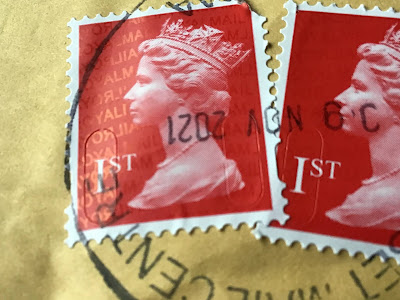
It is understandable that Royal Mail would want to surcharge invalidated stamps - plenty of notice has been given after all.

Pre-barcode, possibly counterfeit, 1st class stamp used after invalidation.

But where were Revenue Protection when this letter was posted to Canada (and cancelled there on arrival)?


In terms of total value, the correct postage is paid - £2.20.  But only 10p went to Royal Mail, the rest went to the Tristan da Cunha Post Office.  And not only were the stamps not cancelled at the mail centre, but nobody noticed that they were not British.  

No monarch's head (the cypher instead) is a big clue - but apart from that and the name of the country, they could easily have been issued by Royal Mail.  Very many of our wildlife stamps have been photographic.  

'Sea Life of the British Coast' issue 2007.

But it comes as no consolation to those who have been surcharged for stamps wrongly identified as 'counterfeit' that sometimes invalid stamps are let through without any action.

It seems that nothing has changed since we first reported an occurrence of this type four years ago, with stamps from St Helena, Jersey and the Falklands being cancelled at the post office counter, and Isle of Man stamps being cancelled at Peterborough Mail Centre.

UPDATE 3 April 2024

According to a report in the Daily Telegraph 

"Royal Mail is investigating problems with new barcoded stamps amid fears customers are wrongly being fined to receive letters.  

"Postmasters have said that the allegedly fake stamps were bought from Royal Mail directly, prompting fears that they are wrongly being identified as counterfeit. 

Following a meeting on Tuesday between the Post Office minister Kevin Hollinrake and Royal Mail chief executive Martin Seidenberg, the postal service committed to investigating the issue.

The Telegraph understands that a formal investigation has not been launched, but that Royal Mail has assured the minister it is working with retailers including the Post Office to identify the “source of the problem”.

Mr Hollinrake said: “We spoke to Royal Mail and they are investigating and they are working alongside the Post Office and other retailers to try and ascertain the source of the problem.”

Last week, Royal Mail insisted its processes are “secure” and that it uses “specialist equipment” to assess whether a stamp is genuine. Most stamps are verified using the service’s scanning devices at sorting offices nationwide.

The Post Office said any allegation that fake stamps were bought at one of its branches was “extremely serious” as it implied that a postmaster or member of staff had swapped genuine Royal Mail stamps with counterfeits."


Wednesday, 4 October 2023

Surcharges rise on 30 October 2023 - £7 for unpaid maial? Send it back!

Following the postage rate increases on Monday last, another change has been drawn to my attention.

Royal Mail's charges for unpaid and underpaid mail changes on 30 October as shown below. How the charge is worked out when there are a combination of factors is anybody's guess and worth playing with I guess.

In short:
1. No postage or a counterfeit stamp rises from £2.50 to £5.00

2. Underpayment stays at £1.50

3. Use of non-barcoded stamp rises from the moderate £1.10 (which was the 1st class postage rate until Monday) to £2.50.

For small parcels the 'unpaid or counterfeit' charge rises from £3.50 to £7!

New surcharge rates from 30 October for unpaid and non-barcoded post.


Tuesday, 19 September 2023

September 2023 slogan postmarks and other interesting postal markings.

Slogans used in September will be shown here; please check for latest updates before spending your time scanning, but if you have something new or another format, then please do send it in for publication.

The month continued the August use of the default British Heart Foundation support slogan, and it was only on 18th that KD sent the first new slogan for the month.

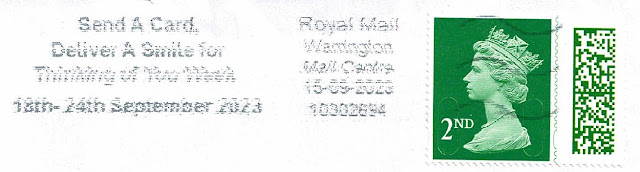
Still hoping that people will send cards instead of text messages, and supporting the greetings card industry, the latest slogan repeats the Thinking of You Week from previous years.

Send A Card
Deliver A Smile for
Thinking of You Week

18th-24th September 2023

KD sent one from Warrington dated 15-09-2023 and the other format from Bristol dated 18/09/20223.
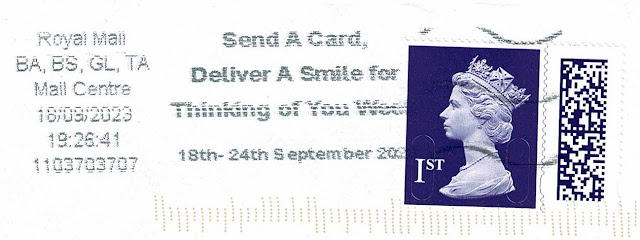
Thinking of You Week slogan used at Bristol Mail Centre 18/09/2023

Thinking of You Week slogan used at Warrington Mail Centre 15-09-2023


UPDATE 30 SEPTEMBER 2023. We received a letter this week with the default British Heart Foundation slogan, used 29/09/23 at Manchester Mail Centre.
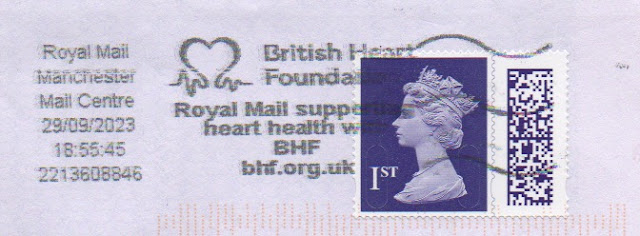
British Heart Foundation default slogan Manchester 29/09/2023

And here is an example of the Thinking of You Week slogan from Grand Rapids, Michigan, USA.
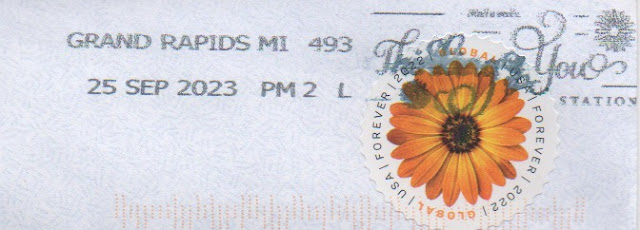
USPS Thinking of You Week slogan used at Grand Rapids Michigan USA 25 SEP 2023
on 2022 Global Forever stamp.


Other postmarks, postal markings etc,

I will probably produce a separate page of Yellow Label surcharge marks eventually, but for the present I will put in these monthly posts any which I see.

This is the standard wording for a counterfeit stamp surcharge label for £2.50.  It was addressed to the Southampton area.
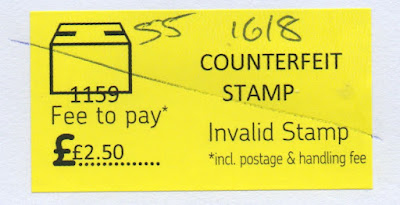
Counterfeit Stamp - Invalid Stamp 1159 Fee to Pay stamp with £2.50 overprinted.

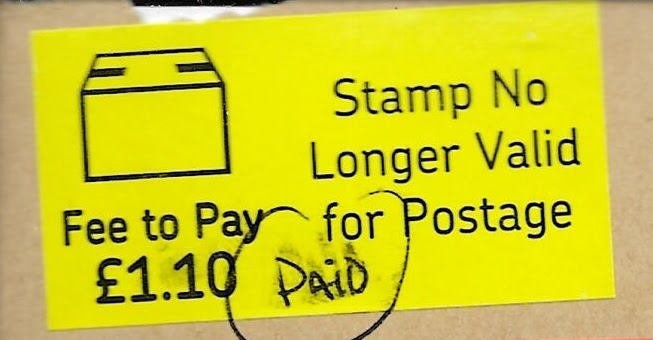
When a definitive stamp with no barcode is used - or when the Revenue Protection department thinks that the stamps used are no longer valid - this label is used.  In this case it is the Olympic definitives are deemed invalid.

Stamp No Longer Valid for Postage Fee to Pay stamp £1.10 with no identification number

For many years 'tick-box' labels have been in use and P6715 is the current(?) one, which now has provision for a wide selection of mis-use.

As well as he 'Size and.or weight' deficiency, this includes the following:

- re-used stamp
- Unofficial Redirection
- Unpaid PPI
- Counterfeit Stamp
- Defaced/Barcode Removed
- BR Cancelled.
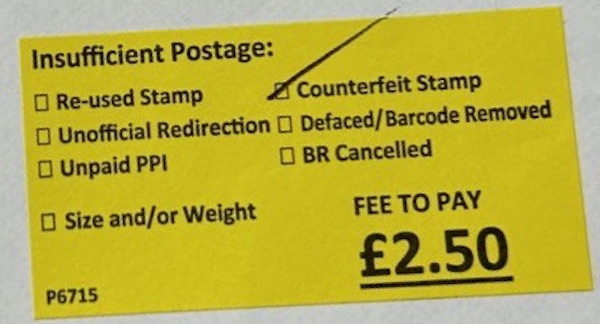
Multiple-reason 'tick-box' Fee To Pay label P6715 for £2.50

Unofficial Redirection is something that has worried some in the Union for sometime; casual redirection rather than payment for the full redirection service means that the letter is being handled twice for no additional payment.  

Unpaid PPI (Postage Paid Impression) is an odd one, because if the mail had been posted without a contract posting docket being provided by the license-holder, then that should have been picked up at the office of posting and the license-holder's account charged.  The only explanation for this being used, that I can think of, is if a license-holder provided a PPId envelope for a reply, when of course the docket could not be provided at the time of sending.  Either way, the license-holder would be charged - or is there another explanaiton.

The meaning of BR Cancelled has been the subject of some speculation with possible explanations being: Business Reply account has been cancelled, or "Barcode Recorded" - which would effectively cancel the stamp.

Any other thoughts, or knowledge from insiders, are welcome!


If you have any other interesting postal markings, please send them to one of the email addresses in the top right of this blog.  Thank you.


Remember, any other slogans appearing in September will be added to this post, so check here before you spend time scanning and emailing.  I'll add new ones as quickly as possible.


Tuesday, 22 August 2023

Post-invalidation treatment of the mail

I should think everybody is expecting to receive some mail which uses old stamps and has been surcharged - or which has been allowed through when it should have been surcharged.

I've started a separate post on my Postal History Blog and look forward to seeing your comments and examples there.

Visit In the post after the Machin and Country definitives invalidation on 31 July 2023


Here's the first one, sent Bristol - Devon 16 August 2023

I'll note here when the other post is updated, but please follow there as well.


UPDATE 29 August - more examples have been added including correctly surcharged cover, and more which should have been but were not.


Thursday, 9 December 2021

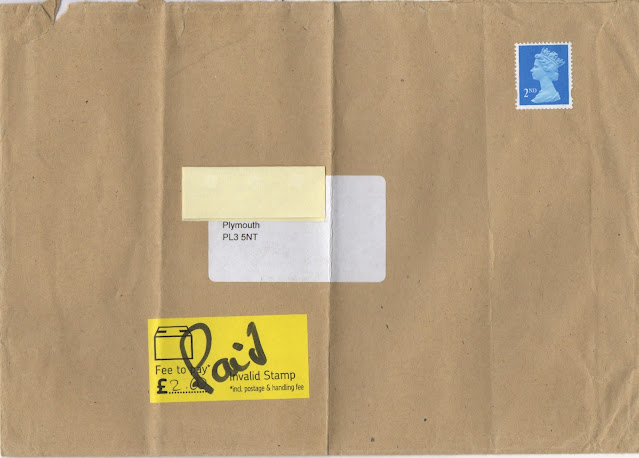
Modern postal history; what's wrong with this cover?

No prizes, but I would be interested in the observations of readers on this one.  I can think of two things wrong.

I'll add my opinion after reading some of yours!  (A larger image may be visible if you click on this.)

UPDATE 13 December.  Thank you for all your comments and suggestions.

The stamp was supplied by a stamp dealer as discount postage.  It's a perfectly valid pre-Pricing in Proportion 2nd class definitive probably from a booklet, accounting for it's short perforations.

The envelope is c5 size (ie within the size for a normal letter), and if the sender is correct the weight was under 100gr, so the single 2nd class stamp is absolutely correct.

So the problem is that somehow the mail centre Stamp Image Database did not detect it as 'good'.  The letter was posted in the Norwich Mail Centre area, though being 2nd class it may have gone straight to Peterborough Mail Centre.  That is probably where it was flagged as being suspect.

Royal Mail Revenue Protection Officers then decided - probably due to the absence of any post-2008 security features - that it was not 'good' and applied the yellow sticker.  This is the wrong one as it is for a parcel, rather than a letter, but that doesn't matter much because the amount due was not pre-printed.

I don't know whether the policy is not to cancel suspect stamps; certainly the lack of an obliteration makes it easier to prove that it is not invalid.

As to the fee, of course most people outside the hobby/trade would accept it and grumble, but I hope that most collectors would, if they went to the enquiry office to pay and collect, protest that the charge was invalid.  Complaining after you have paid online and had the item delivered is likely to be tortuous but entertaining, judging by reported attempts to convince Royal Mail Customer Service of the validity of older stamps.

It's frustrating, thought, when they happily let through packets with four of these on:

Forged 1st class stamp with ROYAL MAIL printing reversed.

Revenue Protection probably think they are good, and are just another example of security printing that the bosses haven't told them about!


Monday, 10 May 2021

Unexplained delays and invalid charges - the 'new normal'?

When I received a letter last week (7 May) postmarked 6 April, I just put it down to 'one of those things". The stamp is an Olympic definitive, so not current (but valid) so maybe it just got delayed somewhere between Preston and Norfolk.

Posted Lancashire 6 April, delivered Norfolk 7 May 2021 - no obvious reason.

But today I had an email from regular contributor RW who forked out a £2 unpaid item charge for this:

Letter posted Milton Keynes October 2020 - delivered Devon 10 May 2021, after payment of £2 'No postage paid' penalty.

Until recently there was a Royal Mail webpage which showed the complete range of special stamps (from 1964?) issued, at rmspecialstamps.com which is now longer functioning although it is still linked from here http://500years.royalmailgroup.com/about/

If only Revenue Protection had access to that, or some sort of index as is contained in the Gibbons Concise catalogue they might not make these silly mistakes and delay letters while they decided.  

I suspect my Olympic one was put aside so that somebody could check it 'when they had time' and they then passed it on without comment having decided that there was somebody working there for more than 8 years who remembered it.

UPDATE 11 May.  My thanks to GONJ who sent this cover, properly stamped to a customer.  "A large letter 79g so 96p and over paid by ½p, the initial report of non receipt after 10 days was followed the next day by a surcharge card."

April 2021 example of properly paid letter marked as 'Underpaid', but with no indication as to which stamp was not counted.   

It took over an hour with different branches of Royal Mail's customer services team for the sender to get this sorted out.  A standard apology and 6 x 1st class stamps will be sent to the addressee (who paid the fee) although this is not an admission of any error.


Have you had similar problems with mail being delayed when old stamps are used?  Let us know.


Monday, 1 March 2021

Anonymous letter - interesting, but not really welcome.

I've just found an envelope and letter which arrived in the middle of last month.  I meant to scan it for the February postmarks subject but then read the letter.


The anonymous sender thought we might be interested, 

"that I have been posting a few letters with 1p stamps on just to test the Royal Mail system, all these letters were delivered within 24 hours of posting.

"It seems many forgery stamps (sic) are around, why is it that Royal Mail seems unable to monitor what goes through the post in spite of all the security measures on current stamps.

"What is the point of having any security if it isn't checked." (sic)


Another 1p stamp was attached to the letter!

What our correspondent fails to appreciate is that Royal Mail have a lot more to worry about at present than a few pennies on these experiments.  

With numerous local sorting offices and most mail centres affected by Covid-19-related absences over the last 12 months, and with your delivery postman working multiple rounds and extra hours during (including Sunday) to get letters and online-ordered parcels delivered, the effort involved in sticking a surcharge sticker on this, writing a 'something to pay' card, and then dealing with me when I go to look at it to find out whether it is worth paying for, is all extra work that they would rather not have to do.  

The manpower cost of all the above - and processing the payment - is worth more than the £1.50 that Royal Mail would charge.

As you can imagine I would have been mightily cheesed-off if a charge had been raised - it's bad enough when an innocent mistake is made and I actually want what is in the letter.

So whoever you are, you have proved your point - please desist and let the hardworking post-men and -women get on with delivering real post.


Friday, 27 November 2015

New arrangements and charges for underpaid and unpaid mail

Until 1983 mail on which the postage was not paid, or was underpaid, was subject to a surcharge equal to double the normal postage, and postage due stamps were applied.  From 5 April 1983, the shortage was charged, plus a fee representing a penalty which was supposed to reflect the cost to Royal Mail of collecting the underpayment.   This fee started at 10p and gradually rose to £1 by May 2003.  The use of postage due stamps to collect the sums due stopped in 1994, not long after new 'To Pay' stamps were issued.

A new system started on 5 October 2015. The Royal Mail press release explained that:
Royal Mail is introducing a simpler flat-rate charging structure for letters and parcels where insufficient postage or no stamps have been attached. The changes are designed to reduce delays in processing underpaid mail and minimise inconvenience for customers. Even with these changes, surcharge fees will not fully meet the cost to Royal Mail of handling mail where the appropriate postage has not been attached.
From Monday 5 October 2015, Royal Mail will introduce a flat-fee of only £1.50 to be paid by the recipient of a letter or a large letter where insufficient postage has been paid. This fee will be £2 when no stamp has been attached. A £3 fee will apply to a Small Parcel with insufficient postage or no stamp attached.
For Medium Parcels and Special Delivery Guaranteed items with incorrect or no postage, a fee of £1.50 plus the postage due, rounded to the nearest 10 pence, will apply.
Under the new process, items which incur a surcharge will spend less time in our system whilst the surcharge is calculated, meaning customers will receive these items more quickly.
Recipients can still pay a surcharge by debit or credit card online via the Royal Mail website. Alternatively, they can pay in cash at the delivery office or by affixing the fee in stamps or a franking machine impression on the “fee to pay” card Royal Mail leaves with the customer.  Royal Mail is also looking at other payment options to make it even easier to receive underpaid letters and parcels.
Also this year, a new system of handling and identifying surcharged items has been introduced in delivery offices.  This did not occur at the same time, as an example has been reported as early as April 2015, but that may have been a limited area trial.

The system involves a numbered white label being attached to the surcharged mailpiece (see right), with a similar label attached to the grey 'Fee to Pay' card (P4605) which is delivered.

The label is 99 x 49mm.  I assume SU = Surcharge, and that a similar label with a different identifier is used for payment of Customs Duty and VAT.  (CD?)

Apparently when the addressee takes the card to the delivery office, the number allows for the easy retrieval of the item that has been held.  On Royal Mail's 'Pay a fee' webpage, after entering details of the address, amount to pay, etc, this box appears:


After Postage Due stamps were abandoned in 1994, various means were used to identify surcharges, including continuing with the multiple-reason tick-box rubber stamp, to yellow Revenue Protection labels which indicated the underpayment and the fee.  Obviously once the label system started they had to be reprinted every time the fee was changes, and while there were pre-printed labels for the most used values (total non-payment of 27p, 30p, 32p, 36p for example - the 2nd class rate was always assumed for standard letters) there were labels which had to be completed in manuscript.

All these could have been collected as part of a Postage Due 'Stamp' collection, but as Martin (who provided the pictures*) suggested, these fixed-value labels are closer to traditional Postage Due Stamps.

* Our customers, of course, never underpay their letters to us, so we haven't yet received any of these!


Also reported, but not formally announced, there appears to be a new policy regarding underpaid greetings cards.   Despite the  Pricing in Proportion system being introduced in August 2006, Royal Mail receives a lot of bad press at key times of the year - Christmas, Mother's Day, Valentine's Day, Easter, and Father's Day - because many customers post Large Letter-sized cards with only basic letter stamps.  The popular press persists in supporting the errant customers - even though many card manufacturers print a size-indicator on the back of cards - with headlines such as  
"Royal Mail wouldn't deliver my mother's card and charged her £1.10 for delaying it!"
Now it seems that these people have won, and Royal Mail will no longer surcharge underpaid cards - but unpaid cards will still be surcharged. Again, we don't have any evidence of this yet, and the only Christmas cards we have received so far (well, it is still November!) had the correct postage.


Tuesday, 15 May 2012

Postage Paid Stationery cut-outs invalid for postage

Royal Mail have made the following announcement regarding PPI postal stationery

"Postage Paid Stationery - Symbol Policy and Procedure

"PPI designs which are used on official stationery are not valid if cut out or detached from the cover, label or form on which they are printed. Similarly any post paid design, without a monetary value if cut out or detached from the stationery for which it is intended, is not valid for postage.

"Any item found to have been posted in this manner from 1 August 2012 will be subject to our revenue protection process and will be pulled from the mail stream and a fee assigned to the item for collection at the local Delivery Office in the form of a surcharge."


When I originally drafted this blog entry I decided that there was a certain ambiguity in the announcement.  So I checked with Royal Mail and have been told that:

No Cut-outs are valid for postage, Revenue Protection teams are instructed to take such items aside and surcharge as appropriate”.

Which isn't anything like the same thing.  The original statement says "without a monetary value"; the 'clarification' says something quiet different.

We all make mistakes, but if you are going to make what amounts to a definitive policy change statement, it makes sense to double-check that it says what you mean it to say, and to get it right!

We will, of course, be interested to see any surcharged - or indeed unsurcharged - mail which bears cut-outs.  I have some old 3p postcards which I might use, in their entirety, on a larger item.  Not a cut-out, so should be OK.

Tuesday, 8 September 2009

Saving the ½p !

As most people in Britain know, the ½p coin was demonetized on 31 December 1984, but stamps of that value and any others which had ½p in the denomination, such as the 4½p, 19½p, 20½p could continue to be used in combination to make up whole penny postage rates.

Earlier this year we were told by Royal Mail that the ½p element no longer counted at all on stamps:

• All postage stamps issued after decimalisation in 1971, except for the half pence stamp, are still valid and must be accepted.
• All half pence values shown on other stamps must be discounted when calculating the postage paid.
For example: A thirteen and a half pence stamp has 13p of valid postage. Two thirteen and a half pence stamps have 26p of valid postage.

I have been told about Revenue Protection surcharging letters as underpaid because the senders had counted 4½p + 20½p as 25p.


This came as a great surprise to me, because abut 2 years ago I bought a couple of sheets of the 1974 Charity stamp, with a face value of 4½p + 1½p, and I had been using them in multiples on most of my mailings to the Royal Mail Special Handstamp Centres! 6 x 4½p = 27p, 8 x 4½p = 36p, the 2nd class and 1st class rates until April of this year! I had no indication that any of these, to Royal Mail or to customers, had been surcharged and I suspect that none were.

However, in a reversal of this policy that nobody seems to have known about, I have heard from two Royal Mail sources as follows:


#1
Royal Mail have reviewed and changed their acceptance policy on post decimalisation half pence value postage stamps.
From Thursday 27 August 2009 if any half pence value stamps are used together on an item, then the total value will apply. However if used singly (or in an odd number when multiple stamps are used) the value must be rounded down.

For example: A thirteen and a half pence stamp has 13p of valid postage, two thirteen and a half pence stamps have 27p of valid postage, three thirteen and a half pence stamps have 40p of valid postage and four thirteen and a half pence stamps have 54p of valid postage.


#2
Following the withdrawal of the 1/2p coin from legal tender in 1984, Royal Mail had a policy of honouring all stamps tendered which still bear the 1/2p value as long as the total postage affixed was in whole pence. Recently, this policy was reviewed as the amount of such stamps in circulation had dropped to a negligible level after 25 years and after consulting the relevant parts of the business, such as Revenue Protection and RM Philatelic, it was agreed that we would continue to accept stamps with a 1/2p value as long as the total amount attached was a whole penny value, otherwise they would be rounded down to the nearest whole penny value.


That's all clear then. Another thing these two statements demonstrate are two different styles of presentation. One is much more 'plain English' than the other, don't you think?