Showing posts with label perforation. Show all posts

Thursday, 11 December 2014

New Machin security stamp printings - the last for 2014?

Several new Machin printings have appeared in recent weeks, one of which has produced yet another new stamp for 2014.

Following the 2p M14L printing, and the two Special Delivery stamps, the 5p (reprinted on 17/09/14) has now appeared.  This will be numbered 3005.4 in the Norvic Catalogue: a new edition will be available in January.  The stamp, cylinder and date blocks are available now in our webshop.


Other new printings recently available include two more printings for the 97p - obviously for the Christmas market despite Royal Mail's assertion that this value wasn't need for Christmas, which was why they issued £1.28, £1.47 and £2.15 Christmas stamps but not the value which does double duty for 10g Worldwide and 20g Europe letters/cards.

97p - 18/09/14 and 03/11/14
£2.15 - 17/09/14

When new dates are found I generally only buy a few date blocks for customers, although for totally new stamps I buy sheets.  The new 97p printings are a case when I really wished I had bought the whole sheet: had I known about this mis-perforation I would have! The die-cut is shifted to the left and up, leaving the left-hand security cut passing between the two figures of value.  There is no colour on the tips of the left-hand perfs, but that is only by luck - all the perf-holes on the right-hand side cut into the colour.


This block will probably be offered in the next MBPC Auction.

Wednesday, 10 April 2013

Doctor Who gets more complex: Tardis has two perforations!

In an earlier report we calculated that there were 30 different stamps in the Doctor Who issue, although there is still some confusion about who printed what. 

But amongst all the confusion we dealers and collectors often forget philatelic basics - and we have to acknowledge that we were not the ones to discover that the Tardis stamps exist with two different perforations!

The stamp from the miniature sheet is perforated 14¾ x 14, whilst the one from the miniature sheet pane in the prestige stamp book is 14¾ x 15.   (The perforations of the 2nd class 'Enemies' stamps are the same from both sources.)


The difference is easy to spot without even resorting to a perforation gauge because the miniature sheet stamp has 11 holes above the elliptical one, and the pane stamp has 12.  The stamps in the Retail Booklet & Generic Smilers Sheet also have 11 holes.

Addition
Royal Mail have usually made it easy for the self-adhesive sheets and panes to be removed from the backing paper for fixing to FDCs (or even postal packets) by ensuring that the die-cut perforations are interrupted.  And this factor also demonstrates that perforators were used.

On the Miniature sheet the Tardis stamp perfs are interrupted on the end of the 3rd tooth in from the corners, on each side, except that the interruption is on the 2nd tooth from the bottom on each vertical side (8 in total).

On the PSB pane there are just four interruptions: top left and top right are on the lower side of the first tooth, lower left is on the upper side of the last tooth, and lower right is on the lower side of the last tooth.  There are no interruptions on the short side of the stamp.


Thus 3 are within the sides, and the lower right is right on the corner.  This can be seen in the images as an uneven tear of the paper, rather than a clean die-cut, most noticeable on the top of the right-hand stamp in the image.

Similar differences occur on the 2nd class stamps.  The MS has interruptions on the top of the 4th tooth on each side (hence 8 in total).  The stamps on the PSB pane have just 4 interruptions, in various positions and various sizes, on the last tooth on each vertical side (as with the Tardis).


Incidentally the size of the Tardis stamp image is different on the Retail Booklet.

The stamp design on the Retail Booklet is 17.5 x 21.5 mm but on the stamps on the Generic Sheet, Miniature Sheet, and MS pane from the PSB have images only 17 x 21 mm.

Sunday, 17 February 2013

Perforations are Go! Imperforate Thunderbirds miniature sheet reported! sheet

The Thunderbirds miniature sheet issued in January 2011 was notable for having lenticular images and thus being much thicker than normal stamps.

Some people thought it wasn't gummed and others thought that if individual stamps were used they would be pulled off the envelope by the sorting machinery.  Thankfully this didn't happen and examples exist on normal (albeit) philatelic mail.

Now two years after the issue Rushstamps have reported that an imperforate miniature sheet has been discovered on a combination FDC!


This sheet, like the only known mint example, was purchased on the day of issue at Tuckton, Bournemouth.  The collector who prepared the cover only recently realised that he had an error when he was mounting his mint stamps and miniature sheet - and realised that the sheet was different to the one on his cover.
Rushstamps will have this at Spring Stampex next week.

Friday, 10 August 2012

Two perforation variations on Gold Medal stamp sheet

My thanks to Andy D. who has taken the trouble to write to me (not being a whiz at computers) alerting me to two different rouletting patterns on the gold medal stamp base sheets.

The bases sheets are printed, die-cut and rouletted by Walsall Security Printers so this is down to them.  On the sheets that I've examined I've only found this on the side rouletting adjacent to the fourth miniature sheet, which is good news for people who have only bought that MS:


As you shown in the image, there are 4 extra long roulettes (or uninterrupted) on the left-hand sheet.  This is not restricted to GMW07 or to one printer location, and could be found on any sheet.  As the sheets are printed two-up on the web, this difference probably occurs on one side only.

I've not had a chance to examine the horizontal rouletting between the MSs and will be pleased to pass on any information that you have, preferably with images.  (And see the comments below for other people's findings.)


Friday, 11 December 2009

Now, the 2nd class Machin with 4 security slits.

Following our report of the 1st class Machin stamp appearing in kiloware with four security slits we have now been sent an image of the 2nd and 1st with four slits.


These are soaked off and have machine wavy-line postmarks so
(a) we don't know where they were posted, and
(b) they have been through mechanised sorting unlike most of the other odd-ball security Machins which have packet handstamps.
Both these and the previous 1st class (shown again below) have very flat 'tops' to the perforations, similar to, but possibly flatter than, the Walsall stamps in mixed booklets, and are probably from business sheets. But their real origin remains a matter of speculation.


We still await any reports of these found unused.

Friday, 6 November 2009

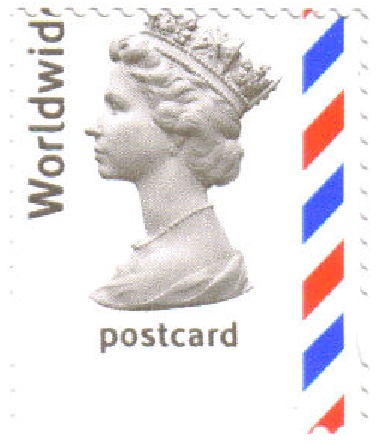
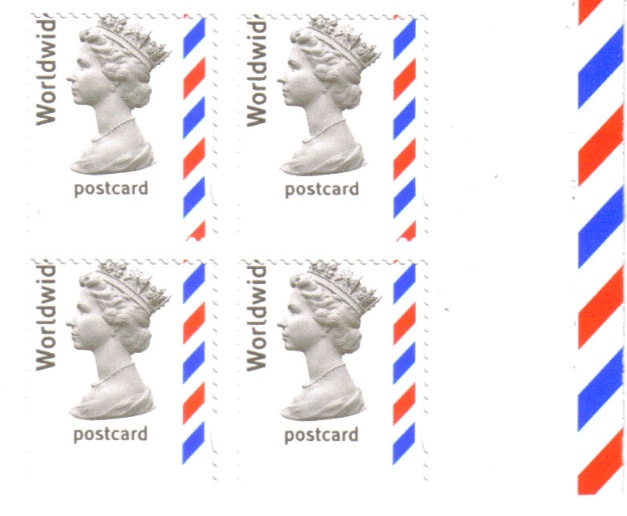
Perforation Shift Produces Major 'Worldwid' Error

No, it's not my error, the stamps actually are Worldwid Postcard stamps!


Thanks to our correspondent, another Ian, who reports:
There is a very short band on the bottom stamps but a full band on the top stamps. I understand that two books were found -- which is not to say that there may not be 10,000 more out there waiting to found! As this is a plain (non-cylinder) book, I'm not sure if these are from the recent reprint from grey cylinder W3, but I think that they are.

Unlike more recent sheet-printed stamps, the phosphor on these and the 40gr booklets was printed on the central matrix as well as the stamps, meaning that only the bottom row could have short bands at the foot, and only the top row could have short bands at the top. Even if this is a new printing, it would make sense for the phosphor cylinder on books of 4 to continue if possible.

Here's a picture of all 4 stamps: