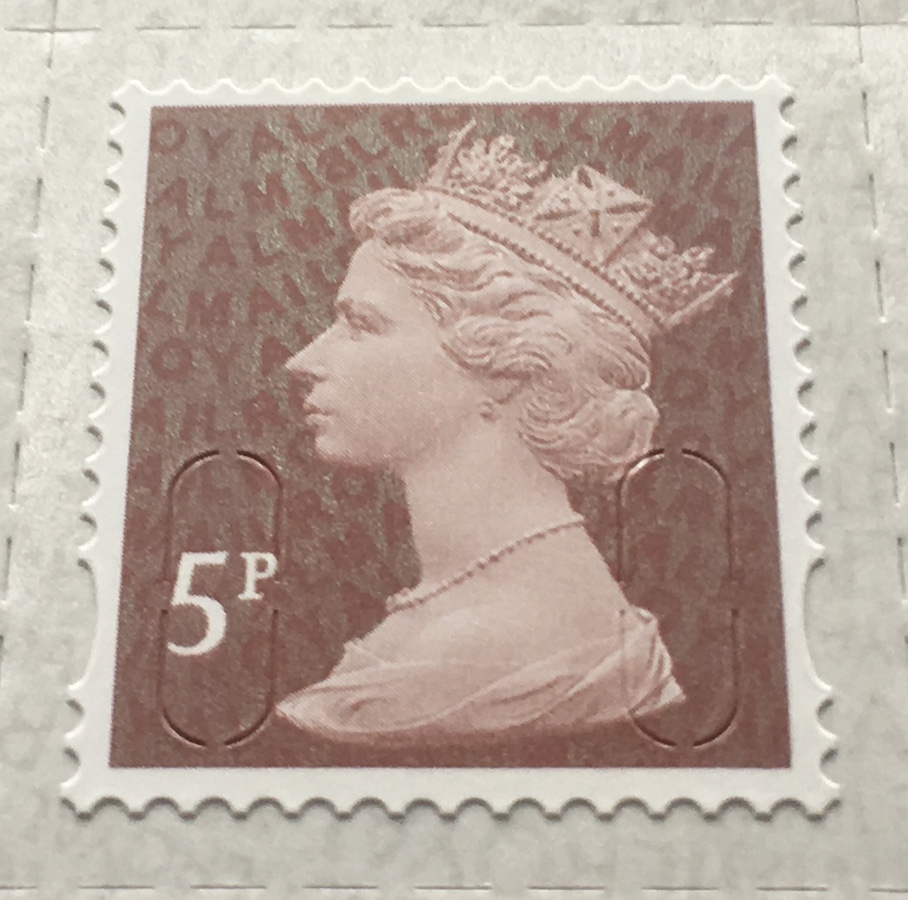
in relation to their printing dates, and now that we have time to examine them properly we can report the variations with the phosphor bands and other aspects of fluorescence on these stamps.

This post has had a major re-write following further information received. And because several people remarked on the change in font and size, which made it difficult for them to read, the tables have been removed, and the detail is now contained in a separate page.
In his Machin Watch column in the August 2018 edition of Gibbons Stamp Monthly, John Deering referred to blue and yellow phosphor on different values printed by Walsall.
After I expanded on this in the original of this post, the additional findings of John Brain showed that not only were there two colours to the phosphor afterglow, but that under UV light some of the stamps had iridescent ink which displayed a yellow reaction. Further, just one printing of one value had coloured ink which reacts with yellow fluorescence. All these can be seen with a short-wave ultra-violet lamp (245nM).
Initially I identfied two types of the 2p green, with the first (9/2/18) printing having yellow phosphor, and the second (8/5/18) printing having not only blue phosphor but yellow fluorescence in the iridescent ink, as shown here:

Further examination of other values showed that the fluorescent iridescent ink is present on most May printings, and this shows quite clearly on the 10p stamp. See how the ROYAL MAIL lettering shows black against the yellow of the ink, and even shows through the blue phosphor, being highlighted by the fluorescence.

The only stamp (so far) to show fluorescence in the visible ink colour (the phosphor being blue) is the second (6/2/18) printing of the £1.45, the February printings of other new tariff values being normal blue phosphor. Note in this case the ROYAL MAIL lettering is yellow rather than black, as it is seen through the (normal, uncoloured) iridescent layer.

So far there are eight M18L stamps which exist in two forms. Whilst these are only apparent with the aid of the ultra-violet lamp, they are marked - and so far unexplained - variants which will earn a listing in the GB Specialised catalogue even if they are excluded from the Concise.
It is likely that there will be other variants before the M18L printings are finished, so detailed information and more pictures are included on a separate page on this blog.
If you want a complete collection of Walsall-printed sheet stamps, there could be far more than we have been prepared for! So far we have only obtained the 2p stamp in both variants. We will endeavour to obtain all variants listed and add these to our shop as soon as possible. A further posting will be made when we have new stock.
UPDATE 1 October. In addition to the Hampton Court and WWI MCIL booklet stamps, booklets with yellow fluorescing iridescent ink are now reported as follows:
- 6 x 1st padlock - packing date 28/06/18
- 12 x 2nd - packing date 23/05/18
- 4 x 2nd large - packing date 30/07/18
UPDATE 5 October. It appears that this situation has been common on the Walsall-printed booklets for some time, although I don't recall any mention of it in the philatelic press. In the two 2016 mixed booklets for the Queen's 90th birthday, the definitives in book 1 had yellow fluorescence in the transparent iridescent ink, but those in book 2 did not. (And we assumed they had been printed at the same time - clearly not!) Take a look under the UV lamp.
If you find any new printings that we are unaware of, please let us know and we will add them to the list.