Showing posts with label phosphor bands. Show all posts

Friday, 14 July 2023

Major error on River Wildlife stamps - 2nd class service for 1st class stamps!

The first major phosphor error for many years, affecting a special issue, has occurred with the River Wildlife stamps.


1st class stamps have a single central phosphor band, the same as the 2nd class, in error.   So far no 'correct' ones have been reported.

This applies to counter sheets and presentation packs.

If you find any 1st class stamps with 2 phosphor bands as they ought to be, do please let us know!

Update 19 July - reprint due!

I've received this communication from Royal Mail Stamps & Collectibles:

Due to a technical error in the printing of our River Wildlife Special Stamp issue, some of the 1st Class stamps in the set may be processed as 2nd Class stamps. We have removed the affected products from sale and apologise to any of our customers who have been affected.

We are  currently setting up a mechanism for customers who have purchased 1st Class stamps in this issue, or products that include those 1st Class stamps,  to exchange these for replacements free from technical errors.

Further information will be communicated in due course.

So I was wrong in doubting that there would be a reprint!

UPDATE 20 July:

1st class Stamps have now  been withdrawn from Post Offices.

UPDATE 9 August
The reprinted 1st class stamps were available from Royal Mail's website from 27 July. (More detail in the comments.)


Wednesday, 22 February 2023

Going back in time... the delights of the earlier Machin definitives.

Although as a collector I bought countless Machin definitives, visiting the Norwich Philatelic
Counter frequently at lunchtime to find what was new, I had put all this aside for other things, and only looked back after I had stopped providing a new issue service for the Security Machins.

As we know, there has been plenty to study with those, even with most of them being NVIs there have been different year codes, source codes, colour changes, backing paper changes, etc which has kept collectors interested.

In the 1970s we didn't have those varieties but there was a lot of variation in head type, gum, paper type, and phosphor.  Also for some values the location of the denomination varied especially in relation to the head. 

I was reminded of all this when I came to prepare my earlier Machins for Royal Mail's Swap-Out scheme - or for earlier sale.  In this and further posts I shall explore some of the differences which are easy to see with the naked eye.

Catalogues - but which?

Aside from the very large number of stamps, one of the problems now for the new collector of earlier issues, is the multiplicity of catalogues some very much more complex than others.  All useful up to a certain period, and some for the whole period, most ask too much of the collector - or assume too much.

The Machin Collctors Club catalogue, to take one example at random, is excellent if you know what you've got.  It even has some useful aids to identifying what you have (papers, gums etc by a process of elimination).  But the section on single stamps is separated into singles from sheets (subdivided by paper and gum), then booklets (ditto), then coils (ditto), rather than by value, which is where the collector starts.

Before the catalogues

In the 1970s and 80s in the UK we had the benefit of Stamp Collecting Weekly which didn't have the long lead times that modern monthlies do, and provided a great deal of timely news every week, whether emanating from the GPO, from specialist collectors/dealers, or from readers who were reporting their 'finds'.

So we were told about variations which were very easy to find and to collect - and waited until later to see what the catalogue editors decided to do!    


In this post I explore some of the phosphor variations.

15 February 1971 - whether we managed to get the stamps on the proper day of issue or when the Postal Strike was over, the first unexpected variant came with the first low values. As well as 12 values to 9p there were booklets - stitched not folded - containing panes of 4, 5 or 6 stamps.  

The 50p book contained 10@  3p, 5@ ½p, and 7@ 2½p.  As well as containing panes of 6 stamps or 5 and a label, one pane contained 4@ 3p and 2@ 2½p - the latter having a single phosphor band at the left.

Pane SG X852L from 50p booklet 1971.

So immediately there was a second variation of the 2½p stamp to collect - and easily obtainable*. Incidentally, the image deliberately shows part of another pane: booklet pane collectors could also find a variety of different finishes to the panes, with properly guillotined, roughly cut, and perforated binding edges.  There were also variations in the central horizontal row of perforations, as shown, with some margins being perforated right through, and some not.

* Easily obtainable, but not always easy to find with full perforations. Adjacent to this pane was another identical but inverted pane, the booklets being assembled stitched and then guillotined leaving some poor perforations, some adequate for collection, and some full holes+.  This applied to all three sides of the pane.  Finding a 'good' example was more difficult than finding a bad one!

(I would like to show actual photographs of phosphor bands and reaction but as the main equipment I used for earlier photos has broken, and is no longer available, I shall rely on graphic overlays on scanned images instead.)

Wedgwood £1 Book

The following year, on 24 May 1972, the second Sponsored Stamp Book was produced, the Wedgwood £1 book.  (The first was the pre-decimal Milk Marketing Board book.)   This contains a mix of 1st and 2nd class (6@ 3p & 17@ ½p (7) as make-weights for the difference and to make up the £1 face value.  

The 2½p stamps are a mix of centre band, left band, and right band, but the final pane contained 2@ 2½p and 4@ ½p arranged in a 2 x 3 block.  With the normal ½p having two bands, and the 2½p having one, the format was similar to the pane above, but it left one ½p stamp with only a single band at the left.  When this was reported it was sought after, and finding it with complete perforations on the two cut sides proved difficult.  Although the price has varied over 50 years, it is still one of the most expensive non-error Machins.
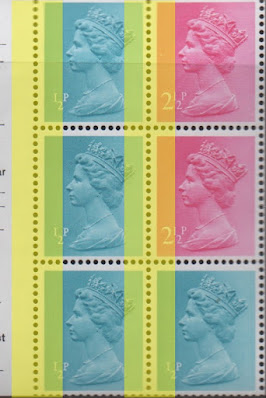
Pane 4 from £1 Wedgwood sponsored book, 1972.


I was going to add Machine Vended Booklets here, but as Royal Mail have now unblocked the despatch of international mail, I will hold those over for a later post.

All these stamps are prefixed X- by Stanley Gibbons, and many of the unlisted are available for sale in our recent List 7.


More to come soon!


Wednesday, 9 September 2020

More fluorescent variations - now Business Sheets.

Regular readers will recall that the counter and business sheets printed by Walsall in 2018 had a wide variety of fluorescence and phosphoresence, but that after that printing seemed to settle down with fewer variants in 2019.

John G has recently sent these pictures of (Walsall-printed) 2nd Large Business Sheets from 2019.  As you can see there is a marked difference in the two printings.


John writes:
The fluorescence from stamps printed on 22 October 2019 (sheet 2960957) is very bright whereas the fluorescence from stamps on the sheet printed on 6 February 2019 (sheet 2783747) is dull. An image of the fluorescence elicited by long-wave UV illumination of two stamps photographed together is shown. (Note also the slightly short bands on the later printing.)
As I wrote in January last year, "these are much more difficult to find because they require the purchase of whole sheets (of 100 small stamps or 50 large letter): if the stamps turn out to be the same then that expenditure - by collector or dealer - is wasted as few people have an outlet for that many spare stamps."

If you are a specialist collector preferring mint then these could be costly or impossible to find.  On the other hand if you don't mind including used stamps in your collection, postally used examples should be easier to find in kiloware.  With the (non-soakable) self-adhesive stamps tending to be collected on paper, the UV reaction won't be affected by soaking.  Although white envelopes show the stamps better in a collection, manilla are better for testing a UV reaction, unless the white paper has no brightener.


Wednesday, 5 August 2020

Strange Machin counter sheet shifts

Minor mis-registration of colour, phosphor or iridescent printing are not uncommon, although few of the phosphor shifts have warranted much attention unless they are totally clear of the perforation hole.  Then they are described as 'short-band' foot, top, left, right as appropriate.

The same attention has not been given to shifts of the iridescent printing on security stamps although it is easier to see, especially if the iridescent ink is tinted and shiny, and shows up on the white margin of the stamps.

Melvyn D has sent some pictures taken with a USB microscope showing some quite spectactular shifts on recent stamps.  My USB 'scope doesn't have UV light, and it doesn't have Mac-compatible software although it can still be used.  But maybe I shall have to investigate some better equipment.

There are two examples of phosphor shifts on the 5p. On the first the phosphor is shifted dramatically up to the foot of the elliptical perforation, giving a 'short-band foot':


With the second, the movement is even greater, which gives only one 'short band foot' on the sheet, with all the others having interrupted phosphor - which is also shifted to the right, meaning that it is inset at left. 


The 10p has phosphor inset at the right, and the 20p at the left. 


What does all this suggest?  All these are ISP/Walsall printings, suggesting that quality control - for the sheets at least - is less stringent?  But similar insets have not been seen on recent Christmas stamps which are also printed by Walsall.  It's clear that Royal Mail are not too concerned about the iridescent printing - after all if these valued stamps are self-adhesive then they are from counter sheet printings, the only others being gummed from prestige stamp books.

But the important thing for phosphor is that there should be two clear bands of decent size.  After the pandemic is over they may get back to separating 1st and 2nd class mail and using the phosphor for segregation.

The other thing that these pictures demonstrate is that with the right equipment you can collect stamp variants that are not immediately obvious to the naked eye, and show them in your collections, exhibits, or in club displays (when they return) with suitable illustrations like these.  


Wednesday, 30 October 2019

Phosphor variations on Walsall's 2019 definitive printings.

Last summer a chance examination started the process of revealing the multiple variants in Walsall's printing of Machin definitives - dull and bright blue phosphor, yellow phosphor, fluorescent iridescent inks, and even a fluorescent colour ink.  These were summarised on a separate page.

Although not supplying the M19L reprints of these stamps, I have had the opportunity to examine 2019's printings.  For some values there have been three, others two, and in some cases as yet only one - including the 5p which only had one printing in 2018.

Once again these findings are based on the use of the Uvitec Micro short-wave lamp.  Other SW lamps may produce different reactions, and the light must be shone directly at the stamp: the yellow does not show if the stamps are behind some transparent (Hagner-like) strips.  My thanks to BE for access to his collection.  Click on any image to see enlargements.

Just how different some of these are is debateable, there is certainly not the variation that thesr was in 2018.  Whether these should be considered worthwhile is a matter for individual collectors: some of them are very distinct.

Valued stamps

1p - dull and bright

10p - both printings appear the same

20p - both printings appear the same


£1.00 - dull and bright


£1.35 - dull - very bright - bright


£1.55 - dull and bright


£1.60 - bright bluish and bright yellowish


£2.30 - dull, and the latter two are apparently equally bright


£3.60 - bright bluish and bright yellowish


NVIs

2nd class - blue and bright yellow


1st class - dull, and bright bluish and bright yellowish?


2nd class Large - dull, and bright blue and bright yellow


1st class Large - dull and bright


To be updated if new printings appear.


Tuesday, 7 May 2019

Phosphor - or non-phosphor error?

We know that all defintive stamps for decades have carried two phosphor bands, except for 2nd class which have one, usually at the centre.  There haven't been any missing phosphor errors for many years as far as I can recall. 

Many people still use the traditional 'hold-to-light' method for checking short or shifted bands, especially in the summer when the real darkness necessary for a UV-lamp is in short supply.  Years ago this method was also used as a first check to find out whether the stamp had phosphor missing altogether - we could even do that in the post office and I remember looking at my first 1980 £3 Wedgwood PSB and saying to myself - "oh, they've changed the phosphor bands again" as I found the bands on the se-tenant pane shifted.   I soon shifted that on my next trip to Stampex! 

So what do we make of this:


It's a mix of stamps, the 1p and 11½p definitely se-tenant and the 14p and 11½p maybe not.  Certainly the 11½p have left bands and if the 14p is - or was - joined as a pair, then that will have 2 bands - which are not visible by this method.

Fortunately the bands are visible to the Uvitec lamp, confirming that there is nothing amiss, aside from a lack of postmark on these!   It also makes it much easier to see that the stamps are joined, at least in  pair even if it is not a block of 4.


So remember, a UV lamp is a very worthwhile investment. What good finds have you made, with or without a UV lamp?

Wednesday, 23 January 2019

Walsall phosphor and fluorescence variations, continued.

I've reported at length (most recently here) on the phosphor and fluorescence variations on counter sheets printed by ISP Walsall, and similar variations on booklets have also been noted, some going back many years.

It comes as no surprise that the same sort of variations occur on Walsall-printed business sheet stamps.  These are much more difficult to find because they require the purchase of whole sheets (of 100 small stamps or 50 large letter): if the stamps turn out to be the same then that expenditure - by collector or dealer - is wasted as few people have an outlet for that many spare stamps.

I've recently been shown examples of the small stamp sheets from 2018 and can now show variations between two printings of each value.

2nd class - printed 14/03/18 and 23/04/18.  Phosphor is blue, but on the later date the iridescent ink has yellow fluorescence.


1st class - printed 01/03/18 and 17/04/18.  As above, the phosphor is blue, and the iridescent ink has yellow fluorescence.


These will be listed in the next edition of our Machin Checklist, but we will not be able to supply them.  For the record, the ones we have already supplied are of the first type, with blue phosphor only.


Thursday, 13 December 2018

More new Walsall Machin printings

I'm sure you remember life before Walsall won the contract to print Royal Mail's counter sheet definitives?  There were just as many printings during the year by De la Rue but they were all the same - well, maybe with slight differences to the brightness or dullness of the phosphor reaction, but most people were not concerned with that.   This - indeed the period after Autumn Stampex - was usually a quiet period for Machins, and we could consolidate and look out other things to offer you.

What a difference a year makes!  The variations in printings by ISP/Walsall have meant that there are up to three different printings and variants for the same stamp, if you want to collect them.  Some people are happy with face different.   By the way, none of these will be available from our shop until January.  We all have far better things to do over the next week than order and post stamps around the world.

The latest printings were made known to us at the end of November and our supplies arrived yesterday.   The values concerned are the second printings of the 2nd class and 1p stamps, and the third printing of the £1.45 airmail stamp.  This was the one that surprised us, you will remember, with the second printing having yellow fluorescence in the dove grey ink, the only stamp so far to have appeared with fluorescence in the colour ink.  So I'll start with this.

The third printing, on 30/10/18 continues with yellow fluorescence in the dove-grey ink, but also in the transparent iridescent ink!

2nd printing - yellow fluorescence only in dove-grey ink meaning that the ROYAL MAIL pattern stands out clearly with the yellow letters showing through the iridescent ink.

3rd printing - yellow fluorescence in both dove-grey and transparent iridescent ink; the ROYAL MAIL lettering barely shows at all under UV light. The blue phosphor cylinder number is off-picture to the top.
  
  £1.45 2nd & 3rd printings compared.

And now an apology.  The original printing of the 1p maroon is correctly shown (in my stockbook) and on our web-shop as having blue phosphor and yellow fluorescence to the iridescent ink, but our Checklist doesn't mention the fluorescence.  This has now been corrected for an edition to be published in January.

The second printing, 22/08/18, has only blue phosphor and no fluorescence.

Lastly the 2nd class.  Surprisingly this is only the second printing for what must be one of the most used values - but as I have mentioned before finding used counter sheet examples rather than stamps coded B or T from business sheets and booklets is quite difficult.

The first printing had bright blue phosphor, which we had identified as just 'blue'.  This has now been changed on the Checklist as the latest (29/10/18) printing is dull blue, as shown below.


The last addition before Christmas (I hope) is the long awaited 6 x 1st Padlock booklet on SBP1.  This was first mentioned in October but we didn't have any supplies or pictures.  We now have the pictures and the stamps will also be available to buy in January, as 2936aS.8a.


When we re-open after the Christmas/New Year break we will also be restocking some of the other recent stamps.    By then Royal Mail should have announced to the media the stamp programme for the first half of 2019.


Thursday, 25 October 2018

Ultra-violet lamps for detecting phosphor and fluorescence.

A number of people have asked about what lamp to use to detect the phosphor and fluorescent variants on Walsall-printed Machin stamps.

If you can find a Uvitech Micro, then I would recommend that as the one that I have been using, and through which I have taken all the UV stamp photos shown in earlier blogs.  Unfortunately Ramley stopped making those decades ago.  They occasionally crop up on eBay and other sites, and it is possible that you may find one in an old-fashioned stamp shop (where the dealer has stacks of stuff that he has forgotten about), or in local general (house-clearance) auctions.  However, that is very hit and miss.

This is what you would be looking for.  It takes 4 x AA batteries, and was designed when batteries were slightly less 'fat' than they are now!  One terminal for each battery is a metal stud, while the other is a very flexible spring which holds the battery in place, sort of.  But I have noticed auction listings mention corosion, and I have had the same problem, even if the battery is not leaking through storage.  (Always remove the batteries when not in use - this is a precious and valuable tool; if you can find one, look after it!)

The other thing to check is the switch mechanism; this is not a toggle switch, at least not on mine, and works by depressing a copper strip against a terminal.  Again, over time, this gets worn.  My strip is held in place by some self-adhesive sheet edging, being the right size and much easier to use than transparent adhesive tape.


It works reasonably well in daylight, good enough for a quick look at phosphor bands, to look for short bands, etc, or just to check the colour.  This is because it has an aperture through which the eye can see the lit stamp in relative darkness.


But where the phosphor bands are glowing brightly, it is easier to see fluorescence on the iridescent ink or colour ink if you workplace is in total darkness.  With the main room light off, dimming the computer screen and brightening it again generally provides sufficient darkness and light to see the effects (and take photos), and then to select different stamps.

The model was also sold branded as Stanley Gibbons in the UK, and Scott in the USA.


All the photos I have shown are taken with an iPhone, the newer the better although my previous models have produced acceptable results as shown on the blog in past years.  The camera is in one corner, rather than centralised which probably helps.  I'll be happy to add reports of your experiences with other phones or cameras.

Ramley also produced the Uvitech Minor, a smaller mains-operated lamp which, while useful for detecting phosphor band colours (on Wildings especially I understand) does require total darkness.
Both these lamps are short-wave only and use 254nm light wavelength.  This is important.


BUT WHY GO ON THAT HUNT WHEN OTHER LAMPS ARE AVAILABLE?
Because I have no experience of them, so can't tell you more than I can find by research!
Stanley Gibbons sell a dual-wave lamp for £119 which uses short and long-wave light.  This is the one that John Deering uses for his reports in Gibbons Stamp MonthlyThis also has an eye-piece and is battery operated.  However,  SG's website does not indicate the wavelength although it obviously works.  Another user has declared it to be 'temperamental'.  Maybe new batteries are needed!
Update: I have been told by Gibbons that "the spectrum covered is 254 to 390nm which I believe is the longest range covered by any UV lamp on the market."

Gibbons also sell the SAFE Philalux, which incorporates a magnifier and is also a banknote tester.  The lamps are "Shortwave 266nm with phosphor filter (for identifying phosphor bands and 'all over' phosphor on Great Britain stamps) and Longwave UV lamp 365nm (for identifying fluorescent paper, inks, forgeries and repairs)".  I don't know whether this works for the stamps now available.

A portable lamp with the PRINZ branding is also available for less than £15.  This is battery-operated and therefore portable, but is long-wave 366nm, and so not suitable for our current purposes.  PRINZ also have a 254nm short-wave lamp for under £30 which ought to work.  I was shown a PRINZ lamp at a recent stamp club meeting which was useless for identifying the Walsall variants, so I assume it was the long-wave one.  If the short-wave one does the job, it would seem to be the cheapest option on the market at present.   If you look at their full range, they also have separate mains short- and long-wave lamps, and sell replacement bulbs should failure occur.  They also have a selection of lamps with Lindner branding.
Prinz website - http://tinyurl.com/y75wbhjx

Only the Gibbons dual-wave has the eyepiece and so can be used in daylight, and probably used for taking photos.

I'll be happy to add any feedback and experiences from readers.   Whilst my lamps don't actually have the designation 'Patent Pending', unlike my (grandfather's) original SG Instanta Perforation Gauge, they are very old but they work.  Your reports on more modern equipment will be welcomed by other readers, I'm sure.   Good luck!

UPDATE 14 November.
Richard Moss has sent me a long email about his experimentation with UV lamps. This is an edited version:

I have Four UV Lamps at home, 
- my old Uvitec, my workhorse of the 90's which gave up the ghost 15 years ago, 
- a longwave battery powered Prinz lamp sold about 10 years ago, 
- a short wave 'Money Detector' desk top lamp and 
- my old Long Wave 'Philatell' model bought in 1970 for testing 'Woodfree' Paper on CW stamps and papers on the high value postage dues of the late 60's. This latter item is unquestionably long wave and is incapable of finding the afterglow on violet phosphors.

I had the following results with the 2018 Yellow Fluors:- 
1) Uvitec - obviously no result as it's broken. 
2) The Prinz Longwave - No yellow activation. 
3) The 'Money Detector Short Wave - very poor yellow on stamps but not every time.   
4) The Philatell Long Wave light. I never expected anything from this and only checked with this for 'a bit of fun'. The stamps were in Hawid Strips and the page covered by a Venus Protector but there it was - a really strong glow which would have been good enough to photograph.

A was talking to Jim Bond on Friday afternoon and he has had a similar experience. He has had his best reaction with one of his Long Wave lights.

I think we all know that some lights give different results to others.The message here is clear, different makes of lamps can have different performances.

So, summing up, before going out to buy an expensive short wave lamp to detect 2018 Yellow Fluors you should test the reaction on all your Long Wave UV Lights.

What really surprised me was that this reaction showed through the Hawid strip.  So if you can, test before you buy, with some known different stamps - if you have the dated examples or cylinder positions that would be most useful.

UPDATE 29 November 
Reader DG has sent details of his US-retailed UV lamp, which has both Long Wave and Short Wave lamps.  As he writes, one disadvantage of this is that is mains-powered so no use for shows and fairs.


Now that I have once again, used my UV light to verify a distinct difference in the two printings of the £1.25, I thought that perhaps I should identify the lamp which I have been using with great satisfaction for over 20 years. I have 2 other hand-helds that I admit, do not produce the same results.

  (£1.25 printing 1 & 2)

Made in the US, it is labelled as a RAYTECH ULTRAVIOLET LAMP, Model LS-2, and has 2 distinctly separate lenses.   It is 7½ inches long. 

As you can see from the picture, it has the European Certification [CE] mark, but the only ones I could find on the internet were US-made 115 volt, so no use in the UK.


Wednesday, 12 September 2018

2018 Machin counter sheet stamps reviewed

As we have reported, the distribution of Walsall-printed counter sheet stamps has been erratic
in relation to their printing dates, and now that we have time to examine them properly we can report the variations with the phosphor bands and other aspects of fluorescence on these stamps.

This post has had a major re-write following further information received.  And because several people remarked on the change in font and size, which made it difficult for them to read, the tables have been removed, and the detail is now contained in a separate page.

In his Machin Watch column in the August 2018 edition of Gibbons Stamp Monthly, John Deering referred to blue and yellow phosphor on different values printed by Walsall.


After I expanded on this in the original of this post, the additional findings of John Brain showed that not only were there two colours to the phosphor afterglow, but that under UV light some of the stamps had iridescent ink which displayed a yellow reaction.  Further, just one printing of one value had coloured ink which reacts with yellow fluorescence.   All these can be seen with a short-wave ultra-violet lamp (245nM).

Initially I identfied two types of the 2p green, with the first (9/2/18) printing having yellow phosphor, and the second (8/5/18) printing having not only blue phosphor but yellow fluorescence in the iridescent ink, as shown here:

 
Further examination of other values showed that the fluorescent iridescent ink is present on most May printings, and this shows quite clearly on the 10p stamp.  See how the ROYAL MAIL lettering shows black against the yellow of the ink, and even shows through the blue phosphor, being highlighted by the fluorescence.


The only stamp (so far) to show fluorescence in the visible ink colour (the phosphor being blue) is the second (6/2/18) printing of the £1.45, the February printings of other new tariff values being normal blue phosphor.  Note in this case the ROYAL MAIL lettering is yellow rather than black, as it is seen through the (normal, uncoloured) iridescent layer.


So far there are eight M18L stamps which exist in two forms.  Whilst these are only apparent with the aid of the ultra-violet lamp, they are marked - and so far unexplained - variants which will earn a listing in the GB Specialised catalogue even if they are excluded from the Concise.

It is likely that there will be other variants before the M18L printings are finished, so detailed information and more pictures are included on a separate page on this blog.

If you want a complete collection of Walsall-printed sheet stamps, there could be far more than we have been prepared for!  So far we have only obtained the 2p stamp in both variants.  We will endeavour to obtain all variants listed and add these to our shop as soon as possible.  A further posting will be made when we have new stock.

UPDATE 1 October.  In addition to the Hampton Court and WWI MCIL booklet stamps, booklets with yellow fluorescing iridescent ink are now reported as follows:
   - 6 x 1st padlock - packing date 28/06/18
   - 12 x 2nd - packing date 23/05/18
   - 4 x 2nd large  - packing date 30/07/18

UPDATE 5 October.  It appears that this situation has been common on the Walsall-printed booklets for some time, although I don't recall any mention of it in the philatelic press.  In the two 2016 mixed booklets for the Queen's 90th birthday, the definitives in book 1 had yellow fluorescence in the transparent iridescent ink, but those in book 2 did not.  (And we assumed they had been printed at the same time - clearly not!)  Take a look under the UV lamp.

If you find any new printings that we are unaware of, please let us know and we will add them to the list.


Friday, 29 July 2016

Phosphor Puzzle on Queen's Birthday Stamp Books

Earlier in the month I mentioned the different phosphors that have been used on definitives in recent months, with an explanation from Royal Mail.  As Brian said, there were also similar but possibly better variations 3-4 years ago.

Of course the same applies to the commemorative stamps in mixed retail booklets, though reader John S has sent me some surprising photos of the two booklets issued for the Queen's Birthday.  Of course not all UV-lamps or cameras/devices are the same so I checked with my own (a mains UV lamp probably ought to be on the Christmas list!).

These are the pictures John sent.  In all cases RB1 is at the top, and RB2 at the foot.  There is clearly some difference, although only in the third picture can you see clearly what John suggests, that is that the phosphor on RB2 is brighter than that on RB1 - which would suggest that it was printed first using the old phosphor?


The reaction of the part of the stamp without phosphor bands is also interesting, suggesting that maybe the iridescent ink is what is causing the apparent difference.

On my own picture, the Ultra Violet light is shining from the left, but I don't think the intensity of the light is what is causing this difference. In this case RB2 is on the left, and RB1 on the right.


The reaction on the left is brighter, but the part of the stamp without phosphor is strikingly different.

So, any thoughts, readers?  Maybe when it's dark, I'll have another look...

Friday, 8 July 2016

Stamp Collecting Isn't Dull, But Phosphor Has Become Duller

During the last year the phosphor used for British stamps has been changed, and I have been asked to write about which stamps exist.

I understand that although the basic composition remains the same, the phosphor ink from the new supplier is not as bright as that used previously.  (I've been told that on some examples of stamps or Post and Go Faststamps the brighter phosphor had taken on a yellow tinge over time, which may be the reason for the change of supplier !)

First things first, this change was made in the autumn of 2015, so all printings with 2016 year codes have dull phosphor.  The following stamps with 2015 year codes exist with both bright and dull phosphor.   In the case of counter sheets all printings after the date shown are dull. 

Counter Sheets
1p             05/11/15
2p             28/09/15
5p             06/11/15
10p           30/09/15
20p           01/10/15
£1             12/11/15

1st purple     18/09/15
1st Large      01/10/15
2nd class      29/09/15
2nd Large     03/09/15

1st Signed    13/11/15

Business Sheets  - these exist with and without SBP

2nd class    
2nd Large
1st class
1st Large

Booklets:  information awaited.


Because I have concentrated on year codes as and when the arrive or are discovered, I have not kept track of whether our supplies have bright or dull phosphor.   A later version of the Norvic Security Machin Checklist will have this information when it is finalised.

At this stage I cannot supply specific types for any of the 2015 issues.

Thursday, 16 February 2012

Major phosphor shift on Aerial Post Machin stamp pane

A correspondent in the USA has reported a significant phosphor shift which I don't think has been reported elsewhere.

"Recently I ordered a First UK Aerial Post Prestige Book from Royal Mail.

"When it arrived late last week, I noticed that the mixed Machin pane had its phosphor bands shifted 6mm left. This leaves the right column of stamps with what looks like a center band instead of two side bands, and the stamps in the center and left columns have a double-wide band covering the right half of each stamp from the stamp centerline to just inside the right perfs. Even the center label of KGV has a phosphor band.

"I realize that phosphor shifts do not command the prices that a visible color would get, but I’m not going to look a gift horse in the mouth. It is not often one gets an EFO direct from the source.  As these panes were printed as multiple panes on one sheet, I assume there should be more examples out there, have you heard of any?"

If a picture can be obtained, I'll add it here in due course.

Do let us know if you have any significant phosphor shifts or any other errors.  It's a very long time since we had a book with any duplicated pages!

Monday, 6 April 2009

Short phosphor bands on Faststamps

Several people have reported that the labels we know as Faststamps (but which Royal Mail refers to as 'Post and Go stamps') exist with misplaced phosphor - inset right, short top or bottom.

As you may know, the Philatelic Bureau (aka Tallents House) now sells sets of 5 labels in a specially designed carrier - not quite a presentation pack, but similar, along with badly creased cellophane sleeves. These are not dispensed from Post & Go machines, which produce labels with thermal print values etc, but are specially printed by Walsall in gravure.


It seems that short bands on these are more common than on the machine dispensed labels. Here are the findings from some of our batches:

1. Inland (2) and Europe very short at foot; worldwide slightly short at top.
2. World 10gr slightly short at top, World 20gr slightly short at foot; remainder OK.
3. Inland (2) very short at foot; World slightly short at top; Europe OK.

Remember, these are each sets of 5 dispensed from the same pack, so the packs are assembled from various parts of the print run.

I still have more to check, but I have 3 type 1, 4 type 2, and 1 type 3 packs. Not scarce at all, it would seem!

Friday, 13 March 2009

Northern Ireland Castles brings a third self-adhesive 1st class

This is getting complicated.

Collectors will know that the Glorious Northern Ireland Smilers Sheet contained the first self-adhesive 1st class country stamp. The perforations (die cuts) were 'ordinary' and the phosphor bands fuzzy at the edges.

The Glorious United Kingdom Smilers Sheet, containing 1st class stamps from all four countries had elliptical perforations (syncopated, in US) and the phosphor bands were sharp-edged.

Now the Castles of Northern Ireland Smilers Sheet combines the two, with elliptical perforations and phosphor bands fuzzy at the edges. So that means the specialist has three different self-adhesive 1st class stamps from Northern Ireland and can look forward to the same from the other three countries.

Tuesday, 10 March 2009

Robert Burns 250th Anniversary - miniature sheet phosphor positioning

Thanks to Alex Goodall for drawing my attention to the phosphor bands on this miniature sheet, which seems to affect most of the sheets seen so far. These very minor variations aren't easy to see on the FDC due to the brilliance of the white envelope, showing through the perforations. My own observations show a movement only to the left, not down as Alex reports:

* General - under x10 magnification and using long wave UV, the phosphor looks cross-hatched.
* A Man's A Man 1st class - RB clearly inset (by 0.5mm?) from perfs compared to normal copy.
* 2nd class Saltire Flag - CB appears to have slipped by <1mm as the phosphor has intruded more onto the 50p Thistle stamp. If you removed this stamp from the M/S it would clearly have a thin phosphor line top middle.
* The 1st class lion & 81p tartan have the LB shifted slightly left. If you look closely at the lions 'thumb' for want of a better description, the normal phophor stops just to right, while, on the shifted phosphor it stops neatly to the left! giving a slightly narrower LB. The effect on the 81p is the gap between two perfs.
* There is also a slightly but clear downward shift of the two bands down the 1st class lion and 81p, with more perf exposed but not quite getting to the stage of a phosphor bar.
* The RB of phosphor down the 1st class and 81p is clearly inset left (by 0.5mm?) giving a bar effect down both.
* The 1st class portrait has such poor phosphor any effect is lost, however, there appears to be a bright fluor effect just to the left of the perfs on the M/S itself.
-------
This is the last Royal Mail special issue produced by Joh Enschede.

Thursday, 12 February 2009

Inset Phosphor Bands on most Security Machins

For some reason the phosphor on the self-adhesive definitive stamps is not printed in the space between the stamps (known as the matrix) as on the those printed on normal sheets of 200. Whereas short or inset phosphor bands on the normal sheets would apply only to a proportion of the sheet (bottom or top row, first or last column because they are printed continuously, across all perforations), such phosphor shifts on the new stamps will apply to every stamp. This should have an impact on their cost and value.

Updated 24-02-09

2nd class [04/12/08] - All are very slightly short of the top perf tips [Later: Phosphor on sheet 0000440 is 100% OK]

1st class [09/12/08] - Most are very slightly short of the top perf tips

2nd Large [10/12/08] - All are short at the foot, some sufficiently to be catalogued, but most not.

1st Large [09/12/08] - All are very slightly short of the top perf tips

50p grey [08/12/08] - All are very slightly short of the left perf tips [Later: Another sheet has phosphor slightly short at the top but the left is OK!]

£1 ruby [08/12/08] - All are very slightly short of the left perf tips

£1.50
[20/01/09] - All are very slightly short of the top perf tips

£2.00 [20/01/09] - All are slightly short of the top perf tips, some almost listable. Two sheets found are also slightly inset at right

£3.00
[20/01/09] - Very nearly all are 'OK'. One Cyl block seen has left and foot extreme tips clear of phosphor.

£5.00 [20/01/09] - All except one Cyl block are slightly short at the top. The odd one is 100% ok.

Tell us about your discoveries!