Tuesday, 2 February 2010

Security Machins - PART missing security print layer!

In September 2009 we reported on the appearance on internet auction site eBay of the security version of the 1st class gold Machin stamps with no security 'overprint'.

The pair, postmarked Devon & Exeter, were found in kiloware and aroused suspicions from expert collectors and dealers, but none could find a way to remove a properly printed security overprint without damaging the stamp. No copies were found mint, but before long further copies were found not only with no security print but with 4 security slits! These were postmarked Plymouth Devon. The 2nd class with four slits was reported in December. All these came from kiloware, but there have been reports of the 2nd class being found mint - we've not had photos of these supplied yet.

Now a new development from California, reported in influential American weekly philatelic magazine Linn's Stamp News. Reader Michael Ward of California received a Christmas card from a friend - in Exeter - bearing 2 x 2nd class security Machins partially missing the security print layer.


[Image ©2010 Linn’s Stamp News (www.linns.com), used with permission.]

The stamp on the left has the security layer only at the extreme lower left of the stamp; the other stamp has only a stripe at the left of the stamp - giving all the appearance of being where the phosphor band would be on a 1st class stamp.

Collectors here who saw the report questioned the use of inland 2nd class definitive stamps - 2 x 30p is insufficient for even a 10gr card, so there must have been more stamps. Maybe there were three which make 90p, exactly the 20gr rate? Maybe the card was contained in a packet (the stamps seem to be on heavy manilla rather than ordinary envelope stock) with a selection of other stamps.

The stamps reported earlier were found on kiloware consigned to Singapore. It's interesting that with all the Machin collectors sorting through competition entry envelopes and kiloware that none of these have yet been reported as found in the UK. Watch this space for more reports, and if you find any, wherever you are, our readers will be interested!

Thursday, 28 January 2010

It's not always Royal Mail's fault - or ours - if we don't deliver on time!

Most dealers and some collectors will know that dealers registered with Royal Mail can obtain their stamps (etc) in advance of the issue date. This enables us to prepare first day covers ahead of time and generally have them ready for sale with a variety of handstamps soon after the issue date.

This facility extends to Prestige Stamp Books, and in this case we are supplied with unbound panes. That saves us taking them out of books (which is a time-consuming and sometimes damaging process), and of course saves them from being bound into books which presumably saves Royal Mail some money, saves some effort, and saves on waste (save the planet!).

For the Classic Album Covers we received the first full booklets just before Christmas - not many working days before the issue date of 7 January. The loose panes were even more delayed and finally arrived on 6 January with a big surprise: they were not full size! In fact it is quite possible that they had been produced by guillotining bound books and extracting the stamp panes that we wanted!

Whether this is true or not we may never find out. We can't fault the people at Royal Mail Tallents House: they got the stock in late, and they got it out as quickly as they could. As I acknowledged to them at the time, it wouldn't have ocurred to me to check them either!

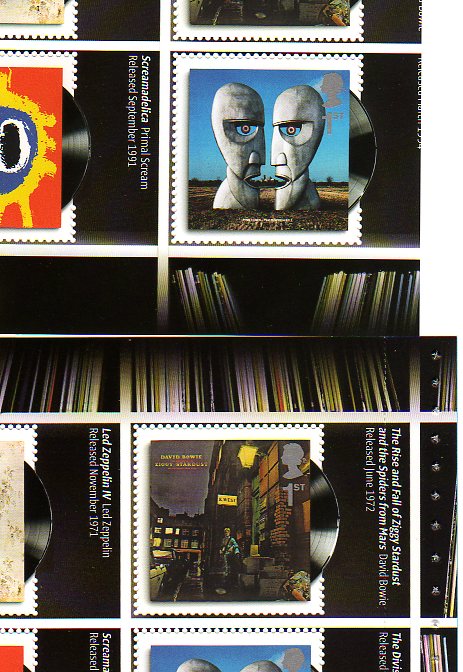
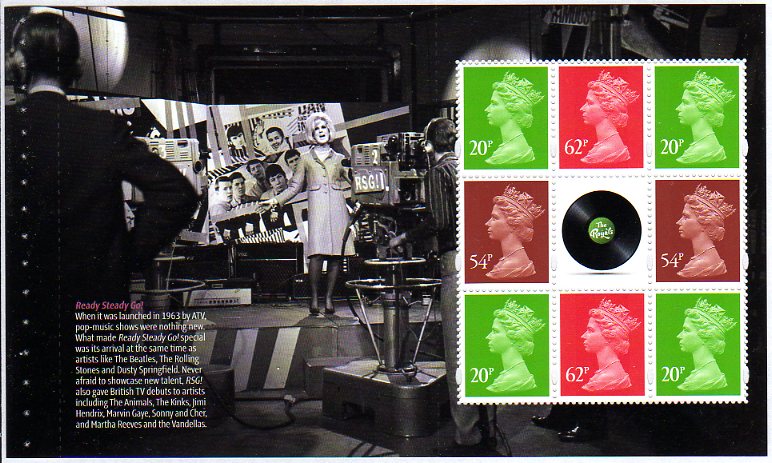
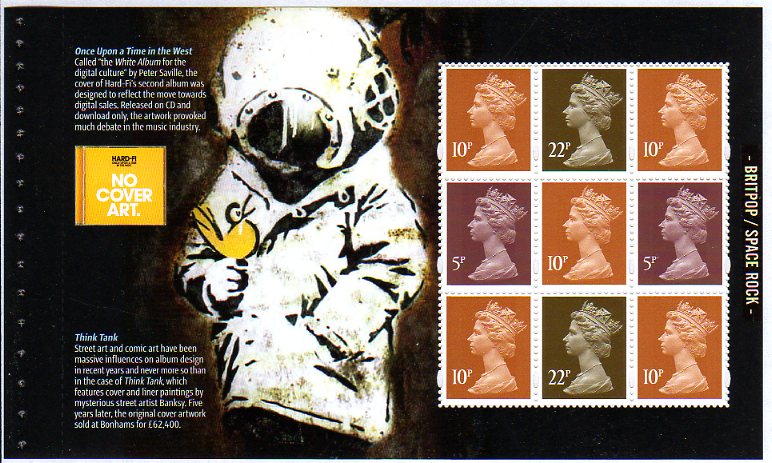
And of course whilst we might have been forgiving and found it just about acceptable with any other PSB, the Album Covers PSB was different because the two special pane stamps were bound face to face. This meant that the rouletting line (which is where these were guillotined) actually passes through the caption on the Ziggy Stardust and Division Bell stamps. The upper part of the picture shows the short pane, and the lower part shows an undamaged pane, taken from a book. Clearly the 6-stamp pane 2 as delivered would not be acceptable on first day covers as the caption is missing from the stamp surround.


Our account managers at Royal Mail took immediate action to rectify this. I still don't know what the solution was, but the replacement stock was delivered on 22 January. Even then, the two Machin panes remain truncated, although this does not affect the design or the stamps to any great degree. It is not the best solution, and sets of 4 covers will have panes in two different sizes, but it does mean that we can now get our covers prepared and sent to the handstamp centres for cancellation. (The only 4-cover sets with full size panes will be those taken from booklets and they will have stitching holes.)

Of course this has had a knock-on effect on customer orders, not only those orders which include PSB fdcs. We have had to take time out from processing other orders to carefully fix the 100-odd panes to the FDCs and send them for postmarking, which we normally have done before the stamps were issued.

So apologies to all our customers who have not yet had their orders, and to whom we cannot spare time to write individually. We're back working on them as fast as we can, whilst also updating the website and blog to keep everybody informed.

Tuesday, 26 January 2010

Tariff increases spring 2010 - new stamps

As has been widely reported, postage rates in the UK will rise on 6 April 2010. The rises, which have been approved by the regulator, mean an increase of 2p each for 1st and 2nd class inland stamps (to 41pand 32p) but no increase at all for franked and PPI business mail.

Increases in other inland and international rates mean rises of 8-10% for some, which will naturally increase the cost of special stamp sets, as well as require new Machin and Country definitives.

The new Machins will be 60p, 67p, 88p, 97p, £1.46.
New Country stamps will be 60p and 97p.
The current 40gr airmail booklets are to be discontinued and replaced with 20gr airmail booklets - at present we don't know whether these will be in similar or new designs, but they will be NVIs

All the new stamps including the booklets will be issued a week before the rate increase on 30 March, which means that the 20gr airmail booklets will initially be sold at £2.24 for Europe (56p each) and £3.60 for the rest of the world (90p each). From 6 April these will be £2.40 and £3.88 respectively.

Thursday, 21 January 2010

So what do the sheet grid marks really mean?

Although many collectors may not know it, special stamps are still available from 'guttered' sheets. That is, printed sheets have (at least) two panes which are divided along the gutter for distribution to counters.

In recent years Royal Mail has copied the US practice of having a grid in the margin, divided into 4 or 6 squares, one of which has a dot in it, indicating the position of the pane in the overall sheet.

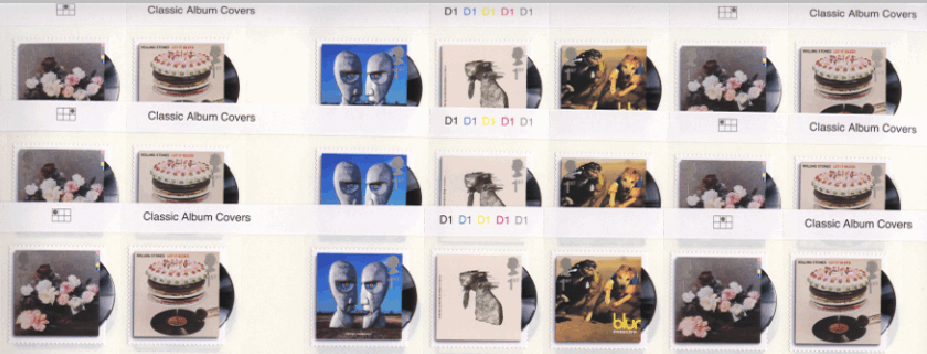
This is how some dealers are able to sell gutter pairs, although when the gutter is vertical between two different sets of 5 stamps, that makes for a long gutter strip! This is a view of part of three double-sheets:


It isn't easy to see in this but the grid positions are:

Upper sheet: position 2 - position 3
Middle sheet: position 3 - position 1
Lower sheet: position 1 - position 2

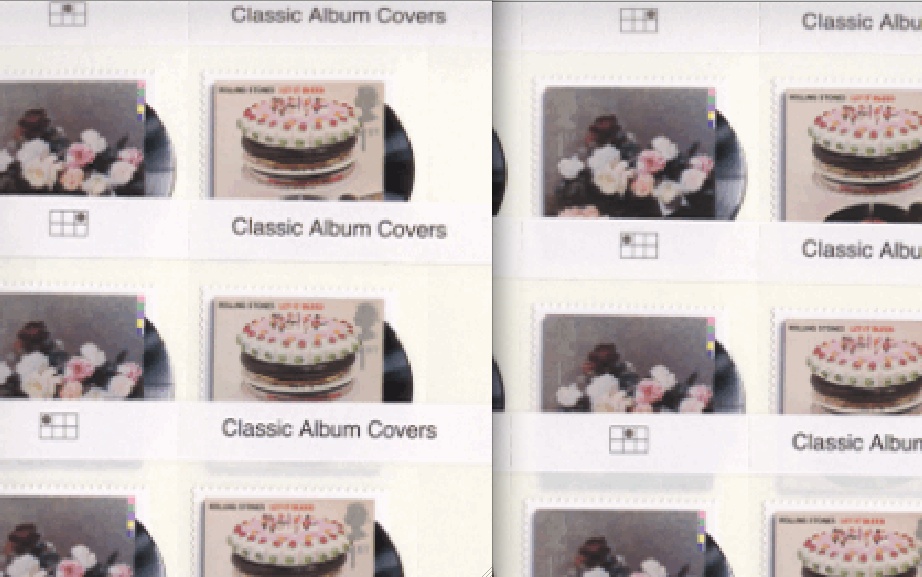
You can see it more clearly here:


Now, if the panes are printed in three positions horizontally, one would expect that one pane (say position 1) would be guillotined off for counter sheets, leaving the other two for philatelic distribution. As the print run would produce more double-panes than would be necessary for philatelic distribution, a large number of the pairs of panes 2+pane 3 would also be guillotined for distribution to post offices.

So why have we got all three possible combinations? We have -

Pane 1 + pane 2 (lowest)
Pane 2 + pane 3 (uppermost in this picture), and
Pane 3 + pane 1 (centre).

Is the cylinder circumference in fact 6 panes round, with positions 1, 2 & 3 duplicated?
Does the grid mean anything at all?
Should we revisit previous grid markings - including for definitive and country stamps - to review what they mean?

Please leave your suggestions as comments!


In the absence of comments I'll suggest a fourth possibility - in fact more like a probability:
There are three panes to a cylinder with a gutter between each, but they are cut into sheets of 2 panes - 1+2, 3+1, 2+3, 1+2 ... etc.


Wednesday, 13 January 2010

Whose shop did Royal Mail use for their Album Covers souvenir?

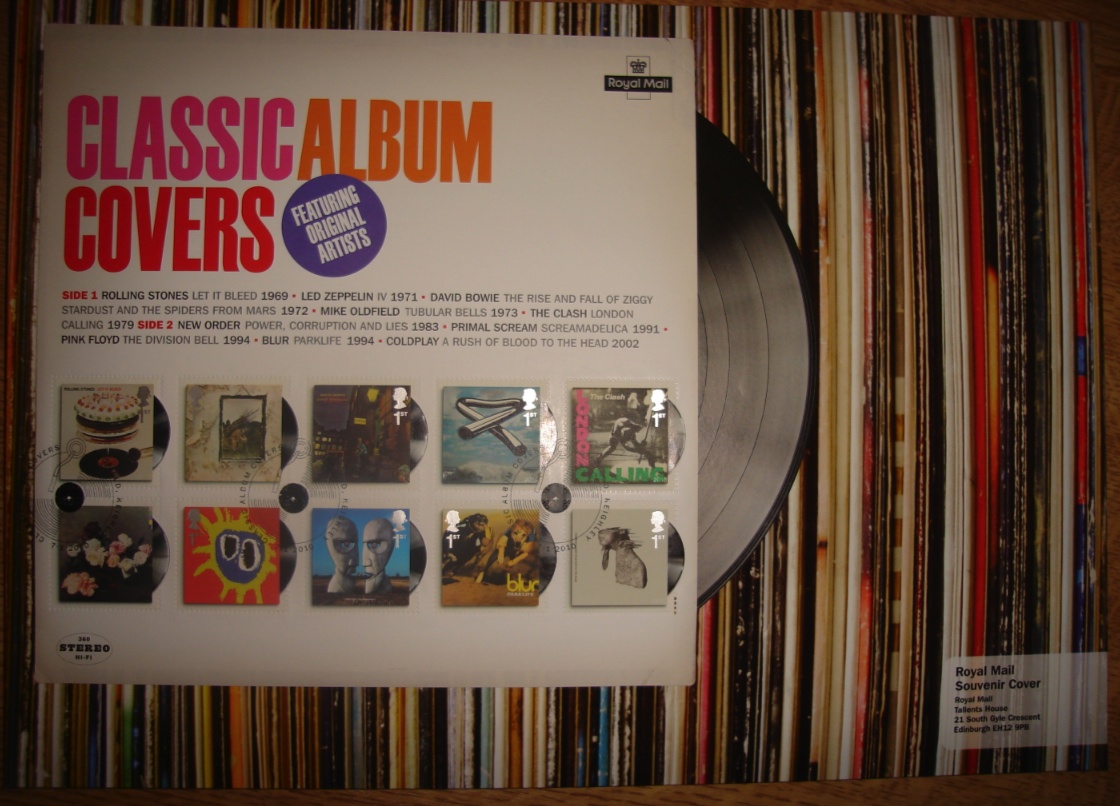
People who have bought Royal Mail's Classic Album Covers Souvenir Cover will probably agree that it is quite impressive - many buyers will be framing it for display.


But what about the insert? Informative and colourful, with the iconic Marilyn Monroe poster in the shop window, but where is the shop?

I don't suppose Royal Mail even know, as they use design agencies for this sort of thing. But the Norvic Sleuths have tracked it down to south London.

The shop, COLLECTIONS, is in Lewisham, at 70 Lee High Road.


Despite appearances on Google StreetView, the shop is still open for business (click on the name above the picture for their website) - and, no, they didn't know of their fame either!
(Update June 2014, the website is no longer working and from the new street-view picture above, the name has changed.)

Thursday, 7 January 2010

Album Covers stamps - interview and video at The Independent

Today the first set of stamps for 2010 is issued, the Classic Album Covers, and the London newspaper The Independent has a story complete with video.

The video includes interviews with Julietta Edgar, head of special stamps at Royal Mail, music journalist Anthony Barnes, and Rob O'Connor Creative Director of the Parklife album sleeve, together with film of the stamps being printed.

Click here to read the story and see the video.

Wednesday, 23 December 2009

Happy New Font! 2010 PSB brings major change to Machins

In the middle of November I had an email from Chris in Australia about the Classic Album Covers PSB. He pointed out that the publicity photo in the Philatelic Bulletin showed the 54p value with rather different figures of value to those we are used to. The way he put it:

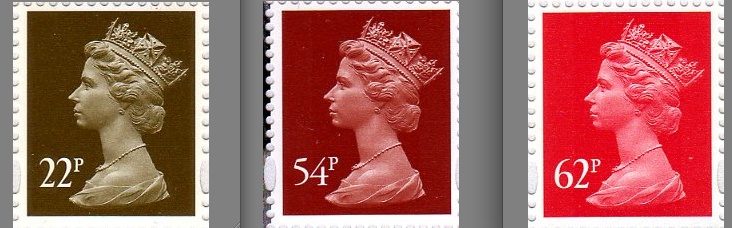
"It appears to be Garamond (or similar) and not Jeffrey Matthews font - the gap at the top of the 4 is very noticeable. I agree this is probably another Royal Mail concoction, just like the panes on your website which have no elliptical perfs, but it is odd that the others seem to use the correct font."


It is not uncommon for Royal Mail to produce pre-issue publicity pictures which vary from the actual stamps - see the publicity image here. The 54p seems quite normal in that picture.

However, today I received the first batch of PSBs (yes, only 2 weeks before the stamps are issued and far fewer working days!) And they are so surprising that I had to take time out from preparing for Christmas to reveal the true position:


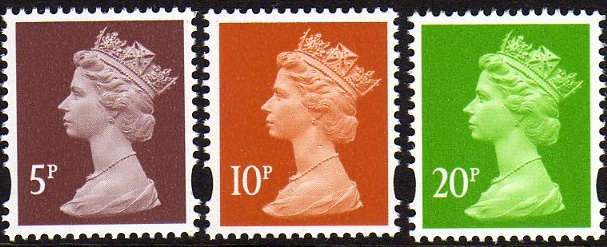
Not only is the 54p with a new font, but the 5p is totally different to the regular sheet stamp. In fact, all the stamps are different, with the 62p being the closest to the De La Rue sheet stamp:


From Album Covers Pane 1


Normal De La Rue Machins from counter sheets:


From Album Covers Pane 4


So, Chris, you were right after all! And another thing I can confirm, the Album Covers special stamps on panes 2 & 3 are NOT self-adhesive but ordinarily gummed. The phosphor block, as on the Souvenir Sheet extends to the perforations, whereas on the self-adhesive sheet stamps the phosphor is only on the album cover.


This is the last blog post before we break for Christmas.

We would like to wish all our customers and other readers

Season's Greetings and all the best for 2010 !!

Friday, 11 December 2009

Now, the 2nd class Machin with 4 security slits.

Following our report of the 1st class Machin stamp appearing in kiloware with four security slits we have now been sent an image of the 2nd and 1st with four slits.


These are soaked off and have machine wavy-line postmarks so
(a) we don't know where they were posted, and
(b) they have been through mechanised sorting unlike most of the other odd-ball security Machins which have packet handstamps.
Both these and the previous 1st class (shown again below) have very flat 'tops' to the perforations, similar to, but possibly flatter than, the Walsall stamps in mixed booklets, and are probably from business sheets. But their real origin remains a matter of speculation.


We still await any reports of these found unused.

Monday, 7 December 2009

Holiday time brings charity appeals - check them for coils!

Although charities send appeal letters and newsletters to their supporters throughout the year, Christmas is an especially productive time as we are all feeling generous and more likely to respond positively - at least that's the idea.

I had an appeal letter from MND Association, Box 45 Diss. It's one of those that uses imitation handwriting for the address and the return address. More crucially for me - and for you - is that the mailing house that sent this out used a 2nd class coil stamp with security features. Yes, an MRIL!

This is the first time I have seen one used, and it comes with the usual laser-print four wavy lines and no date stamp. Check your mail more carefully over the next few weeks - there may be some surprises! Let me know what you find!

Friday, 4 December 2009

Security Machins with 4 security slits - trial, error, or forgery?

Kiloware can be fascinating if you have time for it.
The MRIL coil stamps were found on business correspondence, though it could just as easily have been in kiloware if the recipient hadn't been alert. The 1st class gold reported earlier with no security overlay were found in kiloware, with a Devon and Exeter postmark, and now we've been shown this picture of the 1st class gold with four security slits. - the right-hand stamp on the top row. (Click on the image to see a bigger version.)


This, like the earlier 1st class with no overlay, came from a packet which was manually sorted. But we've also been shown both 1st and 2nd class with four slits, with wavy line postmarks indicating that they had been processed by the normal sorting machinery.

All these have been found by a dealer in Asia. The no-overlay was postmarked Devon and Exeter and the 4-slits is postmarked Plymouth, which is in Devon. Machin specialists are rightly sceptical and suspicious and mint examples bought over the PO counter or from Royal Mail Direct are eagerly awaited!