Friday, 9 October 2009

Royal Navy shifts left - single centre, and wide bands in PSB

A collector in Canada reports having received one of the Royal Navy Uniforms prestige stamp books with the phosphor on the Machin pane shifted to the left by 4-5mm.

The result is:

Right column: 1 single 'centre' band on 17p & 90p stamps

Centre column: wide band on 1p stamps, and on Crown label

Left column: wide 'centre' band on 17p stamps, single 'centre' band on 90p stamp.

Narrow phosphor band on left edge of stamps, to the right of the rouletting.

Four new stamps in total:

1p wide
17p narrow
17p wide
90p narrow

Glasgow goes back in time for Post and Go

When Post & Go machines break down, as - it seems - they quite often do, the software sometimes defaults to an original date, just as it sometimes does with yur digital camera, or PC.

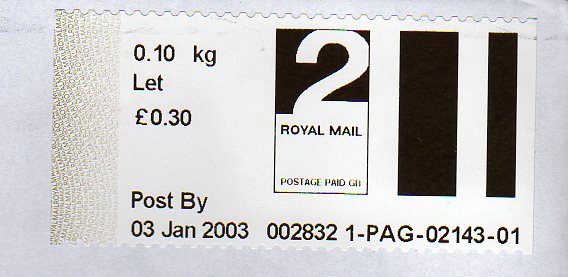
On 1 October 2009 Glasgow machine 1 was dispensing labels which required the items to be posted a little earlier:


Thanks to Alan for this example - which arrived the day after his letter telling me that it was coming, and enclosing the machine's receipt!

Thursday, 8 October 2009

New 12 x 1st Machin book has reset cover


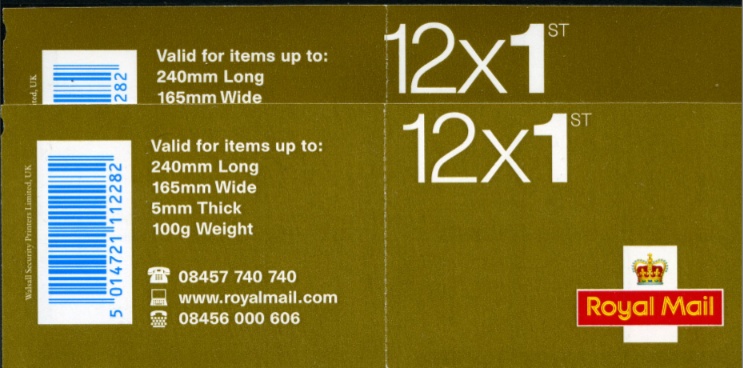
Thanks to Richard P for pictures of a new setting of the cover of the 1st class booklet of 12.

At first it looks as if the printing has shifted to the left, the figure 1 being cut by the fold. But a measurement of the gap between the upright of the 1 and the edge of the colon (to:) on the back reveals a reduction of about 6mm. (I don't have the actual booklets but an onscreen measurement reveals a reduction of about 37%.)

I'm told these books come from a new printing from cylinder W5 and are available in post offices now.

Wednesday, 7 October 2009

Recorded NVIs coming on 17 November

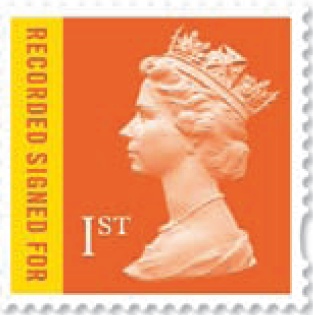
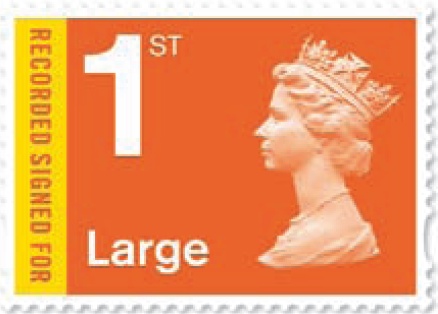
Royal Mail has announced the issue of two new Machin definitives on 17 November. The new NVIs combine the Recorded Delivery Fee and the 1st class / 1st class Large Letter 100gr fees.


We now have the images, and I admit to being a little disappointed. Whilst the stamps keep the 'house' colour scheme of the Recorded Signed For service, I expected that they would be 'flame' on a white background, similar to the airmail NVIs.

When we first heard about the possibility of combined 'postage and premium service' stamps we assumed it was because there was a need expressed by small/medium businesses who would normally use Business Sheets. However a Post Office Ltd spokesperson said that their introduction was because of 'an operational need at Post Office counters' and that they would be issued 'in normal counter sheets only'.

It is to be expected that the sheet format will be the same as other definitives, but whether self-adhesive or ordinary we don't know, nor therefore whether they will have security features!

We now know that these will be self-adhesive with security features. The basic stamp is 24mm square, making it 4mm wider than the ordinary definitive.

Royal Mail will provide definitive First Day Covers in the usual way. Product codes are as follows:


Recorded 1st class £1.14 DS114
Recorded 1st Large £1.36 DS136
FDC Tallents House
or Windsor £3.34 DF053


This is an interesting development. Currently all letters up to 100gr have to be stamped with adhesives, and Horizon Labels cannot be produced. But under 100gr items sent by Recorded Delivery can be sent with a Horizon Label.

However, as the address has to be entered into the system to provide the certificate of postage, and then the weight and so on, to produce the label, all this takes longer than just adding a stamp. Could it be that somebody has discovered the disadvantage - in a busy office - of the Horizon system?

Will the next step be a Special Delivery Machin? Probably not: what we are more likely to see - once all our posties get personal data assistants to scan bar-coded mail - is a Machin Horizon Label with a unique bar-code which will save the production and use of separate Special Delivery bar-code stationery. Or have you a better idea? Let me know, or comment in the space below. Watch this space for developments.

Tuesday, 6 October 2009

United Kingdom Postcodes are 50 years old.

Yes, postcodes in their present form came were introduced in the UK 50 years ago this week.
This is what Royal Mail's Press Release - issued in the last few days of 2008 - had to say about this milestone:


50 years on - 1.7 million postcodes continue to deliver across the UK -
30/12/2008

We all have one and undoubtedly take it for granted, but 50 years on since it 
was first introduced, the postcode is still an invaluable tool for Royal Mail 
and many other industries.

In 1959 the first postcodes were introduced in Norwich with the first half of 
the postcode NOR representing the city name, and the last three characters each 
individual street. During the 1960s postcodes were rolled out to all addresses 
across the UK.

The use of the postcode has developed and it is now much more than a delivery 
tool for Royal Mail, forming the backbone of many services such as online 
shopping and satellite navigation systems.

The very first steps toward the modern day postcode were taken in 1857 when, 
faced with London’s ever-burgeoning population, Sir Rowland Hill, inventor of 
the postage stamp, introduced a scheme to accelerate mail delivery. This divided 
the capital into 10 separate postal districts - N, S, E, W, NE, NW, SE, SW, EC 
and WC. The public were then asked to add these district letters to the bottom 
of addresses.

There are now in excess of 1.7 million postcodes across the UK, covering 27 
million addresses. Postcoded letters can be read by Royal Mail’s machinery and 
sorted 20 times faster than by hand. However millions of people still forget to 
put the postcode on letters and cards with almost 20% of non-business letters, 
cards and packets not bearing a full or accurate postcode.

Giles Finnemore, Head of Marketing at Royal Mail’s Address Management team, 
said: "Although the postcode is celebrating its 50th birthday in 2009 it’s still 
as important today as it ever was to help Royal Mail sort and deliver mail 
quickly and efficiently. Our postcode system now lies at the heart of many forms 
of modern technology, such satnav systems, online mapping and route planners and 
of course online shopping."

Did you know?
• Royal Mail’s online postcode checker gets around 4.5 million hits per month - 
equivalent to 55 million checks per year

• Santa Claus has his own special postcode - SAN TA1 - and gets 750,000 letters 
every year to his North Pole address

• Some famous addresses have their own postcode - Albert Square in Eastenders 
(E20), Coronation Street (M10) and Ambridge, home to the Archers (AM1)


So how did they decide to mark the anniversary - special miniature sheet? Smilers Sheet? No, all was deadly quiet until last Friday when a small entry in their Postmark Bulletin announced that letter cancelling machinery would have a commemorative postmark for a few days.

INK-JET SLOGAN POSTMARKS
An ink-jet slogan marking the 50th anniversary of the introduction of postcodes at Norwich on 8 October 1959 will be used 6-12 October at mail centres applying ink-jet postmarks. A bilingual version is intended for use at mail centres processing mail posted in Wales.

In addition, metal slogan dies are expected to be used at Norwich Mail Centre, 5-18 October. Eight dies are being sent to Norwich
- Code It Keep It/Prevent Crime;
- Get The Most From Your Post/Code It;
- Help Us Push Postcodes;
- Pass On Your Postcode;
- Prevent Crime/Postcode Valuables;
- Remember to Use The Postcode;
- Be Properly Addressed/Postcode it; and
- Sealed & Postcoded Correctly Addressed/Mechanisation/Will Do The Rest.

Six of these eight dies are expected to be used in the three CFCs (Culler Facer Cancellers); dependent on operational requirements.

This announcement is for information only. Collectors are reminded that Royal Mail no longer offers a reposting service for slogan postmarks. An article on the 50th anniversary of postcodes is published in the October issue of the British Philatelic Bulletin.


Look out for all 8 - and the more widespread ink-jet slogans from the IMP machines, including the bi-lingual ones from Wales. Send us your images to show here, please!

UPDATE
Images of all the postmarks so far seen are in a new message here.

Friday, 2 October 2009

GB 2010 stamp programme updated

The Great Britain programme for 2010 has been revised from the outline announced in February:

7 January - British Design Classics II - this will NOT be similar to the 2009 issue as previously thought

2 February - Girl Guide Centenary

25 February - 350th Anniversary of the Royal Society

1 March - Castles of Wales generic Smilers Sheet (last in series)

11 March - 150th anniv Battersea Dogs & Cats Home

23 March - Kings & Queens: House of Stewart

13 April - Endangered Mammals

6 May - Accession of King George V (London 2010 issue)

8 May - The King's Stamps (ditto - 1st day of London Festival of Stamps)

13 May - Britain Alone (commemoration of events of 1940)

15 June - Children's Books

-- July? - Olympics & Paralympics II

19 August - Stage Musicals

16 September - Great British Railways

12 October - Kings & Queens: House of Stuart

2 November - Christmas
-----------------------------

Some of these are sets, some are miniature sheets, some have prestige stamp books, some will have generic Smiers Sheets. There will also be retail booklets advertising London 2010 (March) and the Olympics (January & February).

More details and images in this thread as embargo dates are passed, and here on the blog

Tuesday, 29 September 2009

Security Machins - test version or missing colour?

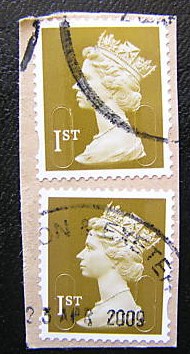
This item was spotted on eBay recently, the 1st class gold with slits but no Royal Mail security overprint. With a postmark of 23 April 2009 it could have come from ordinary counter sheets (issued 17 February) or the early Business Sheets (issued 31 March).

The pair, which sold for £21 on 16 September, was described as:

The error is a completely missing iridescent overprint covering the whole stamp, this overprint is the Royal Mail in wavy lines which has been completely omitted from these stamps.


It's been suggested by somebody who has found some more, that these are "most likely from the DLR coil tests. There are some oddities but given the post mark date 23rd April 2009 they are from tests run by Royal Mail and have slipped through the system.".

Enquiries continue.

Mary Quant's going grey ! Black colour fade on Design Classic book 4.

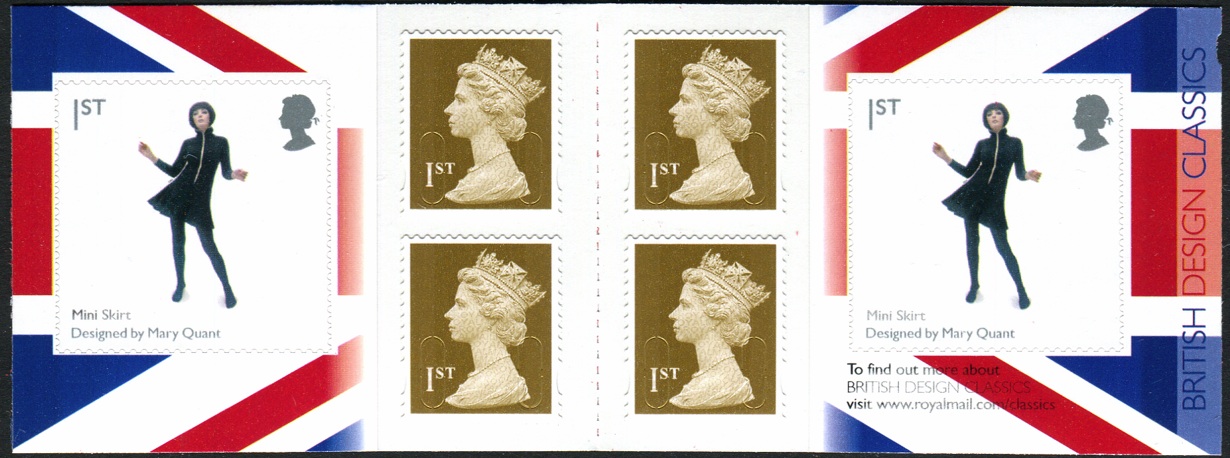
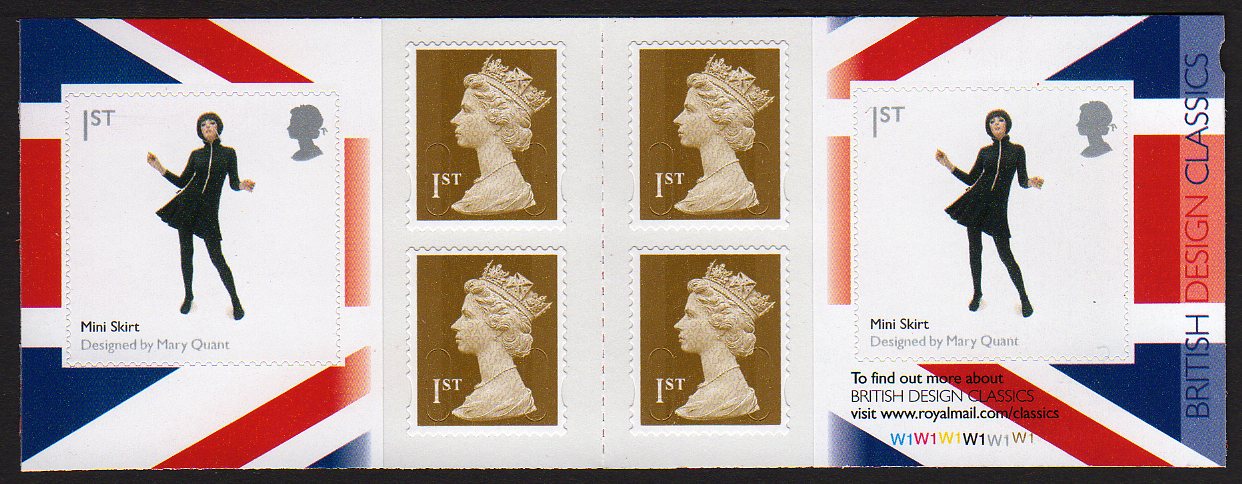
Two collectors have reported a very grey print of the black on the Design Classics Booklet 4, featuring the mini-skirt. One report is from the UK and the other from Australia, neither has the cylinder booklet, though from the cylinders used that would only show that the black was light or dry, rather than missing.

Remember the words 'Designed by Mary Quant' are silver so not affected by this fault. These two scans were not done at the same time, but the outcome is clear enough. Check yours, and let us know if you have any similar - or worse! And if you have a cylinder booklet it would be good to see a picture of that as well.

Error


Normal


Saturday, 12 September 2009

Adieu Camden High Street! Can we get lower than this?

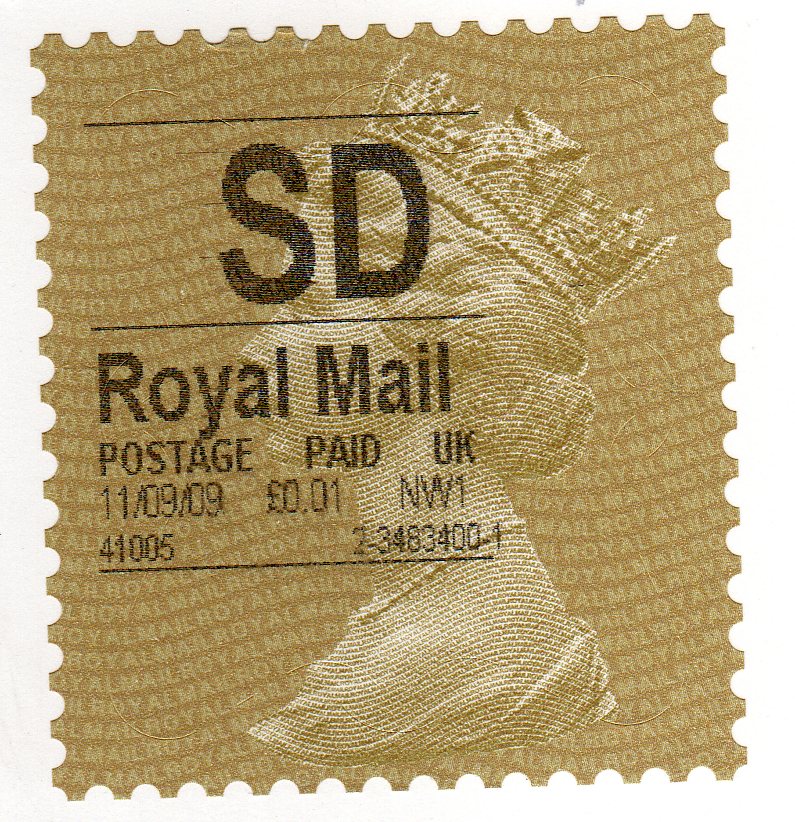
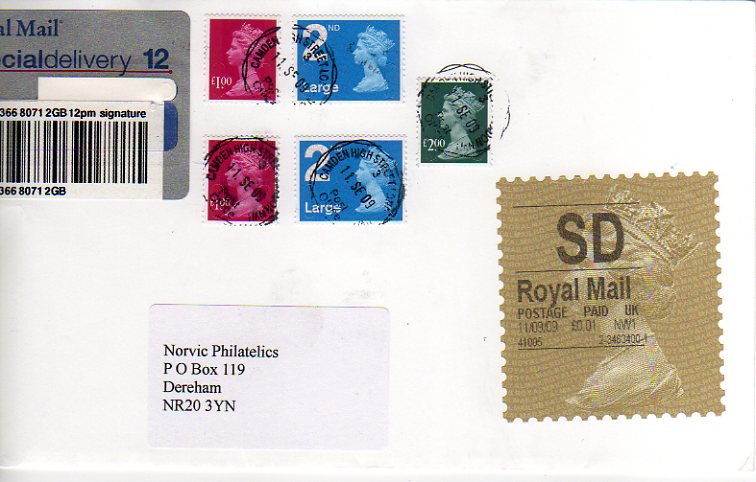
As the trial of Machin Head Horizon labels came to an end (yesterday) we decided to get a cover with the lowest possible value, by pre-stamping the cover with £4.94-worth of Machin adhesives, thus producing the £0.01 label.


Thursday, 10 September 2009

Spectacular perforation error on Lord Mayor's Pane!!

Previously we have reported many errors in Prestige Books involving duplicate panes, most notably on the 2007 Machin Anniversary book, which exists with each of the panes duplicated in different books.

But now for something completely different. A collector in Hampshire bought the Treasures of the Archive PSB to prepare his own FDCs and found to his amazement that the Lord Mayor's pane of 4 x 20p stamps - the lowest value pane in the book - was doubly perforated! The effect of the mis-perf is that the vertical perforations are continuous and the stamps are only held in place by the horizontal teeth.

It's well known that these are printed in larger press-sheets (of 12-18, we think) so as usual, we'd be interested to know of any others that have been found, so that the finder has some idea of the scarcity of the error.