Tuesday, 9 April 2024

Centenary of First UK Commemorative Stamp - 16 April 2024

So-called 'Stamp on Stamp' designs are always popular and Royal Mail have even managed to include a 'Stamp on Stamp on Stamp' in this set of 10 x 1st class stamps.  However, by including three representative stamps from a decade, they have rather crammed the designs - some of which were arguably already too small to be on a stamp originally.

Royal Mail's write-up

In 1924 stamps were proposed to commemorate this British Empire Exhibition, to be held at Wembley Park in London. King George V was a keen stamp collector but he was somewhat unsure about the idea of a commemorative stamp issue, however, despite his initial reluctance several artists were invited to submit designs, and the first British commemorative set, with designs by Harold Nelson, was issued on 23 April 1924, the first day of the exhibition. 

In the early days, there were few commemorative issues. King George V got a commemorative stamp set for his Silver Jubilee in 1935. Numbers of commemoratives remained low in the 1950s, with only five issues. These were produced to mark some of the major events of the decade, most notably the Festival of Britain.
The 1960s saw a marked change in stamp production and a period of great expansion in designs and approaches especially following the reforms to Commemorative Stamp issues initiated in 1964. 

Commemorative stamps are more than just a way of marking events and anniversaries or celebrating achievements -and certainly more than simply a means of postage. They are works of art in miniature. Often starting out as artworks in more traditional sizes, their designs must work when scaled down to something the size of. ... well, a postage stamp! Over the years, some incredible designers and artists have contributed their work, including Quentin Blake, David Hockney, Paula Rego and Yinka Shonibare.  

As commemorative stamps celebrate their 100 years, what better way to mark the anniversary than with a stamp issue about stamp issues!

Set of 10 x 1st class stamps marking the Centenary of the first UK Commemorative Stamp -
click on the image to see a larger version

For the record the designs of the 10 x 1st class (£1.35) stamps show the following stamps:

1920-30's  -  British Empire Exhibition, Postal Union, Congress, Silver Jubilee

1940s - Royal Silver Wedding, Centenary of First Adhesive Postage Stamps, Peace and Reconstruction

1950s - Tercentenary of ‘General Letter Office’, Coronation of Queen Elizabeth II, Festival of Britain

1960s - Landscapes, Investiture of HRH The Prince of Wales, National Nature Week

1970s - Philympia 70 Stamp Exhibition, British Wildlife, British Achievement in Chemistry

1980s - Flowers, Halley’s Comet, Transport and Communications

1990s - Robert Burns: The Immortal Memory, Millennium, Architects of the Air

2000s - The Weather, Lest We Forget, Sounds of Britain

2010s - Landmark Buildings, Jane Austen, Queen

2020s - Platinum Jubilee, Brilliant Bugs, Windrush:75 Years

Technical details

The 41 x 30 mm stamps were designed by hat-trick design and are printed in two sheets of 50 (se-tenant strips of 5) in lithography by Cartor Security Printers on paper with conventional gum.

All images © Royal Mail Group Ltd 2024, except Royal Silver Wedding, 1948, photo by Dorothy Wilding, courtesy of Royal Collection Trust; Investiture of The Prince of Wales, 1969, photo by Godfrey Argent© Camera Press London; Lest We Forget, 2007, Battle of the Somme, photo© IWM Q 70167, and Untitled-06WT, 2002 (Orange Poppy). photo© Chad Kleitsch; Landmark Buildings, 2017, SEC Armadillo, Glasgow, 'SEC ARMADILLO' is a registered trademark of Scottish Event Campus Limited; Queen, 2020, Queen II album cover© Queen Productions Limited, under license from Bravado International Group; Platinum Jubilee, 2022, Her Majesty The Queen during a visit to the headquarters of Ml5, London, February 2020 © Victoria Jones/POOL/AFP/Getty Images.

Products available

Set of 10 stamps, presentation pack, first day cover, stamp cards, collectors sheet, framed set and framed collectors sheet.

Collectors Sheet

As usual the collectors sheet is printed on self-adhesive paper so producing 10 stamps totally different to the ones sold in sheets. On the labels, relevant day of issue postmarks are shown.  This is not expensive at £14.70 (£13.50 face) but not necessary either.

Collectors Sheet of 10 x self-adhesive 1st class stamps
marking the Centenary of the first UK Commemorative Stamp

The next issue will be 'Peppa Pig' issued on 16 May with details available from 2 May.


Sunday, 7 April 2024

Another aspect of Postal Stationery

Last week I showed some less common Machin Postal Stationery in the form of Postnotes. The more common forms included 

● postcards
● reply-paid postcards
● letter-cards
● envelopes of various sizes
● registered envelopes of various sizes 

... in addition to the previously mentioned Air Letters of Aerogrammes.

Those were issued by the (General) Post Office and sold at many branches.  But from 1855 companies and individuals could also have envelopes and paper 'Stamped To Order' (or STO).  The last place this was done was by Her Majesty's Stationery Office printing works at Harrow, until 1973.

This could be done using the same dies as were used for the Post Office official issues, but other values were also available, primarily for companies with large volumes of correspondence with Europe, and for overseas Registered Mail.

Here's an inland use example of a King George 3d violet embossed envelope (a value not used on official products), with additional adhesives used in 1921 (27 June).  At the time the inland postage rate was 2d for 2 ounces and 2d for 4 ounces, but it is unlikely that envelopes like this were prepared for 4 ounce (110 gramme) contents.  

3d Stamped to Order envelope with adhesives stamps for 2d paying additional postage for an inland registered letter.

3d was cost of a letter to 1 ounce foreign (non-empire) letter from 13 June 1921, so it is likely that this was the primary reason these were ordered.  But 3d was also the inland or international registration fee and having such envelopes prepared would permit their use inland - with the addition of 2d-worth of adhesives for postage as shown here. 

Stamped to Order stationery was also used for Certificates of Posting (when the cost was 1d per item).  These seem to have been introduced during 1970-71 so likely all philatelic creations.  I have seen several examples with very clear counter date stamps, particularly skeletons or from Mobile Post Offices.

They were also used by dealers and philatelic organisations in this country and abroad.  Before the end of the system in 1973 HMSO dealt with orders for the bulk uprating of aerogrammes with the necessary new values due to increased postage rates.  These were probably used on First Flights, covers from which were much more popular in Germany than here.

I have one example of a Stamped to Order inland Souvenir Letter Sheet produced by the Association of Essex Philatelic Societies.  The AEPS had been using the STO service for postcard souvenirs from the conventions in 1952, with the 1½d King George VI stamp printed in green. Mint covers were sold at 3d
each, cards at 4d. 

The 1973 Stamp Day saw the first appearance of a the pictorial Letter Sheet. 1st class sheets had 1p + 2p dies, 2nd class had ½p + 2p dies in the same colours as the adhesive stamps.  In second printings the dies were transposed on the 1st class sheets while the 2nd class had 1½p + 1p dies. 

By the time of the Autumn Rally, postal rates had risen to 3½p first class, 3p second class. A number
of the 1½p + 1p sheets were uprated by the stamping of an additional 1p to the left of the original stamps, as shown here, the only one I have seen.

AEPS Autumn Rally 1973 Letter Sheet with additional 1p die uprating the original 1½p + 1p dies due to the increased postal rate.


As I mentioned with the Postnotes and Aerogrammes, a small collection of these as an adjunct to a main Machin collection will always be interesting.  In the case of these examples, especially commercially used STOs, the range of values and uses over the years can be a good subject for research. 

As with the King George V example shown above, some Machin values exist only as STO, for example 6d, 9d and 1s in the pre-decimal range.  Many examples are not costly, mint (though not often seen) but are very scarce in used condition.


Wednesday, 3 April 2024

Still with Machins: add something different to your collection?

The Machin portrait used on the definitive stamps from 1964 was also used on postal stationery including Envelopes, Postcards, Letter Cards, and Air Letters or Aerogrammes.

Whilst some products continued into the 21st century, Letter Cards were discontinued in 1982 and were replaced by Postnotes.  These were in a similar format to Air Letters but are printed on cream laid paper with text in shades of brown, and two phosphor bands (which are visible in this picture). They were valid up to 60g (although now they would be valid up to 100g).  

I don't know the selling price but the postage rate at the time was 15½p, which rose to 16p in April.

Address panel of basic Postnote

The unfolded size is A4, 210 x 297 mm (excluding the flaps)

1. Unfolded Postnote with text* - a 'Royal Mail' product

I don't know whether Postnotes were sold singly, but they were definitely sold in packs of 5.  

2. Pack of 5 Postnotes - front 1982

 
Pack of 5 Postnotes - back 1982

A well-known variation to the Postnotes were those sold in a promotion with the Milk Marketing Board (MMB).   There's an article about them here.  Buying fresh cream in pots would enable you to buy a pack of 7 special Postnotes for 84p (12p each) if you sent in two cleaned foil tops!

Unfolded Dairy Postnote with inscription at foot Post notes: a 'Royal Mail' product

 
The four different 'Dairy' designs on Postnotes - Strawberries, Church, Farm, Milk Churn (my identification names).

 
3. Dairy Postnotes pack of 7 - 2 each of 3 designs plus one other, 1983.

Dairy Postnotes pack of 7 with small Fresh Cream Recipe Book and Film Processing envelope.

The Welsh aspect

There were three other variants of the Postnotes, all apparently available from some Post Offices in Wales. Two showed buildings in Cardiff - Cardiff Castle and City Hall - while the third promoted the Llangollen International Music Eisteddfod.  The exact status of these is uncertain.

4. Postnote promotoing the Llangollen International Music Eisteddfod. The internal inscription on this one is Postnotes: a 'Royal Mail' Product with Postnotes all one word, and Product capitalised.

For Sale

1. Single original Postnote - £2.00

2. Pack of 5 original Postnotes (opened) - £9.00

3. Pack of 7 Dairy Postnotes (opened but with additions) - £25.00

3a. Single Dairy Postnote. These designs only: Strawberries, Church and Farm - £3.50 each

3b. Dairy Postnote (Farm) with BPF 68th Congress Norwich 1986 (see below) - £1.50

4. Eisteddfod Postnote - £5.00

3b Dairy 'Farm' Postnote with 1986 British Philatelic Federation 68th Congress Norwich postmark.
 

UPDATE 4 August 2025.   I found some more Postnotes including this one given away by the magazine Woman's Realm by which the price was 21p (or £1 for a pack of 5).  [Corrected typo; thanks M&M]


Postnote given away by the magazine Woman's Realm - date uncertain.

UPDATE 9 September 2025

Thanks to JW for sending this example of a Postnote properly used in 1999, sent to Edinburgh's best stamp shop, Robert Murray.


I wrote earlier that the Postnotes were based on Air Letters or Aerogrammes.  These were printed on light-weight blue paper in various shades.

Example of 5p Air Letter illustrated with the VC-10 Jet Airliner
The Air Letter had been introduced into the Iraqi postal service in 1933 by the then Inspector General of Posts and Telegraphs, Major Douglas William Gumbley CBE DSO Royal Engineers. The original form, on thin paper sized 124 mm x 99 mm, greyish in colour, with bluelined framing and with the designation legend on the front. It had an embossed effigy of Faisal I of Iraq and was printed by Bradbury Wilkinson.

Lieutenant Colonel R. E. Evans, Royal Engineers, Assistant Director Army Postal Service Middle East Force (MEF), proposed that a lightweight self-sealing letter card that weighed only 1/10 oz (2.8 g) be adopted by the British Army for air mail.  

The private nature of the air letter ensured its popularity among its users and that popularity, with its lightness, brought about its continued use as the civilian air letter (aerogramme). The aerogramme cost 6d to send anywhere in the world from 1943 to 1966, increasing to 9d until 1971.  (Wikipedia)

Normal aerogrammes sold by the Post Office were prepaid postal stationery, but private forms (approved by the PO) with postage paid by adhesive stamps were acceptable. No enclosures were permitted in either.

1948 Olympic Games 6d stamp imprint on Air Letter

The King George VI issues used a 6d purple printed stamp and the 6d Olympic Games stamp in 1948. The first of the new reign used the design of the 2½d Coronation stamp revalued six pence in deep red in 1953. The first definitive design showed the Houses of Parliament and was issued in 1954. Various other imprinted stamps were used, including Christmas, and the long-running VC-10 stamp shown above spanned the conversion to decimalisation, being issued in 9d, 4p, 5p, 6p, 8½p and 10½p values until 1974. 

The Machin head was introduced in 1972 as a 6½p value.  NVI 'stamps' were introduced in 1989.  The last Air Letter was issued in 2007 but they remain valid for postage. By themselves as Air Letters they would need additional stamps, but the NVI ones remain valid at the current international airmail rate of £2.20.  

There is no Air Letter service now: I asked in my post office what would happen if inserts, such as extra pages or a postcard, were included and I was told that the NVI (= £2.20) Air Letters would be valid up to 100g.

Small-format Air Letters as the VC-10 are 150 x 316 mm (excluding flaps), but the 1972 Machin design was the first in 'A4' size, 209 x 294-8 mm.  The final cost in 2011 was 85p according to the Great Britain Philatelic Society website.

1972 6½p value A4 aerogramme

1993 50th Anniversary NVI Postage Paid aerogramme.


The postal stationery catalogue Collect British Postal Stationery records 150 different special issues including this pictorial one issued in 1979 for the Golf Open Championship.

1979 Golf Open Championship aerogramme partly captioned in Gaelic.


I have a number of Air Letters/Aerogrammes for sale, NVIs at less than the new (October '25) postage rate of £2.50 £3.40!   Please ask for details or let me know which ones you are interested in.


Tuesday, 2 April 2024

Revenue Protection - it's a joke!

UK readers will be familiar with recent 'uproar' in the popular press (and on the much-watched GBNews) about Royal Mail surcharging recipients of letters £5 declaring that the stamps are counterfeit.

It seems that some writers whose stamps have been surcharged on arrival to the addressee are alleging that the stamps they used came from the Royal Mail Swap Out scheme.

Certainly with the number of forged stamps that we and others have reported there have certainly been plenty sold to unsuspecting customers who would - understandably - like to spend less than the £1.25/75p that the stamps cost until today.

Genuine, left, and forged 1st class datamatrix Machin definitive stamp.


It is understandable that Royal Mail would want to surcharge invalidated stamps - plenty of notice has been given after all.

Pre-barcode, possibly counterfeit, 1st class stamp used after invalidation.

But where were Revenue Protection when this letter was posted to Canada (and cancelled there on arrival)?


In terms of total value, the correct postage is paid - £2.20.  But only 10p went to Royal Mail, the rest went to the Tristan da Cunha Post Office.  And not only were the stamps not cancelled at the mail centre, but nobody noticed that they were not British.  

No monarch's head (the cypher instead) is a big clue - but apart from that and the name of the country, they could easily have been issued by Royal Mail.  Very many of our wildlife stamps have been photographic.  

'Sea Life of the British Coast' issue 2007.

But it comes as no consolation to those who have been surcharged for stamps wrongly identified as 'counterfeit' that sometimes invalid stamps are let through without any action.

It seems that nothing has changed since we first reported an occurrence of this type four years ago, with stamps from St Helena, Jersey and the Falklands being cancelled at the post office counter, and Isle of Man stamps being cancelled at Peterborough Mail Centre.

UPDATE 3 April 2024

According to a report in the Daily Telegraph 

"Royal Mail is investigating problems with new barcoded stamps amid fears customers are wrongly being fined to receive letters.  

"Postmasters have said that the allegedly fake stamps were bought from Royal Mail directly, prompting fears that they are wrongly being identified as counterfeit. 

Following a meeting on Tuesday between the Post Office minister Kevin Hollinrake and Royal Mail chief executive Martin Seidenberg, the postal service committed to investigating the issue.

The Telegraph understands that a formal investigation has not been launched, but that Royal Mail has assured the minister it is working with retailers including the Post Office to identify the “source of the problem”.

Mr Hollinrake said: “We spoke to Royal Mail and they are investigating and they are working alongside the Post Office and other retailers to try and ascertain the source of the problem.”

Last week, Royal Mail insisted its processes are “secure” and that it uses “specialist equipment” to assess whether a stamp is genuine. Most stamps are verified using the service’s scanning devices at sorting offices nationwide.

The Post Office said any allegation that fake stamps were bought at one of its branches was “extremely serious” as it implied that a postmaster or member of staff had swapped genuine Royal Mail stamps with counterfeits."


Postage Value of Older Stamps including Post and Go - 2024 version.

This post brings previous tables up to date with the postage rates effective from 2 April 2024.

The tables are included primarily to explain the stamps used on cover, because they show that, for example, a stamp originally issued as a 30p Europe 20g stamp would later be valid for 100g and with a value of £1 in 2015 and £2.20 in 2023!

Remember that the International Rate stamps were all valid at the rates shown for inland postage, just as the 2nd, 1st, Large, Signed For, and Special Delivery stamps were all valid for inland services in addition to those shown and on international mail.

Now, of course, the old Machin and Country definitives without barcodes are no longer valid but the Post and Go stamps are as are the commemorative stamps, so the tables are still relevant for new use as well as for for Postal History purposes.

The E stamp was issued from January 1999-2004, and paid the Europe 20g rate.  This was 30p when issued and the cost but also the franking value increased periodically:

October 1999 (34p), April 2000 (36p), July 2001 (37p), May 2003 (38p), April 2004 (40p), April 2005 (42p), April 2006 (44p), April 2007 (48p).

Airmail Rates Table


Europe 20g / E‡
World 10g
World 20g
World 40g
April 2009
56p
62p
90p
-
April 2010
70p
67p
97p
£1.46
April 2011
68p
76p
£1.10
£1.65
April 2012
87p
£1.28
£1.90
April 2013
88p
£1.28
£1.88

E20/ W10
Europe 60g
World 20g
World 60g
April 2014
97p
£1.47
£1.28
£2.15

E20/ W10
Europe 100g
World 20g
World 100g
April 2015
£1
£1.52
£1.33
£2.25
April 2016
£1.05
£1.52
£1.33
£2.25
April 2017
£1.17
£1.57
£1.40
£2.27
April 2018
£1.25
£1.55
£1.45
£2.25
April 2019
£1.35
£1.60
£1.55
£2.30
April 2020
£1.42
£1.68
£1.63
£2.42

E20/ W10
Europe 100g
World 20g
World 100g
Europe Large 100g
World Large 100g
Sept 2020
£1.45
£1.70*
£1.70*
§
no NVI
no NVI
1 Jan 2021
£1.70
£1.70
£1.70
£2.55
£3.25
4 Apr 2022
£1.85
£1.85
£1.85
£2.55
£3.25
£4.20
 3 Apr 2023
£2.20
£3.25
£4.20
 2 Apr 2024
£2.50
£3.25
£4.20
 7 Oct 2024
£2.80
£3.25
£4.20

All definitive and country NVI stamps were invalidated on 31 July 2023;
Christmas and Commemorative stamps remain valid.

* With effect from 1 September 2020 a combined Euro 100g/World 20g Post & Go stamp was issued, priced at £1.70.
§ On the same date the World 100g stamp was replaced by two stamps: World 100g Zone 1-3 is sold for £2.50, and World 100g Zone 2 is £2.55.
 
On 1 January 2021 the pricing for all world zones was standardised, although that for large letters over 100g varied.   The Post and Go range was then consolidated to include airmail Large Letter stamps. 


Inland premium services

Note that some of the rates were in effect before the stamps were issued, and some new stamps were issued at old rates before tariff increases.

Stamps Issued ± 
 
or Rates Effective
1st Signed For 100g
1st Large Signed For 100g
100g Special Delivery
500g Special Delivery
17 November 2009 ±
£1.14
£1.36
-
-
6 April 2010
£1.15
£1.40
-
-
26 October 2010 ±


£5.05
£5.50
20 April 2011
£1.23
£1.52
£5.45
£5.90
30 April 2012
£1.55
£1.85
£5.90
£6.35
2 April 2013 §
£1.70
£2.00
£6.22
£6.95
31 March 2014
£1.72
£2.03
£6.40
£7.15
30 March 2015
£1.73
£2.05
£6.45
£7.25
29 March 2016
£1.74
£2.06


27 March 2017
£1.75
£2.08


26 March 2018
£1.77
£2.11
£6.50
£7.30
25 March 2019
£1.90
£2.26
£6.60
£7.40
23 March 2020
£2.06
£2.45
£6.70
£7.50
1 January 2021
£2.25
£2.69
£6.85
£7.65
4 April 2022
£2.35
£2.85


3 April 2023
£2.60
£3.10


Special Delivery and Signed For stamps were invalidated on 31 July 2023.

 § Royal Mail Signed For stamps were issued 27 March 2013, replacing Recorded Signed For, but were sold at old rates until 2 April. 
 
** Compensation for Signed For was reduced from £50 to £20 on this date, and compensation for Special Delivery was increased from £50 to £750.
  
Inland basic letter rates
Comprehensive tables of postage rates have been published by the Great Britain Philatelic Society and are freely available.  These and the rest of a hugely comprehensive website have been put together using members' subscriptions, so if you agree it is worth paying to join.
 
 
Please let me know by email if you spot any errors or omissions in this blog post.  


No Tracked 24/48 at Post Offices Yet

When the new postal tariff was announced one new service was included in the rates leaflet.  This was Tracked 24/48.


But on Thursday 28th, just before the Easter holiday, Post Office branches were told that there had been a breakdown in the negotiations between Royal Mail and Post Office Ltd about income share, and the service is not yet available.

My contact was unable to say when it might happen, and - until more information was received by them - unable to say whether stamps would be accepted as postage.  (A comment on the original post suggested that they would not be.)

If stamps are not accepted - and there is nothing in the rates leaflet to indicate one way or the other - this would be the only service apart from those operated by ParcelForce for which stamps could not be used.

UPDATE 15 July 2024  'Harry' reports that these services have now gone live at all post offices in WHSmith branches.  There is no option to prepay in stamps neither the whole nor part of the cost.  This is a photo of the screen with the 'Pre-paid' button greyed out.

Horizon screen when Tracked 24/48 being purchased - no option to prepay in stamps.


Monday, 25 March 2024

Post Horizon System Postage Labels

Three years ago Gareth Clark, Post Office Ltd's Strategic Platform Modernisation Director wrote about the way forward for the Horizon system, both in the wake of the Post Office Scandal and the fact that it was beyond aging and still creaking and bug-prone (although this was not mentioned at the time).  (Unfortunately the link to the original article is no longer accessible but it is in the Wayback Archive.)

From that earlier article, the "planned timelines for rolling out the new system are:

  • Late 2021: A pilot and very small version of the new system will be tested in selected new branches
  • 2022 and 2023: We will run pilots in branches to test the new system with different product groups and to understand how it works, ensuring we design and build with postmasters, for postmasters
  • 2023 to 2025: The new system will start to become available to branches, ultimately replacing the current system in its entirety."

I've not heard anything about development of a new system since then: the media and Computer Weekly have rightly been concentrating on the effects of the old system and delving into its predecessor, Capture.

So it is with some surprise that I found some examples of output from a new system in my inbox last week, including payment labels from a live trial which was taking place on one counter position at Aldwych Post Office six weeks ago.


Aldwych trial Post Horizon postage label Special Delivery by 9am 12/02/24


Aldwych trial Post Horizon postage label Special Delivery by 1pm 12/02/24

Aldwych trial Post Horizon postage label 2nd class Large Letter 12/02/24

Aldwych trial Post Horizon postage label 2nd class Signed For Large Letter 12/02/24

As you can see this last one has evidence of processing through Mount Pleasant Mail Centre and the Track & Trace webpage shows evidence of deliveries, the first being the 9am, and the second showing the other three items.


Collaboration with Royal Mail

Although the computer system is a Post Office Ltd project the postage system must at least be approved by Royal Mail and I shall be making enquiries about this.  The original discredited Horizon system was developed when POL and Royal Mail were still part of the same organisation and so when the, first white and then pictorial, labels were introduced they were a Royal Mail product.  

As can be seen, these are back to a plain white label, with the King's head and service indicator at the lower right being printed at the same time as all the other detail.  

I don't know whether this is a temporary arrangement for the trial, or if Royal Mail have decided that printing the very many double ended labels is an unnecessary expense and that these will suffice - after all a lot of postage - even generated by Royal Mail systems - does not show the monarch's head (Click and Drop, Tracked24/48 etc.)

Although it is acknowledged that the Horizon system needs to be changed, it is obvious that even an in-house system designed to serve "11,500 branches, outreaches and mobile vans" and the call centre will take many years and cost a great deal of money.  

If anybody visits Aldwych I would be delighted to receive a sample letter, and if anybody hears anything about extension of the trial or changes please let me know.


Monday, 18 March 2024

More on pre-printed King Charles stamps on Direct Mail (PPI)

We in the UK hear a lot about 'non-doms' in the media and from politicians and tax campaigners.  If you are not aware of this don't worry, this is just a play on words, because here we have what is, as far as I can recall, the first 'non-denom'.  An NVI in the truest sense!

Apparently this is the latest mailshot 'To The Occupier' from the Salvation Army and the picture was sent to me today by DR, who says a number of his friends have received them.  

I don't think we have seen one like this before, nor from the previous reign (though your memory may be better than mine!).

Non-denominated 2nd class green PPI King Charles III definitive on Salvation Army mailshot.

UPDATE 23 April 2024

My thanks to Jon on Stampboards for showing this amazingly poor example of the 2nd class King Charles PPI - it should, of course, be green.


Mailshot from Leaders of Great Britain (LCGB) of London, events organisers, with very poorly printed 2nd class King Charles III imprinted stamp.


Friday, 15 March 2024

Royal Mail Tracked® - a new service coming to a Post Office near you.

A new service was shown in this year's new Postal Rates leaflet. Referred to in the main heading as UK Tracked, but branded as Royal Mail Tracked® this offers yet another level of protection/tracking for mail within the UK. It also seems to offer a better option for posting packages to customers!


This service did not start on 2 April as suggested by the rates leaflet. See new post for more news.


A recap

Existing services are UK Guaranteed, branded as Special Delivery with 9am and 1pm and Saturday Guarantees, with various optional levels of compensation, and weights starting at 100g.  Minimum price will be £7.95 from 2 April 2024.

The other current service is UK Signed which we all know as Royal Mail Signed For. Many members of the public think that as this has a barcode it can be tracked, but the original branding described it exactly - Recorded Delivery.  Nothing more, nothing less - a signature on delivery (probably).  This mail is handled in just the same way as UK Standard 1st & 2nd class mail and is subject to just the same delays. There is no penalty for not delivering within the regulator's targets and so no pressure on delivery office managers to get delivery done.

Minimum price for 1st class is £3.05 (Large £3.80), 2nd class £2.55 (Large £3.25): from 2 April compensation is reducing from £50 to £20.

New Service

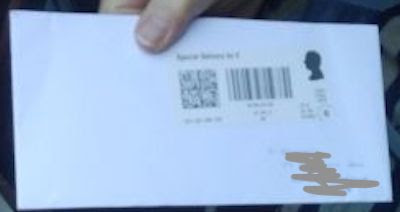
Royal Mail Tracked provides photo-proof of delivery and compensation up to £150.   Currently this service is only available with online postage, although once paid online labels can be printed at Post Offices.   Labels like this are produced

Update 31 July 2024.  The example I showed above is marked (at top right) 'Postage on Account GB'. 

A new Tracked 48 label arrived today which, I think, may have been produced after payment at the Post Office counter.  This has different details, including the Branch Code, VAT code, and only  a QR-type code, not a normal barcode, and the cost of £2.70.  

Tracked 48 label believed to have been generated at a Post Office branch.
 

If it had been sent by ordinary post it would have cost £1.55, but Signed For would have cost £3.25 (both 2nd class).   So if you have no particular reason to use stamps, and every reason (eg eBay sale) to obtain a tracking number, this would seem to be the sensible option.  I think we may see more of these as time goes on, although for sellers who buy discounted postage (not counterfeit) at 80% or less, then Signed For would be an option for the same sort of price, although this is not tracked during its journey.

Unlike for Special Delivery, Royal Mail's online tracker does not show where Tracked 24/48 was posted (Shepperton PO), only the intermediate points (in this case Jubilee and Norwich Mail Centres); it then shows 'delivery' to the PO Box by Dereham DO.

---


The Tracked24 service provides

    •    Tracking to delivery point
    •    Photo on delivery
    •    SMS or email notifications to recipients
    •    Next working day delivery aim
    •    Compensation cover up to £150
    •    Change your delivery options before delivery is attempted

Tracked48 aims to deliver in 2-3 working days, but otherwise the same services.

This is the service which will now be available at Post Offices on demand.  At this stage branches don't know much about it but it seems that whilst normally Horizon labels will be used (and a new code, perhaps?), it will also be possible to prepay in stamps before you leave home!  Wrong - see below; stamps cannot be used.

There is no rate for letters (although letters may be sent at the Large Letter rate) the lowest price is £3.50 for a Large Letter up to 750g for Tracked24 and £2.70 for Tracked48.  The signed option costs more.


So how does this compare with existing services?

The cheapest way to send a letter will still be under a pound at 85p (2nd class) and £1.35 (1st class).  

But for dealers sending out orders, or collectors sending (say) first day covers to the postmarking centres or selling on online platforms, this could be a much better option than Royal Mail Signed For.  EBay, for example, prefer items to be tracked - and Signed For doesn't involve tracking.

If a signature is not obtained every time, or is so illegible as not to indicate who actually signed for the package, then what use is Signed For?

Prices for 750 grammes (I have compared Tracked48 with 2nd class and Tracked 24 with 1st.):

2nd class: standard - £2.70;  signed for - £4.40;  Tracked48 - £2.70;   Tracked48 with signature - £4.40.

1st class:  standard - £3.50;  signed for - £5.20;  Tracked24 - £3.50;   Tracked24 with signature - £5.20.

So rather than send packages by 1st class Signed For (when we don't actually need a signature) we can send them by Tracked48 for 80p less or Tracked24 for the same amount as standard post. 

Yes, you can get your 750g mail Tracked without paying any extra!   

A basic 2nd class Signed For letter at £2.55 is only 15p less than Tracked48 without signature. Similarly a 100g 1st class Signed For Large Letter at £3.80 is 60p less than Tracked 48 with signature but much more than Tracked 48 without.

If tracking is preferable to a signature then 15p is a reasonable price to pay.

Impact on Services

Services will only be impacted if people take advantage of this new option - and if I have understood everything correctly!

Post Office branches will deal with more over the counter work than previously. Even if you take Standard Letters into branch to get a certificate of posting, that has go to be quicker than Tracked processing.

Royal Mail Deliveries are already suffering and workers on the coal face say that tracked parcels are prioritised over ordinary letters (which includes Signed For).  Corporate management deny that this is policy but the fact remains that it is happening.   So if we send Tracked24/48 they will have even more to prioritise.  

I feel sorry for the people who don't get their mail when they should: we have absolutely no trouble locally - if I can send an order to Skye on Friday and have the cheque on Tuesday, then it couldn't be any better.

But UKTracked is certainly going to be worth considering from now on.


UPDATE 15 July 2024  'Harry' reports that these services have now gone live at all post offices in WHSmith branches.  There is no option to prepay in stamps neither the whole nor part of the cost.  This is a photo of the screen with the 'Pre-paid' button greyed out.

Horizon screen when Tracked 24/48 being purchased - no option to prepay in stamps.