Wednesday, 8 April 2020

UPDATES - James Bond, 1d Black, and others

Hello everybody.  The first post today is an update on previously reported matters which were causing some concern.  I've had a lengthy chat with the account manager in Royal Mail, and got unexpected answers!

Starting with James Bond's Presentation Pack that was the cause of much consternation last month. Frankly I'm disappointed and surprised that none of our adventurous readers had already discovered this (only joking, you're not just as adventurous as I thought some of you were!)

Some years ago Royal Mail were selling through eBay, but that shop closed.  About 18 months ago they started selling on Amazon.  Amazon take more commission that Royal Mail normally allow retailers, and so decided that they couldn't sell mint stamps at face.  They sell stamp cards, framed products, and other souvenirs for fans: that's where the special presentation pack comes in.  The target market is James Bond (Star Wars etc) fans, not stamp collectors, so the stamps in products sold on Amazon are rendered unusable by either cancellation or the stamps being stuck to the card (I assume this depends on the product).

This is how they appear on Amazon today:


Other products currently on sale on Amazon are Harry Potter, Elton John, Star Wars, Marvel Comics and David Bowie.  I spotted among these a Harry Potter PSB 'postmarked edition'.   Like I say, I'm surprised nobody noticed it earlier.


Penny Black 180th Anniversary

We've marked the 150th and 175th anniversary and it seems some creative people want to mark the 180th anniversary and wanted large supplies of 1d black stamps.  These stamps were issued in the 2015 miniature sheet and self-adhesive booklet, and in the 2016 Royal Mail 500 PSB.

Royal Mail already had something in mind to accompany the London 2020 International Exhibition so they killed two birds with one expensive stone and so we have the sheet of 25 stamps.


From the Stanley Gibbons catalogues point of view, the stamp has already been listed (SG3807)  so individual stamps will not be listed unless they turn out to be materially different to those already produced in the earlier products.

I don't know what SG's plans are for the sheet - it's not a composite like the 2012 A-Z of the UK (MS3308) or London 2012 Olympics (MS3204a), so it may not be listed at all - it may just get a footnote.  But other catalogues may, and album producers may well have a page for the whole sheet, which is in a unique form.

So to reiterate, this will not be supplied by RM on standing orders to collector customers or dealers. It will not be distributed to Post Offices.  This means that collectors who do want this, whether as a whole sheet or just a small block, they must be obtained by mail order or phone.  (Sheet of 25  ~~  Price £19.00  ~~  Product Code AW144).

I hadn't intended to buy this, but if there is demand for smaller blocks I will make arrangements to get some.  Be aware, though, that posting these will be dependent on movement restrictions in place at the time.  Email me for prices.


Future stamp programme, FDCs, and mail order


I'll preface this with the caveat that all arrangements are under constant review and whatever I write today could change by the time you read this, or any time in the next few months.

Royal Mail are trying to continue to operate 'business as normal' across the board.  That includes issuing new stamps.  Although Spain and Ireland have put their new issues on hold, RM will not do that for the present.

Most stamps are printed by either Walsall in Wolverhampton or Cartor in France, and those to be issued in the next few months will have been printed already.  We know that Walsall reprinted the new tariff airmail stamps in early March after the initial printings in January - this is normal. 

Although most Post Offices are still open many are on reduced hours, and may not regard collectible stamps as 'necessities'.  Not only that, but the demographic of a large percentage of the collectors in the UK means that they also fall into the 'potentially vulnerable' category, and won't want to make the trip anyway.   So getting stamps and FDCs might be a problem.  But, remember, there is now no time limit on getting your covers and cards handstamped at the Special Handstamp Centres.


Royal Mail handling charges:  Given the difficulty in getting stamps, I asked whether RM were considering dropping the handling charges for one-off non-standing order purchases.  No decision has been taken, but it is under consideration.


Tuesday, 7 April 2020

Romantic Poets - 10 x 1st class - 7 April 2020

Last year a number of readers drew attention to this year's 250th anniversary of the birth of William Wordsworth, one of the UK's best known and oft-quoted poets, even if all most of us can quote if from Daffodils.  They must have had high hopes that this would be commemorated with some really nice stamps.  Well....

As my fellow-blogger, WhiteKnight wrote on his Commonwealth Stamps Opinion blog,
Only a Royal Mail stamp could feature a rainbow without using any colour. Fine for an art exhibition, unsatisfactory for a stamp collection.
When Alfred, Lord Tennyson's death centenary was marked in 1992, four stamps designed by Irene von Treskow incorporated portraits of Tennyson and contemporary art works

Tennyson in 1888,1856,1864 & as a young man, with work by Sir Edward Burne-Jones, Arthur Hughes, John Waterhouse, and Dante Gabriel Rosetti.

Ok, so they wouldn't have appealed to everybody, just as most recent stamps don't appeal to all collectors.  But today's offerings are at the other end of the spectrum when it comes to design.  Not that Linda Farquharson is a bad artist, more that lino-cut is not the most appealing way to depict abstract matters expressed in poetry.

Here are today's stamps:


You'll need to click on the image to see them much larger.  I could have separated them, but to be honest I couldn't justify the time for something I disliked so much.  You may have other views.

As if anticipating this Royal Mail didn't provide details of each poet, poem, and stamp design so this is what we have:

a. "For everything I felt like a love, the weeds below the birds above" - The Progress of Rhyme by John Clare.

b. "The frost perfoms its secret ministry Unhelped by any wind" - Frost at Midnight by Samuel Taylor Coleridge.

c. "To see a world in a grain of sand And a heaven in a wild flower" - Auguries of Innoncence by William Blake

d. "And mountains, that like giants stand, To sentinel enchanted land" - The Lady of the Lake by Walter Scott

e. "Higher still and higher From the earth though springest Like a cloud of fire" - To a Skylark by Percy Byshe Shelley

f. " My heart leaps up when I behold A rainbow in the sky" - The Rainbow by William Wordsworth.

g. "The snowdrop, Winter's timid child, Awakes to life bedew'd with tears" - Ode to the Snowdrop by Mary Robinson

h. "absence is The moonlight of affection" - The Fate of Adelaide by Letitia Elizabeth Landon

i. "Beauty is Truth, Truth Beauty. - That is all Ye know on earth, and all ye need to know" - Ode on a Grecian Urn by John Keats

j. " She walks in beauty, like the night Of cloudless climes and starry skies" - She Walks in Beauty by Lord Byron.

This is what Royal Mail told us:

On the 250th anniversary of William Wordsworth, born on 7th April 1770 (exactly 250 years to the day of the stamp issue), Royal Mail celebrate the renowned poet and Romantic poetry with a set of ten stamps. William Wordsworth is regarded as having launched the ‘Romantic era’ of British poetry, was Poet Laureate and remains one of the UK’s most popular poets.

The word ‘romantic’ has a much wider meaning than ‘love’ to define the poets of the late 18th and early 19th centuries. In an era of huge social changes, the Romantic poets reacted against the order and rationalism of the preceding (Enlightenment) era, and highlighted the importance of expressing real personal feelings. They had a sense of responsibility to society: they felt it was their duty to use their poetry to inform and inspire others, and even to change society.

Wordsworth was concerned about the elitism of earlier poets, their highbrow language and subject matter which was not accessible to ordinary people. He maintained that poetry should be democratic; that it should be composed in ‘the language really spoken by men’ and he launched his ideas when he, with Coleridge, published their Lyrical Ballads (1798).

Each of the ten stamps featured the work of the key Romantic poets – John Clare, Samuel Taylor
Coleridge, William Blake, Sir Walter Scott, Percy Bysshe Shelley, William Wordsworth, John Keats, Lord Byron, and two female poets – Mary Robinson and Letiticia Landon, who in their time were extremely popular, and among the first women to support themselves solely by writing.

The target thematic audience for these stamps are those who have a keen or passing interest in
literature, poetry, creative writing and specifically Romanticism, as well as admirers of Wordsworth and fellow writers / poets. Members or followers of the Wordsworth trust and the Tate, which has a William Blake exhibition ending in February. Wordsworth’s childhood home is a National Trust property and it’s worth noting that the founders of National Trust were all committed Wordsworthians and is also celebrating his 250th birthday with a new exhibition & events throughout 2020.

Technical details
The stamps are designed by The Chase, with illustrations by Linda Faruharson.  Printing is by ISP in litho.  Stamp size is 41 x 30 mm, with perforations 14½ x 14, and they are in sheets of 25/50.

A Wordsworth Coin Cover was also available with a special £5 coin.  You can buy all the products from Royal Mail's website.


Discuss!

April 2020 Slogan Postmarks

We start this month with a continuation of the last one in March, but MC has sent this one dated April.

If we don't get any other new slogans this month I won't be surprised.  We might get one for St George's day although it doesn't have the same prominence as the others.  We won't get one for my birthday, but we may get something for VE Day early in May, even if we don't celebrate until VJ Day (15 August).

So this is from Tyneside NE/SR Mail Centre dated 06/04/2020 - Stay Home, Protect the NHS, Save lives.


We had a square card today, and inevitably the postmark was the reverse type - Manchester Mail Centre 09/04/2020


UPDATE 21 April (Happy Birthday, Ma'am)
It is clear that there is just one slogan which will be the default until this business is over.  However, I think we can expect something next month for the anniversary of the end of World War II, and today Royal Mail has announced a slogan marking Captain Tom's 100th birthday.

There can be few in the UK who have not heard about the remarkable tale of 99-year-old Captain Tom Moore, who set out to raise £1,000 by walking round the outside of the house.  His story soon gathered social media momentum and raced around the world with over 900,000 people donating (so far) £27 MILLION pounds through is JustGiving page.  Somebody suggested that he should be sent birthday cards, and now Royal Mail's South Midlands Mail Centre has dealt with 25,000 cards. 

The Northampton-based mail centre which deals with his post has adapted equipment to deal with the number of cards.  Staff have re-programmed sorting machines to re-route his mail into a dedicated collection box.

Tom's birthday is 30th April - we should have some examples of 'his' postmark to show next week.

UPDATE 28th April
Despite some reports that the postmark would be used only on Wednesday, I am pleased to thank RW for sending two examples from Exeter Mail Centre, one 1st & one 2nd, both dated 27-04-2020.


UPDATE 14 May
The Captain Thomas Moore slogan continued into May (see May post).  I've also been sent examples of commemorative covers that two readers produced for their collections.  Thanks for these!


Sunday, 5 April 2020

Spot the difference!

A quick Sunday evening snippet, at the end of a glorious sunny day in Norfolk. With so much wet and windy weather in the first few months of the year, it was good to get into the garden - we wouldn't have gone to the coast today even if we could.

So, just to give you something to ponder over this evening - answer tomorrow sometime - can you spot the difference (other than the barcode number) between these two Recorded Delivery blanks? (I took the image from an eBay listing.)


Second question, have you seen the different one before?

Third question, have you seen or got one on cover?

I don't think I have, but I'll have to look closer at what I do have.

Update - Happy Monday morning!
Thanks for the answers overnight.  Here's the reverse - there's a big clue at the lower right, but again you might need to click on it to see it.


I don't think many of the recorded delivery, special delivery or registered labels had the Royal Mail Cruciform on, so few would have the two versions.  In Scotland, Queen Elizabeth is not the Second, so they don't have the E II R cypher on their postboxes, and they use the Scottish crown.  It's much easier to see on the side of this postvan.


Later today I'll be showing some more modern postal history on the other blog. 

At the right-handside of this one, where I list other blogs you will see when the Postal History one gets updated.


Friday, 3 April 2020

On The Collector's Bookshelf: beyond the basic catalogues

As a collector you will have basic catalogues for the areas you collect.   It might be Stanley Gibbons simplified Stamps of the World (SOTW) if you are a world collector, their Great Britain Concise or even the Deegam Catalogue if you are a specialised Machin definitive collector.

As collectors progress from the very general when they are young, realising that collecting the whole world is very difficult, many decide to specialise in one or more areas.  For the collector who has only been collecting GB or Commonwealth, that may be to concentrate on King George VI stamps, in which case Gibbons' Commonwealth & British Empire (or Part 1) catalogue is needed, and the Murray Payne catalogue which includes more detail on KGVI is also useful.

That applies wherever you are in the world.  If you are in North America, or Germany, India, China, if you decide to concentrate on all King George VI issues, then the Part 1 is essential although you may not buy a new one, nor replace it every year.

Other Countries
When I decided that the whole world was too big I reduced my scope - GB, Commonwealth, and Europe seemed to be enough.  I had my grandfather's Commonwealth collection which was mainly KGVI because they were new issues then.  Unfortunately because times were tight for most people during world war II, many were short sets, missing the top values, so I had plenty of scope.

When I looked at GB I decided that the 19th century period was too expensive for what I could afford at the time.  But the equivalent period in some countries was cheaper - at least here in Britain.  I concentrated on the Scandinavian countries - Denmark, Finland, Iceland, Norway, Sweden etc.  The earliest Facit catalogue I still have is 1968! - and I have more than a dozen.  The catalogues are bilingual Swedish/English and contain far more detail than does Gibbons' Scandinavia catalogue - as you would expect and each one has specialist articles not repeated in the others, which is why I ahev so many.  As I mentioned before, I like covers as well as - or even more than - stamps, and so the inclusion of prices for stamps on cover sometime during the 1970s was a welcome addition. 


Side Interests
Over the course of a few decades I bought (as a collector) mixed auction lots which included something I wanted, and through my cover-browsing, many covers and postcards that I thought just had something interesting about them.  Nowadays the internet is a great help in researching the totally unknown, but there's nothing quite like getting your nose into a catalogue!


But who can afford to buy new catalogues?  The answer of course is to buy second-hand.  I have bought several from dealers selling 'previous years' or from charity shops.  Review copies are sent to magazine publishers and I bought enough at one Stampex to fill a whole Samsonite briefcase and more!  And as a writer and blog publisher I have been sent a couple of new ones which have proved useful, even though one of them was the Sakura catalogue of Japanese stamps.


Back of the book
This term is used, mostly in North America, for those issues not in the main part of the (Scott) USA catalogue which lists revenues, postal stationery, parcel post, and a whole host of stamps not found in the main part.

We've all found odd stamps in old collections, whether bought at auction, inherited, or single sheets from dealers.  You are attracted to what you want or need, but there is often something else that you can't find in SOTW, or even in Gibbons' specialist catalogue for your country.  But the specialist catalogue published in the country that you are interested in holds a wealth of information, and with colour printing getting cheaper, these catalogues are more useful than ever.

You may have seen the revenue stamps shown in this Hungary catalogue, which has a detailed listing.  Or you may be interested in Greece and have a range of (easy-to-read) postmarks on what are often lightly-coloured stamps.  Which ones are from the mainland and which are from islands?  Which are from islands that were only briefly occupied during the war?  (As always you can see these much larger if you click on them.)


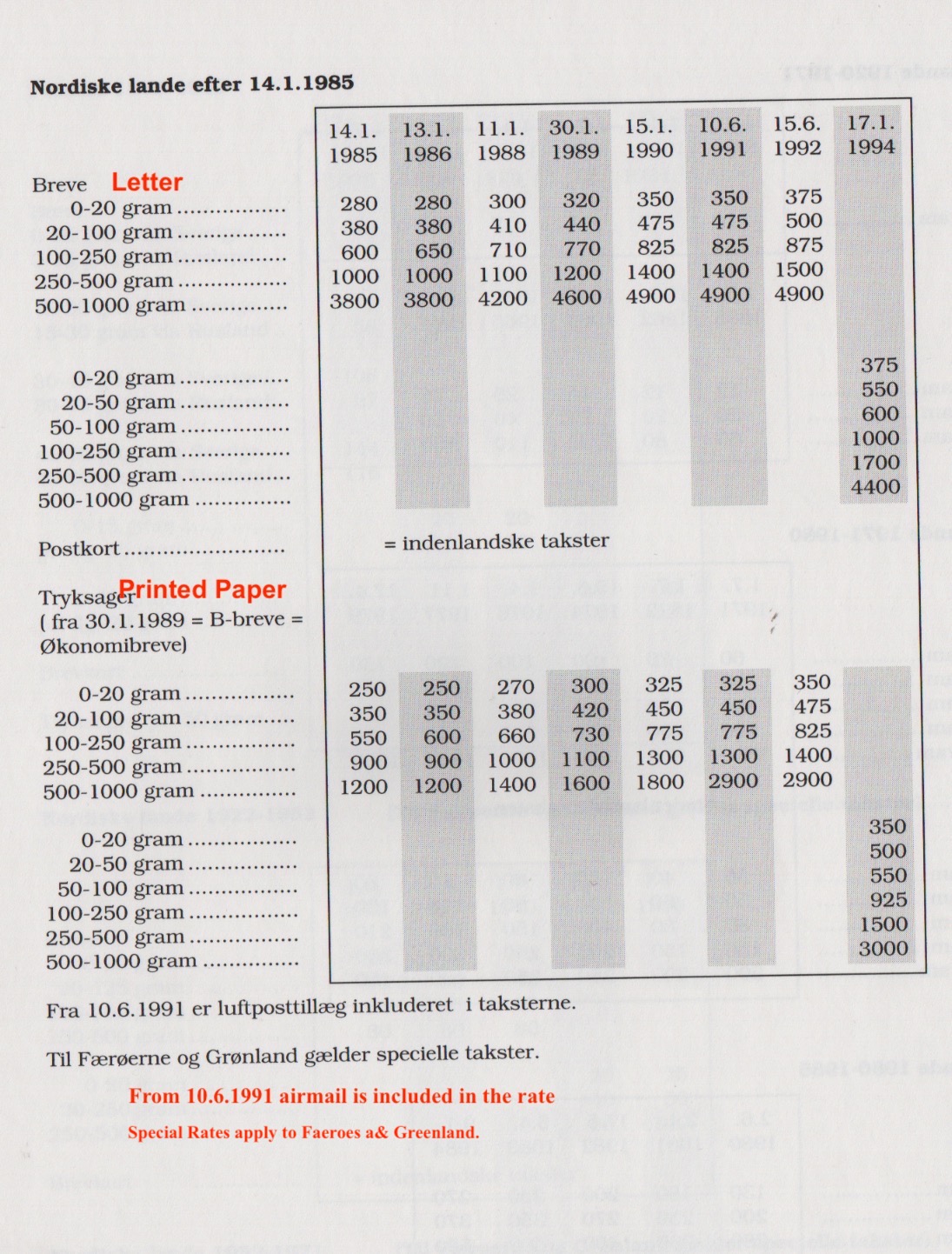
If you collect Denmark, the AFA series of catalogues contain some really interesting nuggets of information.  Especially this 72-page volume about postage rates.

The first picture is from the  Postage Rates tables.  
The second shows, under headings for different postage rate periods, which stamps were current and what purpose they served.


Possibly the most fascinating is the reverse of this which shows individual stamps - definitive and comemmorative - with the purpose they served and the period for which the rate was valid.  The first line shows that AFA460, the 50 øre Frederick IX definitive was valid for the inland letter rate for just three days - 30 June 1967 to 2 July 1967, whilst 462F, the similar 80 øre was valid for overseas letters for the same period.
 

Where can you find such information for the stamps of Great Britain?  You can't, not in a similar format.

Australia
Finally for today, a clip from the specialist Australian Commonwealth Specialists Catalogue (section 9A!).   For every stamp issued, this catalogue shows the technical details which you would hope for,  including which printer and pressAlso shown is which stamp each one replaced, permanently or temporarily.

Most useful for the postal history collector, is the 'Usage' section, which shows the sometimes multiple uses not only when it was first issued, but when the rates increased later.  Finding examples for each of these - or in some cases even any use singly on cover - is the challenge that collectors of Australia have.  Here's a link to discussion on the 1966 definitive birds.


Oh that we had something like that for Great Britain - most of the data is out there, and not just at the Postal Museum, but in hundreds of collectors' libraries.  But it is fragmented: it needs collating, but I doubt that that will be achieved in my lifetime.

Update - PS: More sorting out, I found this piece I wrote for our club newsletter - 22 years ago!

How about these se-tenant stamps from the Netherlands?

In Stamps of the World they are SG 314 & 426a priced at the basic 10p each - which we all know means they are worth next to nothing. But this is a pair. I don't know if it's listed in SG Part 4, but in the NVPH Speciale Catalogus van de postzegels van nederland, it is no 379a. 

The same stamps also occur in the reverse pair (2½+7½ - no 379b), and as strips of three: 7½+2½+7½ or 2½+7½+2½, numbered 379c and 379d respectively. 

My NVPH is the 1985 edition, but prices for this sort of item don't often go down, and even if they do, the prices here are relative guides. 

Used prices are, in Dutch guilders: 379a 75c; 379b 1.75; 379c 6.50; 379d 7g. (Current rate 3.25=£1).
At 75c my pair is about 23p - not much, but better than two singles.


Another pair is one that I bought from the club packet.
 
These are in SOTW as SG522 (cat 85p) and 524 (cat 10p). NVPH lists these as 356a-d in the same combinations as the above. 

 
But the prices are much further away from SG for pairs and strips:
7½+2½ - 7g50 mint - that's nearly £3.
2½+7½ - 45g mint - that's nearly £14!
Strips are 70g and 77.50 - £21 to £23.

Incidentally there were over 89 million 7½c stamps, which explains the low price compared with the 2½c of which only 12½ million were produced. 

OK, so my pair isn't worth £14 until I sell it - but I have access to a wide marketvia the internet.

(1998 report, 1985 prices don't forget!)


Conclusion
I hope I've demonstrated why it might be a good idea to get a 'local' catalogue for your chosen areas of study.  As well as those specifically illustrated I have several of the Scandinavian, Israel (Bale), Switzerland (Zumstein), Germany (Michel), France (Yvert & Tellier), Italy (Sassone), Belgium (COB), Netherlands (NVPH), Armenia, Ukraine, USA, Canada, Ireland, and South Africa - and that's just the ones I can see!

If you have any questions on these, email to the address at top right.  I look fooward to hearing from you!


Thursday, 2 April 2020

My third string - a different Commonwealth.

Thirty Years ago - life was so different, especially in the Soviet Union

1989 was a year of turmoil from Communist China to Eastern Europe, from Tienaman Square to the Berlin Wall, via Poland, Hungary, Czecholsovakia and Roumania, and into the Soviet Union, starting with the 300,000-strong 'Singing Revolution' in the Lithuanian Soviet Socialist Republic (SSR).

There were insurrections in the Azerbaijan, Moldavia, Tajik SSRs and Lithuania declared independence in March - independence from the USSR - it was almost unbelievable, and it was resisted by Moscow.  Estonia and then Latvia followed Lithuania, the two Germanys were united, Boris Nikolayevich Yeltsin bounced onto the world scene as he was elected first president of the Russian Soviet Federative Socialist Republic.

Further east, Iraq invaded Kuwait, Armenia declared independence from the USSR, and at home Margaret Thatcher resigned as Prime Minister and the Channel Tunnel linked France and the UK.  Interesting times, but most interesting for collectors with a wide view was not the joint issue of a set of stamps marking the Channel Tunnel, but what was happening in the Soviet Union over the next few years.

The USSR, CIS, FSU.
All over eastern Europe the fall of communism continued, not least in the USSR where, one after another, the Soviet Socialist Republics declared that they wanted independence from Moscow.  The USSR collapsed and was dissolved on 26 December 1991.  What followed was, for a period, The Commonwealth of Independent States.


But for those states, and their peoples, who had either demanded independence or had it thrust upon them, the troubles were only just beginning. The centralised control over the economy of the Soviet Union meant that the economies of many of the constituent republics had been founded on a single or few industries, with all the market for their products being controlled from Moscow. With the loss of this central control and the loss of raw material supplies from other republics, the new states were now fighting inflation by setting up their own central banks and printing their own banknotes, which created inflation. This caused all prices, including postage rates, to increase, and stamps – and the means to print them - were in short supply. Provisional stamps and surcharges proliferated. The confusion also allowed individuals to create their own free-market economy - and stamps to sell to the west.


Meanwhile in the west.
As usual I visited the big London Stamp Exhibitions.  Stampex, StampWorld '90.  There were also big events held at Wembley in at least 1995-97.  As usual I bought a few stamps, but mostly browsed the boxes of covers, looking for the unusual and cheap, because I favoured quantity over quality.  Yes, it may not be the best way of building a collection, but if you are starting something new, then buying contemporary non-philatelic material was really quite cheap in those days.

It was at one of these that I chanced upon a shoe-box full of c6-size envelopes, mostly from "Russia' but some from Albania and other east European countries. Like many I had learned the Cyrillic alphabet at school, even though I never learned Russian.  Picking out covers from the Baltic States was easy: Latvia, Lithuania and Estonia had bright new stamps, although Latvia had overprinted some Soviet definitives.  These seemed a good find.  But the gem, which sparked my long-term interest - almost an obsession for a while - with this area, was this unstamped postal stationery cover.

Provisional postage from Kazakstan to India 1992 (senders address at lower right).

This has several attractions: (1) it is to India, rather than to the UK or north America; (2) it is from Kazakhstan (Республика Казахстан); (3) the postage is paid by a TP (Taxe Perçue) marking on a small duplicated label.  Although the value is written on the label, it still qualifies in many ways as a stamp.


And so I veered away from GB stamps, in the main, and acquired as much knowledge as I could about this area.  I had never collected 'Russian' stamps - those of the USSR, so the whole area was new to me.

Without the web
But how did you do research before the World Wide Web was established - Tim Berners-Lee only produced the first written proposal for the World Wide Web in 1989, and the internet was in its infancy.  Who remembers 'newsgroups', such as rec.collecting.stamps ?


It's difficult to imagine now, not opening up a web browser (ok, you have one permanently open), and tapping into the URL field a subject that you want to research.  Now, most browsers will give you a google-created list of webpages covering your field.

Then you had to look for discussions already taking place, and read, and maybe ask a question, or just post your own and hope that somebody would answer it - and all this was on a dial-up modem connection!

I had this sort of thing, provisional, typewritten labels from Ukraine, postally used(?):


Eventually I was part of a worldwide network of similarly-interested people, but still email and webpages were not widespread.  To further my studies of the provisionals of Ukraine, I purchased a groundbreaking 270-page handbook (and that's only volume 1) full of illustrations.  However this was produced in eastern Germany, and the text was in German.


It included copies of many 'official' documents from postal officials in the 25 regions of the country - translated into German (above right).

Best of all it included postage rates from 1 January 1991 to December 1993: eight rates in this short period.

Translation
Translation was not easy - and I like languages!  To get the basics I did a term of Russian at a local evening class.  Like English, Cyrillic script letters are quite different to capitals, but more so!  The script т is actually the letter T, which would be written as a small т if written upright!  Now we have google translate and although entering Cyrillic is a pain, at least German is easy enough!

Oh and if you think that is difficult, here are extracts of other languages, in their own script:
  • Armenian: Անկախ պետությունների Համագործակցություն (ԱՊՀ);  (APH)
  • Azerbaijani: Müstəqil Dövlətlər Birliyi (MDB)
  • Belarusian: Садружнасць Незалежных Дзяржаў (СНД), (SND)
  • Georgian: დამოუკიდებელი სახელმწიფოების თანამეგობრობა
  • Kazakh: Тәуелсіз Мемлекеттер Достастығы (ТМД), (TMD)
  • Kyrgyz: Көз каранды эмес мамлекеттердин шериктештиги (КМШ),  (KMŞ)
  • Moldovan: Comunitatea Statelor Independente (CSI)
  • Russian: Содружество Независимых Государств (СНГ),  (SNG)
  • Tajik: Иттиҳоди Давлатҳои Мустақил (ИДМ),  (IDM)
  • Turkmen: Garaşsyz döwletleriň arkalaşygy
  • Uzbek: Мустақил Давлатлар Ҳамдўстлиги (МДҲ),  (MDH)
(Moldovan is like Roumanian (and hence Latin), Uzebek, Tajik, Kyrgyz, Kazak, Turkmen and Azerbaijani are Turkic languages but some use a Turkic variation of Cyrillic!)


My contacts were in the USA, Australia, Canada, Holland, Germany, Ukraine, Siberia, Turkmenistan, and in this country.  But there were not many of us and resources were few.  I joined the British Society for Russian Philately and the American society Rossica.  The drawback to these societies was that whilst there was interest in all periods, the majority were interested in imperial Russia and the USSR period.  But through the BSRP I met and kept in contact with a collector and publisher from Minsk, Belarus, whose website continues to provide useful information to collectors to this day.

One collector in the US formed a new group to study just the 'New Republics', not only the 15 from the USSR but also those which formed out of Yugoslavia some years later.  But he was photocopying and posting all his material.  It was unsustainable in that form and he abandoned the distribution of information in 1995. 


As I pull back from dealing in newer Great Britain, and move to older definitives, my thoughts are on my other two main passions, modern British Postal History, and the Former Soviet Union (FSU).  I think I have more covers for the latter, but both are barely organised.  There is much to do, and for those who are interested I shall be putting more modern postal history on the accompanying blog.  I shall probably add more FSU material to the website, rather than start a third blog, but I'm open to suggestions!


So if you have anything to contribute on either topic, please do write to the email address at top right.  Illustrations should be in jpg/jpeg/png format (not pdfs, please), and no more than 300 dpi for full covers (higher for highlights, of course).

Next - On The Collector's Bookshelf.


The 10p Farm Buildings machine vended booklets.

As Brian M commented on the previous post, Stamp Collecting Weekly (SCW) was a 'great magazine'.  The magazine was founded by journalist Douglas Armstrong, and in 1973 the editor was the eminent philatelic writer and editor Kenneth F Chapman, assisted in 1976 by Douglas Muir, another well-known writer currently Senior Curator of Philately at The Postal Museum. 

Some contributors were anonymous, like 'Watchman' (on market movements) and Queensman's Looking at Current G.B. column quoted last time, and articles.  Another was L.F. (Len) Newbery, whose speciality was GB Stamp Booklets, he also contributed to the Post Office Philatelic Bulletin and co-authored with Jean Alexander what was, at the time, the definitive publication on British Stamp Booklets.

This page from SCW 3 May 1979 describes the difference in the positions of the value on various folded booklets.  We'll start with the earlier 10p machine-vended booklet, SG FA4-9


This is the whole pane:


I don't have a full range of these, but can show these two 7p values compared:


The value block is higher on the left:


According to Newbery, the position of the value relative to the lower edge of the background and the point of the bust is minutely different between stamps on teh same 'sheet' due to incorrect register when the multipositive was produced. But there are patterns.

On the web the stamps are printed sideways in three columns of book panes - for some reason columns I & III had the head to the right, and column II had the head to the left.  But the stamps were always mounted in the cover with the stamps fixed on the left.  There are no miscuts which would produce tête-bêche pairs.

However, the position of the value relative to the foot of the stamp varies: Column III it is 3 mm, column II it is 2 mm, and in column I it is between 2 & 3 mm.  These are noticeable enough to be worth collecting even if they are only noted in some specialist catalogues.

Newbery's column also shows differences with the 8½p and 9p stamps from different booklets. This is the first 50p booklet sold from machines, SG FB1A/B, containing panes X841s/841sa, the former having the 8½p stamp on the right.
 
  
The 85p counter-vended booklet (SG FF1) contains 10 x 8½p stamps.  According to the article, the stamps from 50p FB1 booklet has the value spaced at about 2.5 mm from the foot, and the spacing in FF1 is 3.25mm, as shown in the picture below.


This pattern continues with other booklets.  The spacing in the 50p booklets is quite different from that in the 70p, 90p and £1.60 Christmas booklet although in these booklets the spacing for each value is the same.  More about this in the next post, when I should have more of my own stamps to show.


International Mail Services during the Covid 19 pandemic

I am posting this because a lot of collectors have contacts all over the world and collect more than just British stamps.  The situation is impacting on exchanges and the passing of mail from one country to another.

For outgoing mail (with an implication for incoming mail) this is Royal Mail's 'International Incidents' webpage:  https://personal.help.royalmail.com/app/answers/detail/a_id/5317

This currently shows mail suspended to most of the West Indies, Albania, Armenia, Boznia-Herzegovina, Cuba, Djibouti, Ecuador, French Polynesia, India, Kuwait, Lebanon, Macedonia, Moldova, Montenegro, New Zealand, Peru, Philippines, Russia, Samoa, South Africa, South Korea, Tanzania, Taiwan, Tunisia, UAE, Ukraine, Zimbabwe.

For other countries you can examine their websites and there is also usefulongoing information being added by collectors on the special Stampboards thread on the impact on mail.

Tuesday, 31 March 2020

A delve through the archives, and time for discoveries

Like many of today's 60+ collectors, I started collecting as a child.  Unlike many, I kept my interest going, alongside other things like non-league football, and bought what I could including maagzines of the day.  

I read as much as I could - something I still do within limits - even if it wasn't of immediate relevance to my current collecting.  Who remembers Stamp Collecting Weekly?  Yes, the UK had a weekly stamp magazine as well as Gibbons Stamp Monthly and at least one other stamp magazine from time to time.  Many of these date from before I married, but I am grateful that my wife didn't object to my continued interest in stamps - as long as I could cover purchases with sales of spares all was fine. I enjoyed buying and selling at Essex Stamp Auctions, but didn't auction much after we moved to Norfolk.

I've been sorting out drawers of papers, including scraps and cuttings from those magazines.  It made me realise how much I had forgotten, and how much times had changed.  Over the next few weeks I'll post some of these relics from the past, hopefully alongside the relevant stamps, if I can lay my hands on them.

I'll also try to add some Machin covers to my other blog on Modern Postal History and try to explain why it should be important, and why - if you have odd boxes of covers in your stamp den - now is a time to look at them afresh, and to critically examine what you have before you consign the cover to the bin after taking the stamps off and putting them in the charity bag.


GOING BACK IN TIME!   Machin 10p machine-vended booklets
 
These were first issued on 10 March 1976 containing 3 x 1p, 2 x ½p and a single 6p stamp.  With changes to postage rates the next variant was aa series of booklets illustrated with Farm Buildings, first issued on 8 February 1978.  This contained 2 x 1p, 2 x ½p and a single 7p stamp.  I may come back to those later.

The final variant was issued to publicise the London 1980 stamp exhibition and contained 2 x 1p stamps and single 8p.  These were printed on the Jumelle press.  A reprint was issued on 4 August 1980, printed on the Chambon press.  By the 14 August, Stamp Collecting's 'Philatelic Newsreel' had described the differences, and these were shown in the 28 August edition.


I looked at my own copies and found what appear to be more variants.

In these scans the stamp at the right is a Jumelle printing, and that in the centre is a Chambon.  The stamp at the left is also a Jumelle, but the alignment on the 8p, at least, is quite different with the value set higher than the other, more like the Chambon.


The 1p stamp on the left also depicts the 'repaired chin and beard flaw'.


When we are able to have our shop online, some of these will be there - hopefully with better perforations than some of those shown here!  Just for the record, here's the whole booklet pane, with the 'beard' flaw, etc, on the lower right stamp:


Some words of warning.
As regular readers will know, I have specialised on the U-numbered Machins with security features - cut-outs and iridescent text.  I don't know a great deal about the previous versions, so I'm treading into unfamiliar ground (or waters!) here.  If anybody spots anything that I've got wrong please add a comment, or email other images.  Thanks!


Friday, 27 March 2020

A little light relief to help the posties

Spotted on the web today


Stay At Home -
Save Lives -
Help the NHS