Monday, 19 August 2024

Special Issues coming off sale by the end of the year

Royal Mail have announced dates on which various stamp issues which will cease to be available from their Tallents House bureau, during the remainder of 2024.

30 September

In Memoriam (Duke of Edinburgh and Queen Elizabeth II issues), Her Majesty the Queen's Platinum Jubilee, Tutankhamun.

31 October 2024

Christmas 2022

30 November 2024

Paul McCartney, The Rolling Stones

31 December 2024

Transformers, X-men

Migratory Birds and Cats went off sale on 31 July - sorry for not reporting this earlier.


Thursday, 15 August 2024

A reminder of Royal Mail's reasoning behind £1 & £2 stamps.

 I posted this in May 2023, but it's worth repeating here as people keep asking why £1 and £2 special stamps are being issued when there is no £2 rate.

What values should be used on Royal Mail's special stamps?

For decades Royal Mail has told us that they preferred not to use anything other than 1st class and airmail values for their special stamps, even though this meant that the cost of sets was high, and few were being used on inland mail by people who wanted to send 2nd class mail.

There were always 2nd class stamps in the Christmas set for the obvious public demand reason, but in very few other sets - but things are changing!

I'm highlighting this hear now, although I cannot provide any details yet, but several of the stamp issues projected for the rest of the year have stamps with values other than 2nd, 1st and £2.20.

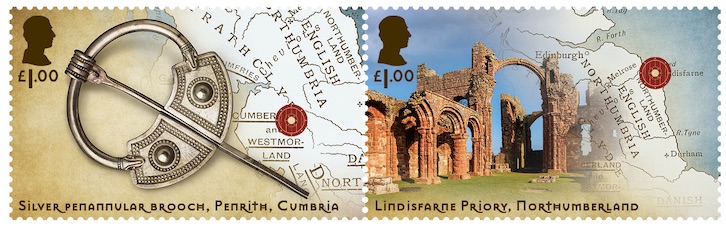
Pair of £1 Viking Britain stamps

Royal Mail have said, "We have chosen to add the other values to ensure variety and also provide the option for more flexible use of special stamps for parcels."  

This would, however, mean that some stamps might being issued for which there was no specific postage rate, and therefore no solo use.

Block of 4 £2 Dinosaur stamps.
 Given reports on how stamps are treated on letters and parcels, I can only hope that the Stamps and Collectibles division of Royal Mail had some influence on the Operational areas of Royal Mail, and on their retail partner, Post Office Ltd.  

This might just ensure that the pictorial stamps that they are making available for all users to actually use, might be treated in the mailstream in a way that made it worthwhile for people to use them.

Look out for these in future new issue announcements.

So there you have it - and there have been plenty of them.  How many other than 1st or 2nd have you seen, if you are in the UK?  How many £2.20/£2.50 have you seen in the rest of the world?

 How many have been offered to people to use on parcels or any other mail?   I know my PO had a supply of Tower of London for all counter positions, and not all would have been bought by collectors.
 

UPDATE - as we know now, the policy changed in the spring of 2025, and all future special stamp issues apart from Christmas will be 2nd or 1st class, or  a mix of both.


Wednesday, 14 August 2024

August Slogan Postmarks and other interesting postal markings.

As in 2023, August has been a new slogan desert, so far. As expected the default British Heart Foundation slogan continues from July.  

My thanks to the anonymous reader who sent this first day cover of the King Charles III Union Flag stamp yesterday (13 August) from Nottingham Mail Centre (not an area we see often).

British Heart Foundation slogan Nottingham Mail Centre 13/08/2024.


OTHER POSTMARKS AND POSTAL MARKINGS

All the way from Canada, reader SS has sent this use of the £2.50 airmail stamp with the Exeter MC Devon 31 JUL 2024 packet stamp.

Exeter Mail Centre Devon packet stamp 31 JUL 2024.

UDPATE 15 August: SS has today sent this from a packet sent to Canada, a proper counter date stamp from Bridlington, East Yorkshire 25 JL 24.

Counter date stamp from Bridlington East Yorkshire

Bridlington Post Office, opened in 1951 with the cypher of King George VI over the door. (Google maps, streetview)


There may well be no new slogans at all this month, so if you receive or come across any other interesting postal markings from any period or place, please send them to the email address in the top right of this blog.  Thank you.

Remember, all postmarks appearing in August will be added to this post, so check here before you spend time scanning and emailing.  


Monday, 12 August 2024

New Counter Information Technology label trial comes to Croydon.

The Post Office in Croydon High Street is now producing the New Counter IT (post-Horizon) postage labels.  

I have no more details (ie whether it is one counter position or all, or how easy it is to get these) but my correspondent  WU sent a 2nd class large letter along with the receipt on 7 August 2024, which may have been the first day.   

New Counter Information Technology postage label from Croydon PO 7 August 2024.

Cash Receipt for the above label,

There's no information about these from official Royal Mail sources - save that the designs etc have been worked out between Royal Mail and Post Office Ltd. 

Please let me know if you see any from sources other than Aldwych (FAD - or branch code 0090107), Leeds St Johns (039323), or Croydon (0240133).  Many thanks.

Update 15 August.  

1. A report from Croydon. PA reports that, on 5 July, Croydon PO initially denied that it was there and wouldn't be for two years!   He eventually obtained just one label. "A large letter copy was refused as it would be overcharging me and she would get into trouble. (Large letters at under 100g cannot be handled by NBIT).   NBIT is very restricted and it can handle very little at present. It cannot handle Tracked, standard Certificates of Posting, banking transactions etc."  (I suspect NBIT stands for New Branch IT, rather than New Counter IT - IB).

2.  Five branches in trial. Thanks to AY who has pointed out a not-entirely unrelated article on the BBC website, which I had only partly read.  Referring to the departure of Post Office Ltd's IT chief it cites delays and cost escalation on the replacement for the Horizon system.

The key point for the purposes of this post, though, states: "pilots for the new system were currently working in five branches, and it has requested cash from the Department for Business and Trade to fund the project to replace it.  Post Office and the Department for Business and Trade are working on this request and as and when an agreement is reached, we will inform our Postmasters,"

If this is, indeed, the same thing it has a long way to go.  Although postage labels are important, they are only part of the requirement.  An accurate accounting system which properly interfaces with third parties (banks, utilities, Lotto, etc) and actually produces a balancing double-entry system with no system-generated errors or omissions, is really important.

Update 20 August

My thanks to AB who has visited Aldwych at a quiet time, and was able to discuss the trial.

"They did confirm there are five locations for the trial - Aldwych, Croydon and St John’s, Leeds as we know, but also ‘Springburn, Scotland’ which I’ve taken to be Springburn Shopping Centre, Glasgow and Melville Rd, Hove  BN3 1UB. 

"The system is indeed slow, as others have said! Services limited to 1st/2nd Large Letter and Signed For as well as Special Delivery (forgot to ask if ‘by 9’ and ‘Sat Guaranteed’). Definitely no international services, and not the new Tracked 24 and 48. 

"I also asked how the trial was going: no info on that! No news on if this will be the final design of labels.

"They referred to the new system as ‘n-bit’ rather than ‘en bee eye tee’."

So if anybody in Hove or Glasgow has a lot of patience and wants to try out the new system, we'll be pleased to report the results.  Thanks!


Thursday, 8 August 2024

Raise the new flag stamp at The Tower of London - 13 August 2024.

On 13 August Royal Mail will issue a package of stamps and philatelic products for the latest in the drawn-out series of Royal Palaces, featuring the Tower of London.  This follows Buckingham Palace in 2014, Windsor Castle in 2017, Hampton Court in 2018, and the Palace of Westminster in 2020.

But on the same day they are issuing an update of an earlier stamp, which will attract far less general attention, and that is the Union Flag.  

This was first issued as one of four flags in the miniature sheet which was part of the 2001 issue marking the Centenary of the Royal Naval Submarine Service. 

Union Flag 1st class stamp from 2001 'Submarines' miniature sheet.

The same stamp was issued in the 2004 Rule Britannia Smilers Sheet and in the 2008 James Bond prestige booklet, and a reduced format was issued in 2005 definitive-sized in a greetings booklet.  It was also issued as a Post and Go stamp in 2012 in time for the Queen's Diamond Jubilee and the London Olympics. and in many private Smilers and Business Customised Sheets.

So it's popularity makes reissuing it with the head of King Charles III a sensible decision - but where can it be bought?  Certainly the few tourists who still send postcards abroad would not use it because two (cost £2.70) would be needed to send a single card/letter.  Unless a Post and Go version is to be reissued in Post Office self-service kiosks it's use anywhere seems to be very limited.  But it will doubtless be used by cover producers, notably the Westminster Collection, for their series of royal memorabilia covers.

King Charles III 1st class Union Flag stamp issued 13 August 2024.

In common with other recent stamps, most notably the country definitives, the head and denomination are reversed-out (ie white), rather than silver as the original issue was.

Technical details

Printed by Cartor Security Printers in lithography with conventional PVA gum in sheets of 25/50. Size 41 x 30 mm, perf 14.5 x 14.

Products available - mint stamps, first day cover. No presentation pack or stamp card.

The Tower of London

Royal Mail information on this issue

For almost a thousand years, the Tower of London has been at the heart of British history, inspiring awe, fear and fascination. Over the centuries it has played many different roles: from impenetrable fortress to royal residence, menagerie of exotic animals to place of execution, Royal Mint to home of the Crown Jewels. Today, the Tower remains a living institution, home to more than 100 people – including the famous Yeoman Warders, or ‘Beefeaters’ – as well as being a UNESCO World Heritage Site and one of the most recognisable historic monuments in the world. 

While the Tower was originally built as a fortress and symbol of royal power, it was also a notorious state prison. For more than 800 years, anyone posing a serious threat to national security – from monarchs and priests to lords and commoners – was incarcerated within its walls.  

Royal Mail explores the fascinating history and traditions of the Tower of London with a set of six mint stamps and a miniature sheet. The mint stamp set consists of The White Tower, Tower Green and The King’s House, St John’s Chapel, Traitors’ Gate, Yeoman Warders and a Raven of the Tower.

Set of 6 Tower of London stamps issued 13 August 2024: 2 each se-tenant vertically 1st class, £2 and £2.50.

The stamps in detail

1st Class - The White Tower is William the Conqueror’s original castle keep. The onion-shaped roofs on the turrets were added by Henry VIII.

1st Class - The Yeoman Warders have been guarding the Tower since Tudor times. Today they take part in ceremonial duties and parades. 

£2.00 - Tower Green and The King’s House. The original King’s House was probably built by Henry VIII for Anne Boleyn. The present building dates from about 1540, four years after her execution. 

£2.00- Traitors’ Gate is the notorious waterside entrance through which many notable prisoners would have entered the Tower by barge.

£2.50 - St John’s Chapel was built as a place of worship for William the Conqueror, although it was not completed until after his death.

£2.50 - A Raven of the Tower,  The Tower ravens are cared for by the Ravenmaster and fed on a diet of mice, assorted raw meats and biscuits soaked in blood.

Miniature Sheet

The additional set of four stamps included in the Miniature Sheet: Sent to the Tower, looks at famous prisoners during the Tower of London’s time as a formidable state prison: 

1st class Princes Edward and Richard - the ‘Princes in the Tower’ and Anne Boleyn

£2.50 - Lady Jane Grey, the ‘Nine Days Queen’ and Sir Walter Raleigh. 

'Sent to the Tower' miniature sheet of 2 x 1st class & 2 x £2.50 stamps issued 13 August 2024.

Details

Princes Edward and Richard - Imprisoned in 1483
The disappearance and supposed murder of the ‘Princes in the Tower’ is one of the Tower’s most tragic stories. After the death of their father, Edward IV, in 1483, 12-year-old Edward V and his 9- year-old brother, Richard of Shrewsbury, were kept in the Tower by their uncle, Richard III – who declared them illegitimate and claimed the crown for himself. The princes were never seen alive again. In 1674, the skeletons of two children were found hidden under a staircase in the White Tower.
 
Anne Boleyn - Imprisoned in 1536
Anne Boleyn was the second wife of Henry VIII and mother of the future Elizabeth I. After just three years of marriage, having failed to provide the king with a male heir and amid accusations of adultery and treason, she was arrested and taken by barge to the Tower. The king ordered that she should die by the sword rather than the axe, which was less reliable, and she was executed inside the Tower’s walls in May 1536. She is buried in the Chapel Royal of St Peter ad Vincula in the Tower’s Inner Ward.
 
Lady Jane Grey - Imprisoned in 1553
After the death of her Protestant cousin, Edward VI, in July 1553, Lady Jane Grey was proclaimed queen in a bid to prevent the accession of her Catholic cousin, Mary I. Within a fortnight of arriving at the Tower to prepare for her coronation, she was deposed as queen and held prisoner after Mary I claimed the throne as rightfully hers. Despite Mary’s reluctance to punish her, the ‘Nine Days Queen’ proved too much of a threat and was executed on Tower Green in February 1554.
 
Sir Walter Raleigh - Imprisoned in 1592, 1603 and 1618.
A famous explorer, scholar and poet of Elizabeth I’s reign, Raleigh was a favourite of the queen and well rewarded. But his reckless nature eventually made him unpopular at court and he was imprisoned at the Tower on three separate occasions by both the queen and her successor, James I. Although deprived of his liberty, Raleigh’s status brought him certain privileges: his family could visit, he could grow exotic plants and he was permitted to study and write. Raleigh was one of the Tower’s longest-serving
prisoners.

Technical details and acknowledgements

The 60 x 30 mm stamps have been designed by Studio Up, and printed by Cartor Security Printers in lithography, in sheets of 30 se-tenant pairs. Perforation is 14.5.

The 180 x 74 mm miniature sheet was designed by Webb & Webb Design and Royal Mail Group Ltd, and was printed by Cartor Security Printers in lithography.  The stamps are 35 x 37 mm and perforated 14 x 14.5. 

Produced under licence from Historic Royal Palaces Enterprises Limited 2024 © Historic Royal Palaces; The White Tower © dleiva/Alamy Stock Photo; Yeoman Warders, and Tower Green and The King’s House, photographs by David Noton © Historic Royal Palaces; Traitors’ Gate © Keith Erskine/Alamy Stock Photo; St John’s Chapel © eye35 stock/Alamy Stock Photo; A Raven of The Tower © DPFSTOCK/Shutterstock.   

The Princes Edward and Richard in the Tower by John Everett Millais © Royal Holloway, University of London/Bridgeman Images; map of area around the Tower © Heritage Image Partnership Ltd/Alamy Stock Photo; Anne Boleyn portrait by unknown artist © National Portrait Gallery, London; graffiti showing Anne Boleyn’s falcon emblem © Historic Royal Palaces; The Last Moments of Lady Jane Grey by Hendrik Jacobus Scholten © Historic Royal Palaces; Queen Jane and Lord Guilford Dudley brought back to the Tower by George Cruikshank, print from The Tower of London: A Historical Romance by William Harrison Ainsworth © The Print Collector/Alamy Stock Photo; Sir Walter Raleigh portrait by William Segar © Bridgeman Images; a handwritten extract from Sir Walter Raleigh’s ‘Cynthia’ poems © British Library Board. All Rights Reserved/Bridgeman Images; background image: North Front of St Thomas’s Tower and Traitors’ Gate illustration © Hansrad Collection/Alamy Stock Photo. 

Products available

Set of 6, miniature sheet, first day covers (2), presentation pack, stamp cards, press sheet of 10 miniature sheets, medal cover (£20), framed stamp and miniature sheet (£45).

Text of Presentation Pack

TOWER of LONDON:  A MIGHTY FORTRESS, ROYAL PALACE AND INFAMOUS PRISON.

For almost a thousand years, the tower of London has been at the heart of British history, inspiring awe, fear and fascination. Steeped in tales of treachery and torture, ghostly sightings and grisly deaths, it is a place of myth and legend, ceremony and tradition.

Over the centuries, the Tower of London has played many different roles: from impenetrable fortress to royal residence, state prison to menagerie of exotic animals, place of execution to Royal Mint, national arsenal to home of the Crown Jewels. Today, it remains a living institution, home to more than 100 people, as well as being a UNESCO World Heritage Site and one of the most famous historic monuments in the world.

The story of the Tower begins after the Norman Conquest of England in 1066. To protect London, the richest and largest city in the kingdom, and to assert his power, William the Conqueror ordered the building of a mighty fortress. Situated in the southeast corner of the city, adjacent to both the Thames and the old Roman wall, his great stone keep dominated the skyline. The White Tower, as it came to be known (after receiving a coat of whitewash in around 1240), was unlike anything that had gone before. A chapel, called St John’s Chapel, was also built within the White Tower. As well as being a spectacular place of worship, it sent a powerful message – that the Normans were God-fearing Christians as well as mighty warriors. The chapel remains an active place of worship for the Tower community today.

William the Conqueror’s military and political stronghold endured and over time many more buildings were added to the original fortress. In the 12th and 13th centuries, both Henry III and Edward I expanded the Tower by enlarging the moat and adding huge defensive walls dotted with a series of smaller towers. The Tower became England’s largest and strongest ‘concentric’ castle, comprising one ring of defences inside another, with royal lodgings at the centre. This was also when the waterside entrance that became known as Traitors’ Gate was built. Prisoners accused of treason would enter the Tower through this entrance, having been brought along the Thames by barge.

In the early 13th century, perhaps surprisingly, the Tower became London’s first zoo after King John established a royal menagerie within its walls. Wild animals never before seen in London were given to successive kings and queens of England as exotic gifts by foreign rulers. Early residents included three leopards, given to Henry III in 1235 by the Holy Roman Emperor Frederick II, a ‘white bear’, presumably a polar bear, which arrived as a gift from the King of Norway in the early 1250s, and an African elephant, which was presented to Henry III by Louis IX of France in about 1255. The menagerie continued to grow until the 19th century, when concerns over animal welfare prompted a move to Regents Park and the founding of what is now London Zoo.

The Tower’s most famous animal residents, however, must surely be the ravens. Known as the ‘Guardians of the Tower’, their presence at the Tower is protected by a legend dating from the 1670s, when the Royal Observatory had a temporary home in the north-eastern turret of the White Tower. The first Astronomer Royal, John Flamsteed, complained to Charles II that the ravens were interfering with his observations. Having first ordered their destruction, the king changed his mind on hearing that a great disaster would befall the kingdom should the ravens ever leave the Tower. The king decreed that at least six ravens should be kept at the Tower at all times. Today the Tower is home to the requisite six ravens, plus at least one ‘spare’ bird. Although their flight feathers are occasionally trimmed to encourage them to stay at the Tower, the ravens are still able to fly and are provided with plenty of food and a comfortable enclosure.

While the Tower was originally built as a fortress and symbol of royal power, it was also a notorious state prison. For more than 800 years, anyone posing a serious threat to national security – from monarchs and priests to lords and commoners – was incarcerated there. The Tower’s first prisoner, Ranulf Flambard, the Bishop of Durham, was also its first escapee. In 1101, while imprisoned in the White Tower on the orders of Henry I, Flambard climbed through a window using a rope smuggled inside a barrel of wine. 

Many of the most important figures in British history were subsequently ‘sent to the Tower’, including Henry VIII’s chancellor, Sir Thomas More, in 1534, the future Elizabeth I in 1554 and, in 1605, political conspirator Guy Fawkes, who was interrogated and tortured at the Tower before being sentenced to be hanged, drawn and quartered at Old Palace Yard, Westminster. 

In more recent times, Rudolf Hess, deputy leader of the Nazi Party, was held there during the Second World War, while East End gangsters Ronnie and Reggie Kray became the last prisoners to be held at the Tower, in 1952. Among the few prisoners afforded the privilege of execution within the Tower were three queens of England: Anne Boleyn, Henry VIII’s second wife, Catherine Howard, his fifth wife, and Lady Jane Grey, known as the ‘Nine Days Queen’. Sightings of the ghosts of both Lady Jane Grey and Anne Boleyn have been reported over the years, with witnesses describing Anne Boleyn’s ghost as a headless figure that drifts from The King’s House to the Chapel of St Peter ad Vincula, her final resting place.

For more than 500 years, between the late 13th and early 19th centuries, the Royal Mint was housed within the Tower’s walls, installed there by Edward I in c.1279. Most of the coins of the realm were struck there until 1810. The Mint within operated from a series of closely guarded temporary workshops, as well as more permanent factory buildings in the Outer Ward, which became known as Mint Street. 

After the death of Henry VIII in 1547, the Tower also became home to Britain’s oldest museum when arms and armour from various royal palaces were collected there, together with what remained of the medieval arsenal. Today, the Royal Armouries has one of the greatest collections of its type in the world. And for more than 600 years, the monarch’s crowns, robes and other ceremonial items have been held at the Tower, with the coronation regalia, or Crown Jewels, having been kept there since the 1660s.

The Tower is guarded by the famous Yeoman Warders or ‘Beefeaters’ – so named, it is said, because they were granted the privilege of being allowed to eat as much beef as they wanted from the king’s table. Yeoman Warders were originally part of the Yeomen of the Guard, the monarch’s personal bodyguard, which was formed by Henry VII after the Battle of Bosworth in 1485. After Henry VIII became king in 1509, he decreed that a small party of the Yeomen of the Guard should be stationed at the Tower permanently. Today, Yeoman Warders must have served a minimum of 22 years’ military service and reached the rank of warrant officer before they can apply for the role.

The Tower hosts several regular ceremonies, one of the oldest of which is the nightly locking up of the Tower, or Ceremony of the Keys. Probably dating from the completion of the outer walls in around 1280, the ceremony involves the Chief Yeoman Warder, accompanied by an armed escort, locking and securing the gates and doors to the Tower. Once completed, the King’s Keys are handed to the Tower Governor for safe keeping overnight. The timing of the ceremony was set at 10pm in 1826 on the orders of the Duke of Wellington and is carried out every night without fail. Other important ceremonies include the swearing in of Yeoman Warders, which features a toast of port served in an 18th century pewter bowl, and the Constable’s Dues, whereby every Royal Navy vessel that moors at Tower Wharf must present the Constable of the Tower with a barrel of wine, brandy or rum.

Comment

The several different elements which make up the design of the miniature sheet make it one of the best designed sheets of recent times, in my view.


Wednesday, 7 August 2024

Once upon a time.....

... there was sufficient information here that I could post several times a week.  And because of that frequency, visitors were equally frequent.

Had that been the case still today, somebody would have spotted when our page-view count passed 7 million.  But that day has come, and passed by without notice!


Without the frequent changes to Machin definitives, and with so few King Charles stamps being issued, due to a surfeit of Machins remaining, the news is these days confined to new stamp special stamp issues, slogan postmarks, and Post and Go information provided by a few stalwarts.

So thank you for continuing to visit, and if you have anything to share with the rest of the community please do!

And if you have any questions, or you would like to write a short piece about anything in particular associated with British stamps, postal history, etc send me an email.  The address is over there on the right! 


[Next regular post will be on the Tower of London and the Union Flag stamps.] 

-


Wednesday, 31 July 2024

Royal Mail launches counterfeit stamp scanner in app

News Release about the Counterfeit Checker app:

Royal Mail today announces the addition of a new stamp scanner to its mobile phone app that will enable customers to check if a stamp is a known counterfeit.

The stamp scanner has been designed to provide extra reassurance to customers who may be unsure about whether a stamp is counterfeit or not. Customers can use the app to check whether it is a known counterfeit, preventing them from inadvertently becoming victims of fraud.

The counterfeit stamp scanner is available to customers who have downloaded the Royal Mail app. The free-to-use app has been downloaded onto more than 12 million phones and receives 4 million unique visitors each month.

Social media publicity for the new scanner.


Once the barcode on the stamp is scanned, the customer will be told whether it is scanning as a recognised counterfeit or not. If customers did not purchase their stamps from Royal Mail, the Post Office or another reputable High Street outlet, they are advised to scan their stamps on each occasion before use.

Independent arbitrator

A further measure being announced is the introduction of an expert from stamp dealers, Stanley Gibbons, as an independent arbitrator in cases requiring resolution.

The arbitration process will be activated only in cases where a surcharge has been raised and disputed by the customer. If Royal Mail’s complaints procedure has been exhausted without resolution, arbitration will be the final stage of the process.

This will involve Stanley Gibbons conducting an examination of the physical stamp identified by Royal Mail as being counterfeit. Their decision will be fully independent of Royal Mail and the judgement binding.

Customers cannot send their stamps in direct to Stanley Gibbons for assessment without going through the Royal Mail complaints process in the first instance.

Partnership working with retailers and online marketplaces

Royal Mail also committed to increased partnership working with retailers and online marketplaces. The retailers the company has strengthened their engagement with are responsible for around 90% of stamp purchases from Royal Mail. This activity will help to build customer confidence, while maintaining pressure on the criminals who seek to profit from mass producing counterfeit stamps.

In addition, the company’s social media and online platforms continue to raise public awareness about counterfeit stamps, including revised guidance and advice to help customers protect themselves.

Royal Mail will also extend the pause on the collection of the surcharge for recipients receiving mail using counterfeit stamps and continue, where possible, to seek to locate and surcharge the sender. The temporary pause will be kept under review. During this extension period, Royal Mail will maintain the process of applying stickers to items to advise the recipient that the stamp used has scanned as counterfeit.

Nick Landon, Chief Commercial Officer, said: “We continue to do all we can to protect our customers from the scourge of counterfeit stamps, and since introducing barcoded stamps we have reduced the number of counterfeit stamps in our network by around 90%. The new counterfeit stamp scanner on the Royal Mail app will help prevent customers inadvertently falling victim to stamp fraud.

==================

The app correctly identified most of the barcoded stamps which I know to be forgeries - high value Machins, Christmas and England country 1st class. But it failed to identify the 2nd Large and 1st Large forgeries, and one of the earlier Christmas stamps.


Monday, 29 July 2024

PSB make-up errors are back - Dungeons & Dragons with two definitive panes

It's four years since we reported on duplicated stamp panes in prestige books (the last duplicate of any sort was the cover of the Platinum Jubilee book), but I am pleased to say that another one has occurred.

My thanks to PMJ who bought this book in Reading Post Office.  The first image shows the back of one self-adhesive pane and the front of the other.  The second image is unfortunately out of focus but it's difficult to take a photo one-handed while splaying the pages with the other hand.  But obviously there are two definitive panes.


Dungeons and Dragons Prestige Stamp Book with the plain reverse of a definitive pane on the left facing a second pane.

Dungeons and Dragons Prestige Stamp Book two definitive panes.

Please let us know if you find any other errors on PSB make-up.  And browse here to see many previous instances.


Sunday, 14 July 2024

The first King Charles badged postbox has been installed.

Royal Mail today announced the installation of the first postbox to bear the cypher of HM King Charles III.

The box, located on High Street, Great Cambourne was unveiled by children from The Vine Inter-Church Primary School in Upper Cambourne, and HM Lord-Lieutenant of Cambridgeshire, Mrs Julie Spence OBE CStJ QPM. The children then posted the first letters in the box, using Special Stamps that celebrated His Majesty’s Coronation.

As a school project, each of the children was asked to write a letter to The King about the school’s Forest School, which will be opening in September 2024. The Forest School is part of The Vine's approach to supporting pupil's social and emotional needs, as well as a first step in becoming carbon neutral. The children also formally invited the King to open their Forest School.

The pupils also expressed their interest in the environment and asked King Charles his advice on moving towards a more sustainable future. The letters were placed in an envelope and posted jointly by the Head Pupil and Deputy Head Pupil and sent to The King at Buckingham Palace.

Emma Gilthorpe, CEO, Royal Mail said: “More than 115,000 postboxes across the UK have recorded the succession of monarchs since the first box bore the cypher of Queen Victoria. We thank His Majesty for granting us the use of his personal cypher as we begin the next chapter in the story of the iconic Great British postbox in Great Cambourne.”

The King’s cypher consists of the initials of the monarch’s name, Charles III, and title, Rex – Latin for King, alongside a representation of the Tudor Crown. Royal Mail is pleased and honoured to carry the cypher as its use is in the personal gift of the King.


A commemorative plaque records the special status of this historic postbox.    Although some new or replacement post boxes have been installed since Charles acceded to the throne in 2022, the cypher of Queen Elizabeth II was still used to prevent wastage.

The new cypher will not be applied to new post boxes in Scotland, as since 1955 they have been distinguished by the St Andrews crown

The tradition of using a royal cypher on postboxes dates back to Queen Victoria’s reign. The use of the cypher on Royal Mail postboxes identifies the reigning monarch at the time they were created. When there is a change in monarch, any new postboxes carry the new cypher, but existing postboxes retain the cypher from the period in which they were installed.

The cypher is also applied to the doors of Royal Mail vehicles. The initial roll-out of the new cypher across Royal Mail’s fleet will see 100 trucks bearing the cypher on the 12 July, with a further 290 trucks due to receive the new logo over the next six weeks.  In total, 3636 delivery vehicles will be updated from August to October 2024.

There are currently 115,000 postboxes in operation across the UK.

We understand that, unlike earlier postboxes which had the cypher integrated into the casting, these new ones are welded  on.


Saturday, 13 July 2024

New Crown should mean new booklets, business sheets, eventually.

From a BBC news report:

Royal Mail has announced a change in its brand logo, which is known as the cruciform.

The Cruciform is comprised of the words ‘Royal Mail’ (or ‘Post Brenhinol’ for Wales) in yellow double line lettering below St Edward’s Crown and is used on the company’s vehicle livery, building logos, online branding and stationery.

The Cruciform will now feature the Tudor Crown, used by King Charles, and will be seen on assets as the business begins the transition to using the new logo. In line with guidance from the Royal Household, the new cruciform will be applied to new and replacement signage, stationery and vehicles to avoid unnecessary expenditure or waste.


The Royal Cypher on postboxes in Scotland
The King’s cypher will not be applied to new postboxes in Scotland. Since 1955 Scottish postboxes have been distinguished by the St Andrews crown rather than the monarch’s cypher. There will be no change of policy on future postboxes in Scotland.

In theory this would mean a change to the covers of all retail booklets and business sheets.