Showing posts with label world war 2. Show all posts

Thursday, 24 April 2025

Valour and Victory: Stories of World War II - and songs - 1 May 2025

Ahead of the commemoration of the 80th anniversary of Victory in Europe (VE) Day on 8th May, Royal Mail is issuing a set of stamps which don't actually mention the event.

From the Royal Mail write-up:

This year marks the 80th anniversary of VE Day and to commemorate this, Royal Mail is proud to present a special collection of stamps and collectibles telling the stories of those who served the wider war effort. Nations might wage wars, but individuals fight them. 

The 80th anniversary of the end of the Second World War is an opportunity to acknowledge just some of the extraordinary people who helped to win the war – fighting on different fronts and in numerous campaigns, working for the war effort both at home and behind enemy lines, and volunteering from across the Commonwealth. It was the courage and dedication of these individuals, and so many more, that led to the eventual victory in 1945. 

A set of ten special stamps celebrating the courage and dedication of individuals whose actions saved lives, changed history and shaped Britain’s war effort.  

Among these individuals was Vera Lynn, a young singer from East London best known for her wartime ballads including "We’ll Meet Again" and "The White Cliffs of Dover." Touring, singing and presenting on BBC radio, and visiting military bases and hospitals in the Middle East and Asia, she became central to the maintenance of morale during the war. Known as the ‘Forces’ Sweetheart’, Vera Lynn came to symbolise the nation’s spirit in wartime. 

The set is accompanied with a special four-stamp miniature sheet honouring the "Forces’ Sweetheart" –Dame Vera Lynn. A tribute to a national icon – commemorating Vera Lynn’s tireless efforts to support the troops and her advocacy for military veterans.

The stamps - 10 x 1st class

A set of ten special stamps celebrating the courage and dedication of individuals whose actions saved lives, changed history and shaped Britain’s war effort. Each stamp features an authentic photograph of the person, capturing their wartime role. They include pilots, nurses, commandos, resistance fighters, codebreakers, engineers, and firefighters. Designed for stamp collectors and history enthusiasts alike.

[The individual stamps may be ordered from Royal Mail in vertical strips of 5.  I have added the product codes against each stamp below.]

Valour and Victory set of 10 1st class stamps issued 1 May 2025.

Details (all details and wording from Royal Mail)

GEORGE ARTHUR ROBERTS BEM, MSM (1891-1970) AS13000D
George Arthur Roberts was a military veteran, activist, and firefighter during the London Blitz. Born in Trinidad, Roberts had travelled to Britain and joined the British Army, fighting on the Western Front during the First World War.  Settling in South London, he was a founding member of both the British Legion and the League of Coloured Peoples.
Too old for combat in the Second World War, he was the first Black man to join the London Auxiliary Fire Service in 1938, serving bravely throughout the Blitz. Roberts was awarded the British Empire Medal (BEM) for bravery and for his work setting up and leading discussion and education groups in the Fire Service.
 
MARY MORRIS (1921-1997) AS13000E
Mary Morris nursed on the home front and in mainland Europe after D-Day in 1944. Born in County Galway, Ireland, she moved to London in 1939 to train at Guy’s Hospital. Morris’s diaries describe how she nursed troops returning wet and wounded from Dunkirk, badly burnt pilots (both British and German) of the Battle of Britain, and victims of the London Blitz. Joining the nursing branch of the British Army, she travelled to Normandy in 1944, caring for casualties of the landings and describing her ward as a “multi-national microcosm of a Europe at war.” Her diaries were published in 2014.
 
TOMMY MACPHERSON OBE, MC, TD, DL, CROIX DE GUERRE, LÉGION D'HONNEUR (1920-2014) AS13000F
Colonel Sir Ronald Thomas (‘Tommy’) Stewart Macpherson was a Commando known for his audacious actions. These included being dropped by submarine in North Africa, where he sabotaged enemy positions before being caught. After several escape attempts from Italian camps, Macpherson was imprisoned in Austria, Germany and Poland. Escaping to Britain, he was parachuted into central France in 1944 to join with the Resistance as part of Operation Jedburgh. Destroying bridges, railways, and roads vital to the German occupation, Macpherson eventually accepted the surrender of thousands of Axis troops.
At one point, 300,000 francs (£1m today) was offered for his capture. He was later sent behind enemy lines in Italy and was on standby to fly to Japan when the end of the war came.

VIOLETTE SZABO GC, CROIX DE GUERRE WITH STAR, MÉDAILLE DE LA RÉSISTANCE (1921-1945) AS13000G
Born in Paris to British-French parents, Szabó grew up in both Picardy, France, and London. She joined the Auxiliary Territorial Service before volunteering for the Special Operations Executive (SOE) in 1942. Szabó undertook two missions to France for the SOE and was captured after a fierce gun battle in 1944. After interrogation in Paris, Szabó was transferred to Ravensbrück Concentration Camp, where she was executed alongside her comrades Denise Bloch and Lilian Rolfe in February 1945. She was 23 years old and left behind a young daughter.
Szabó was posthumously awarded the George Cross, the Croix de Guerre with Star, and the Médaille de la Résistance.
 
JOHN HARRISON (1914-2020) AS13000H
John Harrison served in the Royal Navy on the destroyer HMS Belfast as an Ordnance Officer responsible for maintaining ‘A’ and ‘B’ gun turrets at the front of the ship. Conditions at sea were often hard, and he was saved from being washed overboard in the Arctic Ocean only when his hand froze onto the metal handle of the turret door. When HMS Belfast was badly damaged by a magnetic mine in November 1939, John Harrison suffered two broken vertebrae in the explosion. The ship was out of action for three years, but he transferred to HMS Atherstone before undertaking shore duties.

BHANBHAGTA GURUNG (1921-2008) AS13000J
Havildar (Sergeant) Bhanbhagta Gurung was awarded the Victoria Cross while serving as a Rifleman in the 2nd Gurkha Rifles in Burma, now Myanmar, in 1945. Born in the Gorkha District of Nepal, Bhanbhagta Gurung joined the Gurkha Rifles in 1940.
He fought in Operation Longcloth, the first Chindit mission in Burma in 1943, and was awarded the Victoria Cross for his bravery under heavy fire during attempts to clear Japanese soldiers from their position on high ground near Tamandu, Burma, in March 1945.
After the war, he returned to Nepal to care for his family. In 2000, the Gurkha training block at Catterick Camp in Yorkshire was named after him.
 
THOMAS PEIRSON FRANK (1881-1951) AS13000K
Sir Thomas Peirson Frank was a civil engineer and surveyor, serving as London County Council Coordinating Officer for Road Repairs and Public Utility Services from 1939 to 1945, and was known as ‘the man who saved London from drowning.’
As war approached, Peirson Frank worked in secret to identify the most vulnerable areas of the city, establishing flood defences and the rapid-response Thames Flood Prevention Emergency Repairs Unit.
During the Blitz, flooding was a risk to low-lying areas of London – including the Underground, where so many sought shelter from the bombs. Peirson Frank’s rapid- response teams repaired over 100 breaches of the Thames wall during air raids and saved many lives. He was knighted for his vital work in 1942.
 
MAHINDER SINGH PUJJI DFC (1918-2010) AS13000L
Born in Simla (present-day Shimla, India), Singh Pujji was a pilot and Squadron Leader with the Royal Air Force (RAF) and Indian Air Force, who fought in Europe, the Middle East, and Southeast Asia.
Training as a pilot in the 1930s, he volunteered for service with the RAF, arriving in Britain in 1940. Flying both Hurricanes and Spitfires, Singh Pujji was involved in many dogfights with Luftwaffe pilots and was forced down twice.
In 1945, Singh Pujji was awarded the Distinguished Flying Cross for his outstanding courage and leadership over Japanese-occupied territory. He eventually settled in London and worked as an air-traffic controller at Heathrow Airport.
 
WILLIAM TUTTE OBE, FRS, FRSC (1917-2002) AS13000M
A brilliant mathematician and codebreaker, William (‘Bill’) Tutte’s work was key to decrypting the Lorenz cipher, the German code used for top-level communication and intelligence. The son of a housekeeper and a gardener from Newmarket, Tutte won a scholarship to the University of Cambridge before joining the Research Section at Bletchley Park, the centre of British codebreaking.
Tutte’s groundbreaking work on the structure of the Lorenz machine enabled the team at Bletchley Park to crack the Lorenz cipher, a system even more complex than Enigma, providing information vital for D-Day planning and invasion. After the war, Tutte emigrated to Canada, becoming a Professor at the University of Waterloo.
 
LILIAN BADER (1918-2015) AS13000N
Leading Aircraftwoman Lilian Bader was born in Liverpool and raised in a Middlesbrough convent after being orphaned at the age of nine.  When war broke out, she worked at a Navy, Army and Air Force Institutes (NAAFI) canteen but was forced to leave because of her ethnicity. Undaunted, she volunteered to join the Women’s Auxiliary Air Force (WAAF) in 1944, and went on to train as an Instrument Repairer, passing her course ‘First Class’ and becoming one of the first members of the WAAF to qualify in this role.  She excelled at her job and was soon promoted to Acting Corporal. Bader went on to take a degree at London University and became a teacher.

Technical details and acknowledgements

The 37 x 35 mm stamps were designed by Supple Studio and are printed in 2 sheets of 50 in se-tenant strips by Cartor Security Printers in litho with ordinary gum. Perforations are 14 x 14½.

The designs are montages, so there are many cknowledgements:

 George Arthur Roberts photograph © The Roberts Family; London Fire Brigade tackling fires during the Blitz, May 1941 © IWM HU 1129;
Mary Morris photograph © The Mary Ellen Morris Trust; nurses climbing through rubble, photograph by Picture Post/Hulton Archive/Getty Images;
Tommy Macpherson photograph (GB0232/D1501/1/4) © Macpherson of Biallid Collection, Highland Archive Centre; the French Resistance c.1944 © Mary Evans/Grenville Collins Postcard Collection; //Violette Szabó photograph © PA Images/Alamy Stock Photo; fake French ID card of Violette Szabó © Dixnoonanwebb/Bournemouth News/Shutterstock;
John Harrison photograph courtesy of Coral Green; HMS Belfast, fully fitted out in July 1939 © IWM HU 4662;
Bhanbhagta Gurung photograph © The Gurkha Museum Trust; Gurkha Rifles of the British Indian Army crossing the Irrawaddy River, Burma, January 1945, photograph courtesy of the National Army Museum, London;
Thomas Peirson Frank portrait © Estate of Frank O Salisbury. All rights reserved, DACS. 2025; view of the Thames following the first air raid of the London Blitz, September 1940, photograph by Keystone/Hulton Archive/Getty Images;
Mahinder Singh Pujji photograph © IWM HU 92610; flight line-up of Hawker Hurricane aircraft and their pilots © IWM CH 6761;
William Tutte, with the Trinity Mathematical Society, May 1938, photograph © The Master and Fellows of Trinity College, Cambridge; Lorenz cipher machine © Ken Hawkins/Alamy Stock Photo;
Lilian Bader photograph © IWM HU 53753; Airspeed Oxford cockpit © Trustees of the Royal Air Force Museum.

Miniature Sheet
Dame Vera Lynn miniature sheet 4 x 1st class stamps issued 1 May 2025

A special four-stamp miniature sheet celebrating Dame Vera Lynn, the singer who uplifted British troops and civilians during WWII. The stamps capture Vera Lynn in different aspects of her wartime career, including her ENSA performances, BBC wartime radio, and troop visits.  Commemorating her tireless efforts to support the troops and her advocacy for military veterans.

Technical details

The 146 x 74 mm sheet contains four 41 x 30 mm stamps designed by Together Design London Ltd.  It's printed in litho by Cartor Security Printers with perforations 14 x 14½.

Acknowledgements: Vera Lynn in ENSA uniform (1941) – Popperfoto via Getty Images; ...  serving cups of tea to servicemen (Trafalgar Square, London, 1942) – Keystone/Getty Images; ... entertaining troops during WWII – Trinity Mirror/Mirrorpix/Alamy Stock Photo; ..  on BBC wartime radio programme Sincerely Yours (November 1941) – BBC Photo Library. 

Prestige Stamp Book

This Prestige Stamp Book is a richly detailed tribute to the people who shaped Britain's Second World War effort, from frontline soldiers and resistance fighters to home front workers and intelligence specialists.
It contains all fourteen stamps in the Valour and Victory stamp issue and an additional page of definitive stamps, unique to the issue.
Through compelling stories, historical insights, and archival photography, the book highlights the human impact of war and the diverse roles played by individuals from Britain and the Commonwealth.
The People’s War – How individuals from Britain, the Commonwealth, and occupied nations came together to fight on the front lines, work in vital industries, and serve in intelligence and resistance operations.
Bravery on the Home Front – The heroic efforts of firefighters, engineers, and volunteers during the Blitz, including the Civil Defence network, Thames Flood Prevention teams, and the Home Guard. Codebreaking & Intelligence – The top-secret work of Bletchley Park, featuring William Tutte’s breakthrough in decrypting the Lorenz cipher, which helped shape the outcome of the war.
Women in Wartime – The crucial contributions of the Women’s Auxiliary Services (WAAF, WRNS, ATS), including Lilian Bader, and the SOE agents, like Violette Szabó, who risked their lives in enemy territory. Frontline Battles & the Commonwealth’s Role – The fearless service of Gurkha soldiers, RAF pilots, and Royal Navy sailors, highlighting Bhanbhagta Gurung, Mahinder Singh Pujji, and John Harrison.

All the panes are printed in litho with conventional gum; the definitive pane is self-adhesive in gravure. 


Prestige Stamp Book of 4 panes including a pane of definitive stamps containing
20p and 2 each 50p & £1 coded M25L MPIL.

Collector Sheet

... includes the 10 Valour and Victory stamps paired with photographs showing the work of the ten roles carried out by those individuals featured on the stamps. The background shows the crowds in London's Trafalgar Square on VE Day. 
Note: As is standard, the Collector Sheet is printed in litho and self-adhesive. The set of stamps from sheets have ordinary gum.

Products available

Set of 10 stamps, miniature sheet, prestige stamp book, first day covers (3 including definitive block), presentation pack, stamp cards, collector sheet, press sheet of 15 miniature sheets, various coin covers, framed set, set of 10 '24 carat gold' stamps limited edition of 1945.


Tuesday, 26 April 2022

Unsung Heroes: Women of WWII - 5 May 2022

I'm not really sure about the timing of this stamp issue.  The subject is worthy enough, and indeed the Royal Mail write-up makes several references to the Women of World War II memorial in central London. That was erected in 2005, sixty years after the end of the war.  An unambitious miniature sheet was issued that year, but (apart from the Battle of Trafalgar) there was no other conflict commemoration. 

So why now, 77 years after the end of the war?   For sure, with most of the women concerned having contributed when in their 20's they are all reaching an age where there are fewer left to see such a commemoration (certainly fewer than when the memorial was unveiled), but Royal Mail makes no attempt to explain why now. 

The Royal Mail write-up:

A stamp issue paying tribute to the contribution made by women to the war effort during WWII.

Until 1941, women’s work was voluntary, but the increased demands of a global war meant that female conscription was increasingly seen as necessary by the government. By the middle of 1943, most women in wartime employment, both full and part-time, were working in industry, agriculture and the women’s services. The women’s auxiliary services were established at the outset of the war: the Auxiliary Territorial Service (ATS) in 1938, and the Women’s Auxiliary Air Force (WAAF) and Women’s Royal Naval Service (WRNS) in 1939.

To begin with, roles in the ATS were limited to cooks, cleaners, orderlies, store women and drivers, but as the war went on these were expanded to include other duties, notably work on the anti-aircraft sites. More roles were open to women in the WAAF and the WRNS, while the ‘Spitfire women’ of the civilian Air Transport Auxiliary (ATA) delivered planes to airfields around the country.

Among the volunteers were many women from the British colonies and Dominions, who served in the auxiliary and medical services. Other women worked as nurses, air raid wardens and tube and bus drivers, while over one million women volunteered with the Women’s Voluntary Services. At the war’s end, many of these roles disappeared, but women’s contribution to the war effort is commemorated by the Women of World War II memorial in central London.

Women overcame prejudice about their gender, and sometimes about the colour of their skin and their social class, to contribute to the war effort. While much of women’s war work was temporary, ‘just for the duration’ of the war, the changes brought about by their work helped to drive some of the post-war social changes that eventually saw equal opportunities and equal pay legislation. Today, the Women of World War II memorial, erected in Whitehall in 2005, reminds passers-by of the vital work, and contribution to the war effort, undertaken by nearly seven million women in Britain during the war.

The stamp issue

The issue consists of a set of 10 x 1st class stamps, a miniature sheet, and a prestige stamp book. 

The stamps

Set of 10 x 1st class stamps showing Women in Wartime, issued 5 May 2022

Details - 1st class x 10:

Row 1:   Protecting Civilians / Air Raid Precautions; Nursing on the Front Line / Queen Alexandra’s Imperial Military Nursing Service; Repairing Army Vehicles/ Auxiliary Territorial Service; Arming The Fleet/ Women’s Royal Naval Service;
Row 2:   Powering The War Effort/ Factory Worker; Deciphering Enemy Messages/ Codebreakers; Supplying Military Production/ Women’s Voluntary Services; Lighting The Way To Victory/ Auxiliary Territorial Service; Maintaining RAF Aircraft/ Women’s Auxiliary Airforce; Meeting Britain’s Demand/ Women’s Land Army.

Miniature Sheet

The miniature sheet honours the ‘Spitfire Women’, an incredibly brave and ground-breaking group of women whose job it was, in the Air Transport Auxiliary, to "ferry” the planes to the front line airfields once they were ready for combat.

Miniature sheet of 4 stamps depicting the 'Spitfire Women'.

Details:

1st Class - Pilot Meet in their Ferry Pool Briefing Room;
1st Class - Pilot climbing into the cockpit of a Supermarine Spitfire;
£1.85 - Pilot Completing her post-flight paperwork in a Lockheed Hudson;
£1.85 - Pilots of the No. 5 Ferry Pool disembarking from an Avro Anson.
Background: Airfield photograph of the first eight women to join the ATA in 1940.

Technical details
The stamps and miniature sheet were designed by Supple Studios, printed in lithography by ISP (Cartor).  The 35mm square are in two sheets of 50.  Perforations are 14½, and there are two phosphor bands.  The 192mm x 74mm miniature sheet contains 41mm x 30mm stamps perforated 14½x14.  © Royal Mail Group Ltd 2022

Credits and acknolwedgements.

Air Raid Precautions photo © Fox Photos/Hulton Archive/Getty Images, Queen Alexandra’s Imperial Military Nursing Service photo © IWM B 5842, Auxiliary Territorial Service (Repairing Army vehicles) photo © Hulton-Deutsch Collection/Corbis via Getty Images, Women’s Royal Naval Service photo © IWM A19470, Factory worker photo © Bert Hardy/Picture Post/Hulton Archive/Getty Images, Codebreakers photo used with kind permission of Director GCHQ, Women’s Voluntary Services photo © Evening Standard/Hulton Archive/Getty Images, Auxiliary Territorial Service (Lighting the way to victory) photo © Popperfoto/Getty Images, Women’s Auxiliary Air Force photo © Hulton Archive/Getty Images, Women’s Land Army photo © Sayers/Popperfoto/Getty Images,

Miniature sheet: Background image – First eight women to join the ATA, 1940 photo © Saidman/Popperfoto via Getty Images. Pilots meet in their ferry pool briefing room photo © Leonard McCombe/Picture Post/Hulton Archive/Getty Images. Pilot climbing into the cockpit of a Supermarine Spitfire and Pilot completing her post-flight paperwork in a Lockheed Hudson photos © Maidenhead Heritage Trust. Pilots of the No. 5 Ferry Pool disembarking from an Avro Anson photo © Fox Photos/Hulton Archive/Getty.

Prestige Stamp Book

The Prestige Stamp Book is a 24-page booklet written by Professor Lucy Noakes, Rab Butler Chair in Modern History, Department of History at the University of Essex. The book starts with the outbreak of war, looks at the discussions around female conscription and then goes on to explore specific areas such as women in the military, women in industry, women from across the Empire, the Ferry Pilots, the front line, SOE and Home Front. The book is filled with photographs of the women, many in action in their wartime roles and contains all 14 Unsung Heroes stamps perforated as ‘panes’ within the book plus an extra pane of definitive stamps which is unique to the stamp issue.

In the information provided to us before the issue, Royal Mail made much of the fact that "this is the first PSB to include barcoded definitive stamps and also the first gummed Barcode Stamps as those issued to date have been printed in self-adhesive only."

Except that it isn't.  The definitive pane actually turns out to be self-adhesive, with stamps coded MAIL, not MPIL, which makes them the same as the stamps printed in sheets.

UPDATE: a new picture of an actual definitive pane is shown below.  The backing paper is the same as for counter sheets in the same orientation; there are no roulettes between the stamps of course.

Because of the new size of the definitive stamps, the book is a slightly larger size to accommodate this barcoded pane – it will be 4mm larger in height - 96mm increased to 100mm.  (A larger leaf for the PSB album will be needed and will be available to buy at issue.)

Prestige Stamp Book cover and some open pages (above).

Panes 1-4 (below)

Click on the images to see enlargements.


Pane 1: 4 x 1st class stamps; Pane 2: 'Spitfire Women'; Pane 3: Machin definitives with datamatrix codes, 2 x 50p, 3 x £1.  Pane 4: 6 x 1st class stamps.

UPDATE - images of real definitive pane:

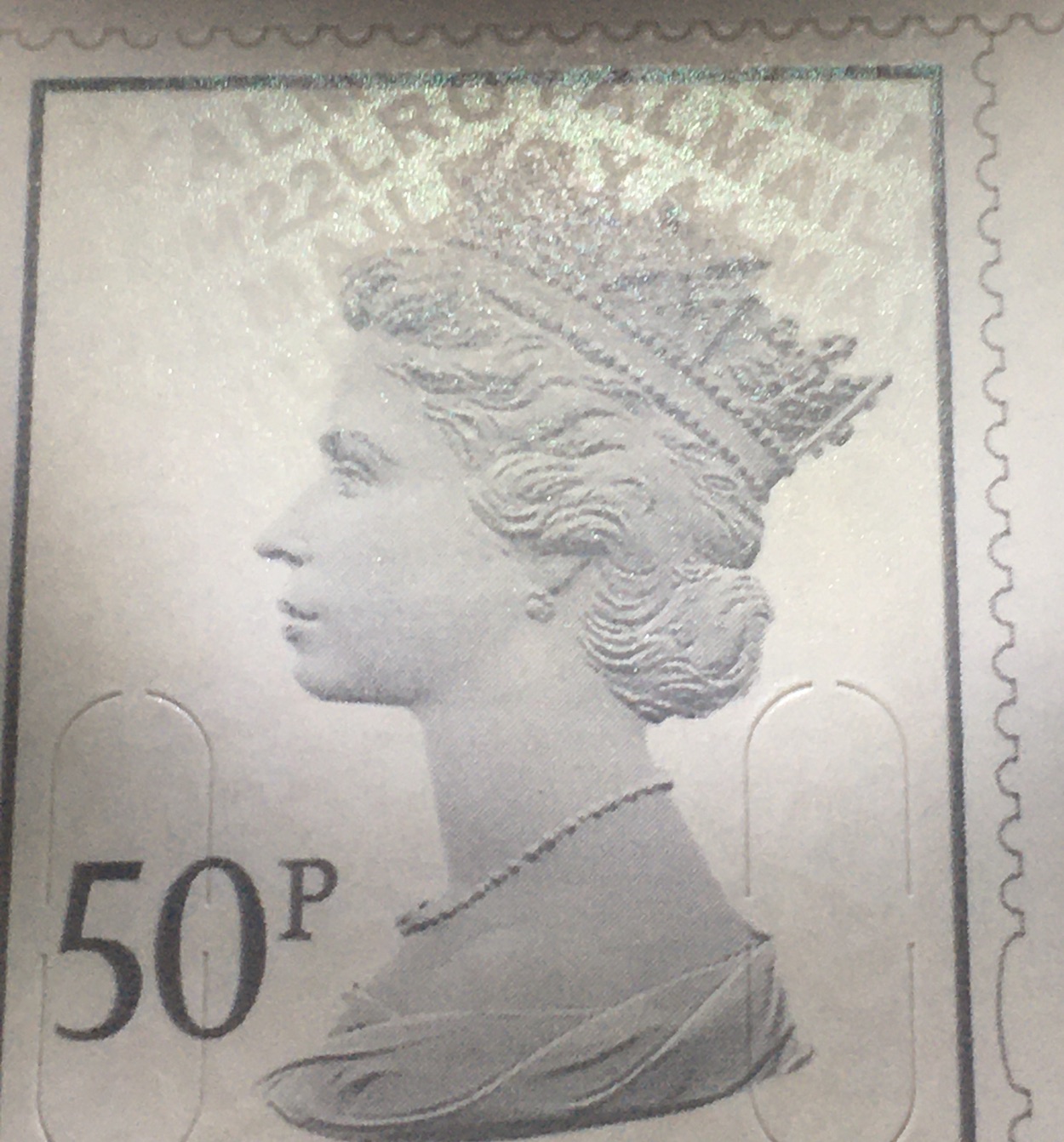
Scan of actual definitive pane from Women of World War II Prestige Stamp Book.
The Datamatrix codes are different on each stamp.


50p stamp from Unsung Heroes Women of World War II Prestige Stamp Book definitive pane, showing iridescent printing with year code M22L and source code MAIL (the same as on counter sheets).

Other products

First day covers x3, presentation pack, uncut press sheet of 14 miniature sheet. / Framed set, and framed miniature sheet.


Thursday, 16 April 2020

End of the Second World War details - 8 May 2020

The next stamp issue marks the End of the Second World War, timed to coincide with the end of the War in Europe and Royal Mail have started distributing the stamps to registered dealers.  Several people alerted me to its arrival on the Royal Mail website although that was only a place-holder and has since disappeared. 

This seems to be a regular thing, that the techies test the page on the live site, and either then realise their error or are told, and off it goes again until the proper embargo date. However, although they don't have a lead-in page, all the items are now available to view via the Special Stamps page.

Background
This stamp issue reflects on the end of the war both in Europe and in the Far East, with three concepts: Celebrating, Returning and Remembering.

In the eight sheet stamps are depictions of the sense of relief and celebration by service personnel and civilians when news of the conflict’s end was announced. Also featured in these stamps are images of personnel returning from overseas, as well as the return of children evacuated from major cities.

Of an entirely different tone, four stamps in a miniature sheet will mark the concept of Remembrance, with images depicting official monuments and cemeteries to the fallen as well as a major memorial to the victims of the Holocaust.


The stamp set of 8
A collection of eight Special Stamps featuring evocative photographs capturing the relief and jubilation that followed the formal end of the Second World War in 1945.

The original black and white photographs have been expertly reproduced in colour for the first time.
 
Details
2nd Class A serviceman returns home to South Devon from his airbase in Lincolnshire.
2nd Class Jubilant nurses celebrate VE Day in Liverpool.
1st Class Ecstatic crowds gather in London’s Piccadilly on VE Day.
1st Class Evacuees return home to London after a wartime stay in Leicester.
£1.42 Troops march through London’s Oxford Street during a parade for the Victory Over Japan exhibition.
£1.42 Soldiers and sailors leave a demobilisation centre carrying their civilian clothes in boxes.
£1.63 Allied prisoners of war at Aomori Camp near Yokohama, Japan cheer their rescuers.
£1.63 A member of the Women’s Royal Naval Service (WRENS) proposes a toast during VE Day celebrations in Glasgow.

The Miniature Sheet
... focuses on memorials honouring servicemen and women who gave their lives to serve their country, as well as victims of the Holocaust.


Four stamps feature memorials in Jerusalem and Rangoon, as well as Runnymede and Plymouth in the UK, on a Miniature Sheet carrier bearing the title in stone carved lettering.  A common feature is that the memorials mark the loss of men and women who have no known grave.


1st Class Yad Vashem, Jerusalem Israel’s official memorial to victims of Second World War Nazi genocide of 6 million Jews.
1st Class Runnymede Memorial, UK commemorates over 20,000 airmen and women who were lost during operations from bases in the UK and Europe during World War II and who have no known grave.
£1.63 Plymouth Naval Memorial, UK, originally erected to mark the more than 7,000 sailors who died in World War I with no known grave, and extended in the 1950s to include nearly 16,000 sailors who perished in World War II.
£1.63 Rangoon Memorial, Myanmar within the Taukkyan War Cemetary commemorates almost 27,000 dead British and Commonwealth Land Forces who fell during campaigns against the Japanese in Burma (Myanmar) and who have no known grave.

Technical specifications
The 41mm x 30mm stamps are designed by Hat-trick Design, with Photo colourisation Royston Leonard, printed in sheets of 60.   The 192 x 74 mm miniature sheet contains four 60 x 30 mm stamps.  All are printed by International Security Printers in Lithography, perforated 14½ x 14 with phosphor bands (single central band on 2nd class).

Acknowledgements
Serviceman welcomed home © Hulton-Deutsch Collection/CORBIS/Corbis via Getty Images; Evacuees return home © Hulton-Deutsch Collection/CORBIS/Corbis via Getty Images;
Navy personnel celebrate © Mirrorpix/Bridgeman Images;
Allied POWs liberated © Everett Collection/Bridgeman Images;
Nurses celebrate © Mirrorpix/Bridgeman Images;
Jubilant public © Picture Post/Hulton Archive/Getty Images;
Demobilised servicemen © photo by Reg Speller/Fox Photos/Hulton Archive/Getty Images;
Troops parade at end of war © Mirrorpix/Bridgeman Images
MS Background image – stone carved lettering by Gary Breeze and photography by Joe Howat;
Hall of names, Holocaust History Museum, Yad Veshem, Jerusalem © Israel images/Alamy stock photo;
Plymouth Naval Memorial and Runnymede Memorial – photographs by Mike Sheil © Royal Mail Group Limited 2020;
Rangoon Memorial, Myanmar © Commonwealth War Graves Commission

Prestige Stamp Book

Yes, there's an error in the caption on this one, but this is preliminary artwork. 
The actual pane is correctly captioned.

Compared with the £19.80 selling price, the Machin pane is relatively low priced compared with some others, with one airmail (20g Worldwide letter) and two make-up values the pane provides two sets of new stamps, 5p, 50p & £1.63 which have, at last, the M20L year code and a full MPIL source code. There are two spare 5p stamps so look out for those sometime being used for postage.

The Cartor litho-printed stamps are a good colour match for the Walsall gravure stamps, which means that Cartor are getting things right.  The style of the irridescent lettering is very thin - we've had this before - but the letters are much thinner than on the gravure stamps


These aren't very good photographs but they do show (especially if you click to enlarge them) the codes at top left and top right of the stamps.


The stamps are numbered 3005P.20, 3050P.20 and 3163 in the Norvic Checklist, a new version of which will be issued very shortly, now that the latest numbers have arrived from Gibbons.  A new post will appear here in due course.

Other products
First Day Covers x 2, Stamp Cards, Presentation Pack, Limited Edition Coin Covers, Press Sheet of 14 miniature sheets, Framed Stamp Set.

UPDATE 16 May
Reader GI-man reports:

I received 4 x Presentation Packs yesterday. All of the stamps were fixed the the backing card. The miniature sheet was also fixed to the card.
I was expecting to use the stamps - and now I can't! Has anyone else had similar experiences? Thanks.
It would appear that Royal Mail have not learned from their mistake earlier in the year with the James Bond presentation packs and that there are two versions, one of which is should have been for sale only on Amazon.   But once again they have mixed up the two stocks.  Anybody receiving the wrong one should follow the instructions on their Despatch Note or Invoice to get a replacement.


News About Other Machins
There is still no news of reprinted booklets or business sheets.  These are typically sold at supermarkets, card shops and other small retailers as well as Post Office branches and Royal Mail online.  With so many people finding ways to communicate electronically, and small businesses such as repair garages (who send invoices & statements by post) having far less business, it may be some time before we see any evidence of new printings.  

And of course people who consistently provide me with news, as they use their free public transport passes to trawl around those outlets looking for new stamps, are wisely not now doing so.  So please look out for what appears on your letters.  You may be pleasantly surprised to receive a bill with a new printing of a 2nd class booklet stamp on!

Let us know what you find, please!

Friday, 7 June 2019

D-Day also commemorated with decorated postbox

My thanks to Anonymous for drawing my attention to this report on myroyalmail.com.

Eternally grateful

Special-edition postbox honours those who planned and fought in the D-Day landings

A special-edition postbox has been unveiled to mark the 75th anniversary of the D-Day landings.


The unveiling of the postbox in St James's Square, London, was attended by US Ambassador to the UK, Robert Wood Johnson.

The location is sited close to Norfolk House, where Operation Overlord –  the mission to gain a foothold in France and commence the liberation of Europe – was planned under the leadership of Dwight D Eisenhower, Supreme Allied Commander Allied Expeditionary Force.

‘On this 75th anniversary, I think it's fantastic that Royal Mail is paying a special tribute to the tremendous courage and devotion of our D-Day heroes,’ said Mr Johnson.

‘We should always remember what so many millions of men and women sacrificed for the free world we have the privilege of living in today.’

The images on the postbox, courtesy of the Imperial War Museum, London, represent the success of Operation Overlord – depicting amongst others the inland advance and the preparation and planning behind the operation.

David Gold, our director of public affairs and policy, said: ‘The D-Day landings played a pivotal role during World War Two and Norfolk House was where a major part of the planning took place.

‘It is only fitting that their efforts are honoured on one of our iconic postboxes. Royal Mail is also issuing a set of special stamps to mark the anniversary.’

In addition to unveiling the special edition postbox, there is also issuing a special postmark, which will be applied to all stamped mail from 5-9 June and will read: ‘75th anniversary of the D-Day landings 6 June 1944 #dday75.’ Royal Mail will also be sponsoring a children’s essay competition organised by the Spirit of Normandy Trust.
 

Friday, 17 May 2019

75th Anniversary of D-Day - the Normandy landings of World War 2

Royal Mail is marking the 75th Anniversary of the Allied Landings in Normandy in World War II with the issue of a set of stamps, a miniature sheet and a retail booklet.

Although we were told that we could not publish any details or pictures until 2 June, Royal Mail has now made the products available for pre-order on their website here.  

The anniversary is marked on 6th June 2019 of D-Day, 75 years on since the largest combined naval, air and land operation in the history of warfare. On D-Day, 6 June 1944, Allied forces launched a combined naval, air and land assault on Nazi-occupied France. Codenamed Operation 'Overlord', the Allied landings on the Normandy beaches marked the start of a long and costly campaign to liberate north-west Europe from German occupation. Early on 6 June, Allied airborne forces parachuted into drop zones across northern France. Ground troops then landed across five assault beaches - Utah, Omaha, Gold, Juno and Sword. By the end of the day, the Allies had established a foothold along the coast and could begin their advance into France. Royal Mail is marking the 75th anniversary of D-Day, and its indelible impact on the outcome of WW2 with this set of stamps and products.

5 June - This post is now updated with detaials of the stamp images and technical information.

Set of six stamps
A pair each of 1st class, £1.35 and £1.60 stamps.  The £1.60 pays the rate for European letters up to 100g, and the £1.35 pays for European letters to 20g, Postcards and Worldwide letters to 10g.

The stamps in detail:

1st Class - Men of No. 4 Commando, 1st Special Service Brigade, are briefed by their Commanding Officer, Lt Col R Dawson, just before embarking for Normandy.
1st Class - HMS Warspite, part of Bombardment Force ‘D’, shelling German gun batteries in support of the landings on Sword on 6 June 1944.
£1.35 - Paratroopers of the British 6th Airborne Division synchronising watches prior to take off at about 23:00 on 5 June 1944.
£1.35 - Commandos of HQ 4th Special Service Brigade leaving their landing craft and wading ashore on Juno.
£1.60 - An American A-20 Havoc light bomber with D-Day ‘invasion stripes’ provides air support following the D-Day landings.
£1.60 - Troops from the East Yorkshire Regiment take cover as an enemy shell explodes nearby on 19 July 1944.


Miniature Sheet

1st Class UTAH: More than 23,000 men of the US 4th Infantry Division landed on Utah on DDay. Strong currents swept the first wave of troops into a more lightly defended sector 1,800m to the south of their original target. Airborne troops had already dropped into the area behind Utah in the early hours to secure beach exits and river crossings, providing a route for troops on the beach to move further inland. By the end of the day, the 4th Infantry Division had advanced approximately 4 miles
(6.5km).


1st Class OMAHA: Casualties at Omaha were higher than on any other beach. Preliminary Allied air and naval bombardments failed to knock out strong defence points and the Americans had difficulties clearing the beach obstacles. Allied intelligence failed to realise that the German 352nd Infantry Division had earlier reinforced coastal defence units on anti-invasion duties. With the German defences largely intact, the first wave of troops from the US 1st and 29th Divisions were cut down at the water’s edge, and follow-up units struggled to gain a foothold.


1st Class GOLD: Nearly 25,000 men of the British 50th Division landed on Gold on D-Day. Their objectives were to capture the town of Bayeux and the Caen–Bayeux road, and to link up with the Americans at Omaha. High winds caused the tide to rise more quickly than expected, concealing the beach obstacles underwater. Troops battled to overcome strongpoints that remained intact after the initial bombardment, delaying progress inland. However, by the end of the day, British troops were successful in joining up with Canadian troops from Juno.


1st Class JUNO: The Canadian 3rd Division’s objective was to secure Juno and link up with British forces on Gold to the west and Sword to the east. Juno was heavily defended and casualties were high, especially among the first wave of infantry. Rough seas delayed the landing and the rising tide reduced the width of the beach, which eventually became jammed with incoming vehicles and equipment. By midnight, the Canadians had yet to link up with the British at Sword but had succeeded in joining the British at Gold.


1st Class SWORD: Bad weather and strong German resistance hindered the British 3rd Division’s assault on Sword. Rising tides and the geography of the assault area created a narrow front, causing congestion and making it difficult to land the armoured support needed to advance inland. Although the British 3rd Division successfully repelled a German counterattack, it became impossible for it to take the strategically important city of Caen – its key objective for D-Day. The capture of Caen became a focal point of British strategy in the weeks after D-Day. 


Background Map of the Assault Beach Areas with their respective assault times


The stamps and miniature sheet were designed by Baxter and Bailey.
The 60 x 30 mm stamps was printed by International Security Printers in litho, 36 stamps per sheet in se-tenant pairs.  The 192 x 74 mm sheet contains five stamps 37 x 35 mm.

Acknowledgements: briefing troops © IWM (B 5098); synchronising watches © Imperial War Museum [IWM] (H 39070); light bomber © Galerie Bilderwelt/Getty Images; HMS Warspite © IWM (A 23916); wading ashore © IWM (B 5218); taking cover © IWM (B 7683). 
Utah © IWM (EA 25902); Omaha © Bettmann/Getty Images; Gold © Galerie Bilderwelt/Bridgeman Images; Juno © IWM (A 23938); Sword © IWM (B 5114)


Retail booklet
(Publicity picture)
 

Actual booklet
  

Cylinders
 

Interestingly, with the stamps and background all grey-scale monochrome, the cylinder numbers (all W1) show that the booklet is printed in 4-colour process litho (CMYK), plus

the red (deep scarlet) for the Machin,
the iridescent (invisible security) ink,
the slate/grey (the head, value and captions), and
the phosphor.

Makes you wonder why they didn't just print the captions etc in black, and ignore the colours completely.  The booklet is printed in gravure by ISP Walsall.


Friday, 10 May 2019

75th Anniversary of D-Day, set of 6 and MS - 6 June 2019

It will be a while before we are able to show the pictures of these stamps, but you can see them on Commonwealth Stamps Opinion and also in the latest magazine of Buckingham Covers.

We'll show them in due course, of course.  This isn't like any of the stamps which all show contemporary photographs - another black and white issue.

French postcard by Festicart, Création FORE.

Details of this stamp issue can now be found here, with more details to follow.